
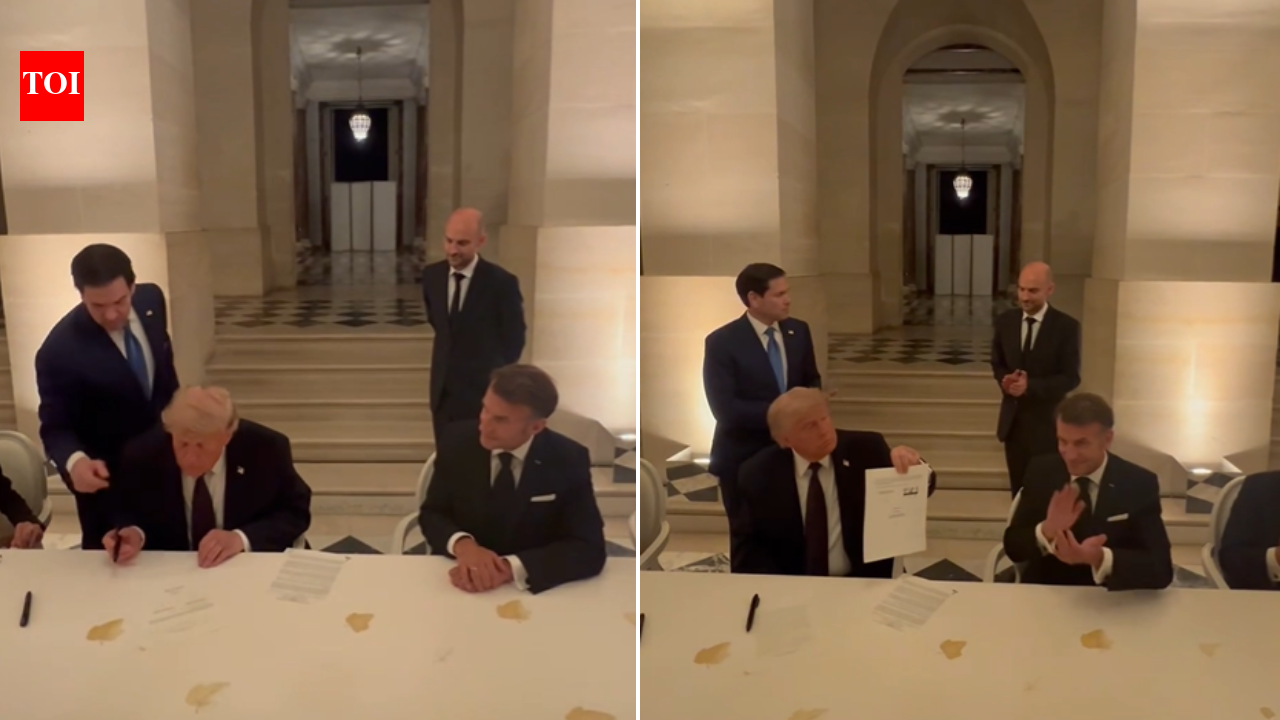
President of the United States Donald Trump The much-anticipated Memorandum of Understanding (MoU) on the US-Iran peace deal was signed at a dinner with the French president Emmanuel Macron exist G7 summit Thursday in Versailles. U.S. Secretary of State Marco Rubio handed Trump the agreement as he sat next to Macron. “It’s not going to be easy,” Trump said before putting pen to paper. After signing the document, Trump held it up and showed the agreement to those gathered in the room.“President Trump signed tonight in Versailles the agreement between Iran and the United States. The agreement paves the way for a lasting peace and allows for the reopening of the Strait of Hormuz. This is an important step in the right direction for our compatriots that will soon bring energy prices down,” Macron said in a post on X, welcoming the deal.For its part, Iran’s President Masoud Pezeshkian signed the agreement.The development is a major step to ease tensions after months of escalating hostilities in the region, including military clashes between Iran, Israel and the United States. The agreement, officially known as the “Islamabad Memorandum of Understanding between the United States of America and the Islamic Republic of Iran,” outlines a roadmap for a ceasefire, expanded economic cooperation, sanctions relief and future negotiations on Iran’s nuclear program.It was unclear whether the signing triggered the start of a 60-day negotiating window aimed at reaching a final deal. Questions remain about how the document Trump signed at Versailles differed from his digital approval of the deal on Sunday. Historically, Versailles has been the site of several landmark treaties, many of which were related to ending wars and territorial disputes. The most famous is the Treaty of Versailles signed in 1919, which officially ended World War I. Some historians believe that the treaty’s punitive conditions for Germany created the political and economic conditions that later fueled World War II.