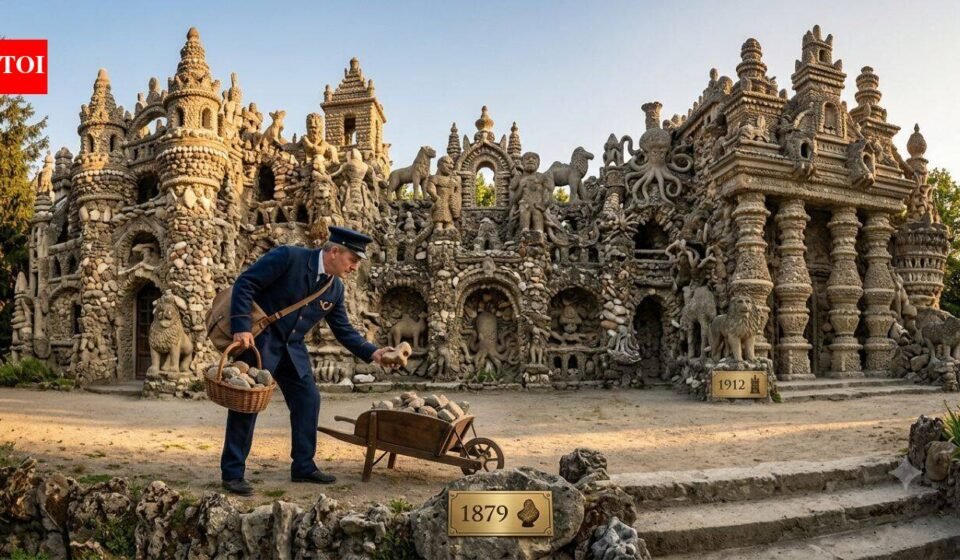
In 1879, a French postman picked up a strange stone. Over the next 33 years, he built with his own hands one of the most extraordinary palaces in Europe | World News

For 33 years, a rural French postman spent his spare time quietly collecting stones from the roadside, turning what began as a chance discovery into one of Europe’s most unusual architectural landmarks. Joseph Ferdinand Cheval, better known as Ferdinand Cheval or Facteur Cheval, began building the Palais Idéal in Hauterives, France, in April 1879 after stumbling upon an oddly shaped stone while on his postal route there. Without any architectural training, he worked on the monument until 1912, carrying rocks in a wheelbarrow after walking more than 30 kilometers each day to deliver the mail.The result is a richly decorated fantasy palace with temples, castles, grottoes, animals and mythical characters, inspired by nature, illustrated magazines and postcards. Initially rejected by many, this self-built monument later became favored by leading Surrealist artists and was designated a French historical monument by Culture Minister André Malraux in 1969, thus securing its place among France’s most striking cultural landmarks.
How the stone discovered by French postman Joseph Ferdinand Cheval in 1879 created the Palais Ideal
In April 1879, when Joseph Ferdinand Cheval was 43 years old, an ordinary working day took an unexpected turn. While delivering letters in the countryside, he tripped over an unusually shaped stone that caught his attention. Instead of keeping it, he took it home.The next day, he returned to the same spot and found more rocks that he had never noticed before. This simple encounter became the beginning of a project he could hardly imagine completing. Cheval later reflected that if nature could produce such extraordinary forms, he could use them to build something of his own through masonry and architecture.From then on, collecting stones became part of his daily life. His daily mail delivery journey exceeds 30 kilometers, which gives him countless opportunities to collect materials from fields, paths and river banks. At first he carried the stones in his pockets and then relied on a wheelbarrow, which became one of the lasting symbols of his work.
How postcards and newspapers inspired extraordinary, lifelong visions
Cheval had little reason to believe he would one day be associated with an internationally recognized monument. He was born in the small village of Charmes-sur-l’Herbasse in 1836 and grew up in a financially strapped peasant family. He completed school at the age of 12, then apprenticed as a baker and eventually became a rural postman.His career exposed him to more than just country roads. He processed newspapers, illustrated magazines and postcards every day, traveling throughout France. These publications introduced far-flung places, unfamiliar buildings and scenes from around the world to readers who might never leave their own villages.Images of temples, castles, mosques and exotic landscapes gradually entered his imagination. They are not fully replicated. Instead, they are blended with forms borrowed from nature, local rock formations and his own ideas to create something that is entirely his own.
Inside Ferdinand Cheval’s 33-year construction project
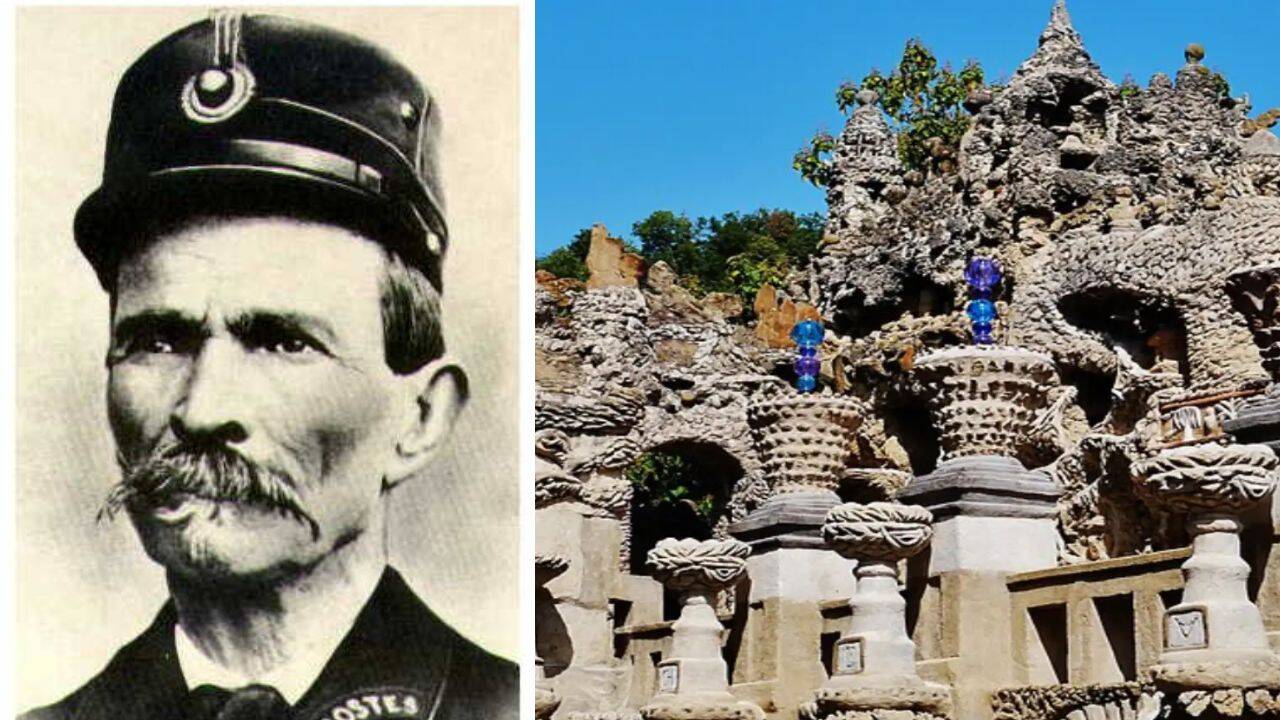
Construction lasted for an extremely long time. Between 1879 and 1912, Cheval spent almost all his free time building extensions in the garden next to his house.The monument itself captures the scale of this effort. An inscription is engraved on the building stating that it took 10,000 days, 93,000 hours and 33 years of hard work. Another declared it to be “the work of one man,” a reminder that the palace was completed without a construction team or trained architect.No master plan was developed in advance. As new ideas arise and more stones are collected, new pieces emerge. Mortar, lime and shells are combined with natural rock to create walls that appear to have grown organically rather than following traditional construction methods.
Why Cheval’s palace looks unlike any other building in the world
The finished monument does not fit neatly into any architectural category. Elements inspired by different continents sit next to each other with no regard for historical accuracy or stylistic consistency.On the east side of the palace is a fountain known as the Fountain of Life, one of its earliest features, guarded by animal sculptures. An Egyptian-style tomb stands nearby, while a Hindu temple occupies another part of the facade. That part of the building hides the Cheval, a wheelbarrow used during construction.Elsewhere, visitors will see medieval castles, Alpine huts, mosques, and civil buildings similar to the structures seen in Cheval’s illustrations. Rather than faithfully replicating famous landmarks, he transformed them into a personal architectural language.
How a Palace Becomes a Living Sculpture
Almost every surface is decorated. The walls, niches and corridors are covered with reliefs and carved figures, with barely any plain stone visible.Animals appeared throughout the palace. Elephants, bears, pelicans, deer, octopuses, birds and caimans sit alongside wolves, flamingos and dromedary camels. Mythical creatures share space with giants, fairies and biblical figures, creating an environment closer to an illustrated storybook than traditional architecture.Long internal galleries extend this idea further, sculpting wildlife around visitors while connecting different parts of the monument. Stairs lead up to the terrace, where one object receives special attention: the stone that inspired the entire project in the first place.
The hidden water supply system behind the Ideal Palace
Cheval’s original intention was to make the palace more than a static monument. At its highest point, he built a cistern designed to feed the fountain below, allowing water to flow through parts of the complex.The system eventually had to be scrapped as persistent moisture damaged the structure. Even so, traces of the original design remain, providing a glimpse into how the palace would have functioned as the creator imagined it during his lifetime.The surrounding gardens are also part of the experience. Trees, flowering plants and cacti soften the dense stonework, making the monument appear to gradually emerge from the landscape.
This monument became his life’s work
When the palace was finally completed in 1912, Cheval was 77 years old. But he didn’t stop building. His wish was to be buried next to his wife in the palace, but the authorities refused permission. Rather than give up on the idea, he began another ambitious project at Outreves Cemetery.He spent the next eight years studying what he called “the Tomb of Silence and the Endless Rest.” Built in the same highly personal style, this became his final creation. After completing another monument largely through his own labor, he finally rested with his family.
belated recognition
For much of Cheval’s life, the palace confused people more than it impressed. It differed from accepted architecture and did not belong to any of the artistic movements familiar to critics of the time.At the beginning of the twentieth century, attitudes began to change. Writers, photographers and artists associated with Surrealism saw something extraordinary in the monument’s dreamlike qualities. André Breton visited the site several times and later called Cheval a pioneer of Surrealist architecture. Photographs of the palace have also appeared in exhibitions outside France, introducing the building to a wider audience.Artists such as Max Ernst created works inspired by Cheval’s achievements, while Pablo Picasso, Jean Tinguely and Niki de Saint Phalle all admired the palace’s originality despite its unconventional origins.
How France finally recognized Cheval’s masterpiece
The most important official recognition came in 1969. André Malraux, France’s Minister of Culture at the time, decided that the Palais d’Ideal should be protected as a historical monument.The decision was far from straightforward. Some officials question whether a building built by a self-taught postman deserves such status. Malraux believed that the palace represented a unique example of modest architecture and that to let it disappear would be to lose something that could not be found elsewhere.His decision ensured the building’s preservation and secured its place in France’s cultural heritage.
The lasting legacy of Ferdinand Cheval’s Palais Idéal
More than a century after its completion, the Ideal Palace remains difficult to classify. It has been compared to the imaginative architecture of Antoni Gaudí and the fantastical imagery associated with Salvador Dali, although Cheval’s work is entirely independent of both artists.Its influence permeates modern art and architecture, with scale models, exhibitions and tributes appearing all the time. Visitors will be struck not only by the appearance of the palace, but also by the extraordinary promise behind it.Today’s Otterives is more than just an unusual building. It is a physical record of the 33 years it took a rural postman to collect the stones one by one, shaped by the persistence of a rural postman who transformed ordinary materials into one of the most unique monuments in France.