
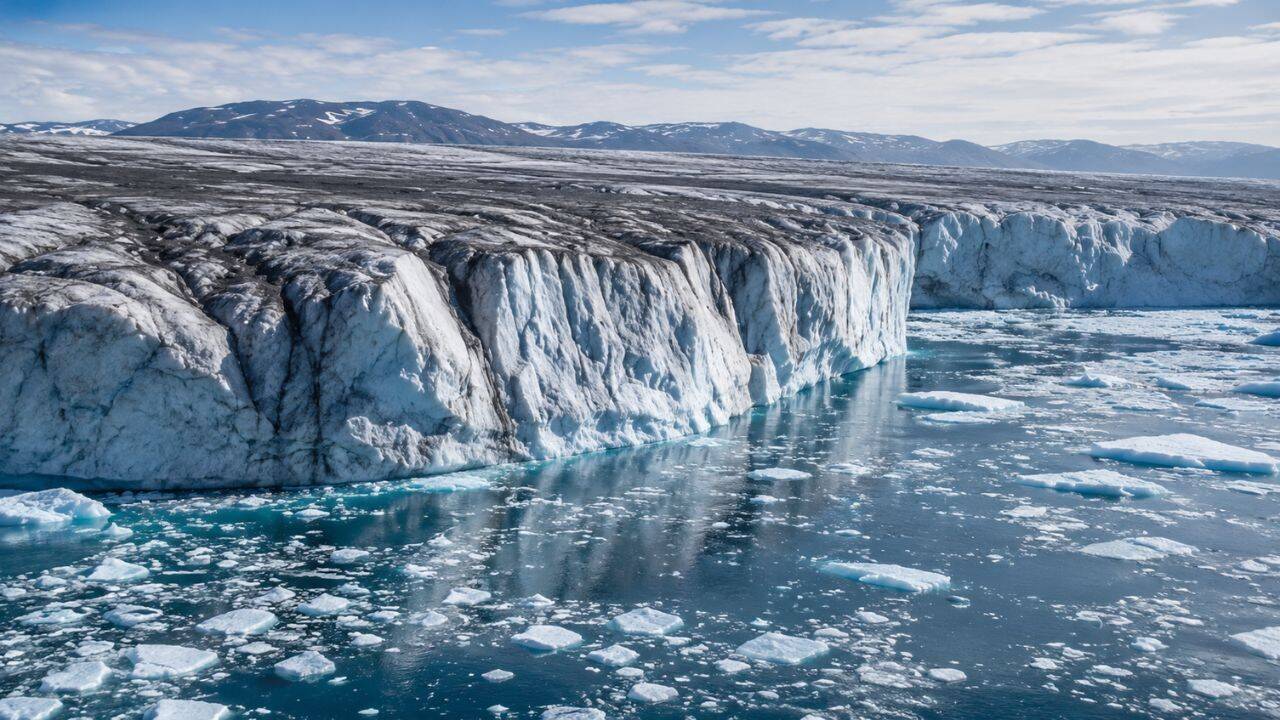
The Greenland ice sheet lost an estimated 105 billion tons of ice during the 2024-25 season. On its own, this number is cause for concern. However, this number is only part of what researchers have been looking at. Satellite images show that in various parts of the ice sheet, especially in late summer, dark ice is growing and the surface is no longer bright white. As seasonal snowfall recedes, dust, soot, wildfire smoke residue and other light-absorbing particles become increasingly visible. What’s exposed underneath is older, darker ice that behaves very differently than new snow.Scientists have long known that darker surfaces absorb more solar energy. The concern now is not just that Greenland is melting, but that parts of the ice sheet will become more susceptible to additional melting once the melting process begins. This shift has turned attention to feedback mechanisms that may accelerate change across the Arctic.
How the blackening of ice accelerates greenland ice sheet melt
According to a report published in the journal Nature entitled “Record-breaking Greenland ice sheet melt event under near-term and future climates“Fresh snow is significantly reflective. It returns much of the sun’s incoming energy back into the atmosphere, helping the ice sheets stay relatively cool even in the summer.As the snowpack thins or disappears, the protective layer weakens. Black particles that have accumulated over time are exposed, while pools of meltwater form on the surface. Dirty ice and meltwater absorb much more heat than clean snow.The result is a self-reinforcing cycle. More melting exposes more of the dark surface. Those darker surfaces absorb additional energy, causing further melting. Researchers call this process melt albedo feedback, and it has become one of the most closely monitored features of Greenland’s changing surface conditions.Evidence in recent years suggests that this dimming is no longer limited to isolated areas. During warm summers, large expanses of exposed ice emerge, allowing feedback to operate over a larger area than in the past.
Greenland ice sheet melting extreme events becoming more frequent
The increasing importance of surface darkening is consistent with another trend: unusually strong melting events are occurring more frequently.Greenland’s melt history found that many of the worst melt events on record have occurred since 2000, according to the study. Some of these events produced unusually large amounts of meltwater and affected areas that had previously experienced limited summer melt.Some events also lasted longer than expected. Scientists have observed melting continuing into this season, reaching a relatively stable period in history. Northern regions of the ice sheet, once thought to be less susceptible to dramatic surface melting, are increasingly showing up in records of extreme events.Researchers are concerned that atmospheric conditions alone cannot fully explain these changes. Even if weather patterns are similar to those of decades ago, current melt rates are likely to be significantly higher because the ice sheet itself has changed. Rising temperatures, the expansion of areas prone to melting and the darkening of surface colors appear to be amplifying this response.
Why Greenland’s 2024-25 ice melt season remains important to scientists
The 2024-25 season is not the toughest on record for Greenland. It’s closer to the middle of the modern range than some of the extreme summers experienced over the past two decades.That’s why many scientists consider it so informative. A season doesn’t need to break every record to reveal underlying change. In relatively mild years, ice sheet behavior can reveal trends that might otherwise go unnoticed. The widespread occurrence of dark ice is one example.According to the study, once the snow recedes, the deposited particles remain and continue to affect the amount of sunlight absorbed by the surface. Wildfire smoke transported from distant areas can add to this burden. In some years, smoke originating thousands of kilometers away is associated with reduced surface reflectivity in parts of Greenland.This means that melting is increasingly influenced not only by local temperatures, but also by processes occurring outside the Arctic. A warmer world would create more conditions conducive to surface darkening, and the darkening itself would promote further melting.
Scientists warn that Greenland ice sheet melting will become more severe this century
Researchers studying Greenland’s most extreme melt events suggest that some climate models may not fully capture all of the processes that exacerbate melting. Surface darkening, atmospheric blocking patterns, over-ice precipitation and changing snow conditions may interact in ways that are difficult to represent accurately.Recent models suggest that extreme melt events could become more severe by the end of the century under high-emissions scenarios. The largest increases are expected in areas of northern Greenland, which have historically experienced less intense summer melt.Its significance goes beyond Greenland itself. Meltwater entering the North Atlantic affects ocean circulation, sea level rise, and regional climate systems. Although considerable uncertainty remains about the pace of future change, scientists increasingly view ice sheets not as passive victims of warming, but as a system containing its own amplifiers. Losing 105 billion tons of ice in one year is a measurable result. Darkening of the entire surface may be a more important signal.