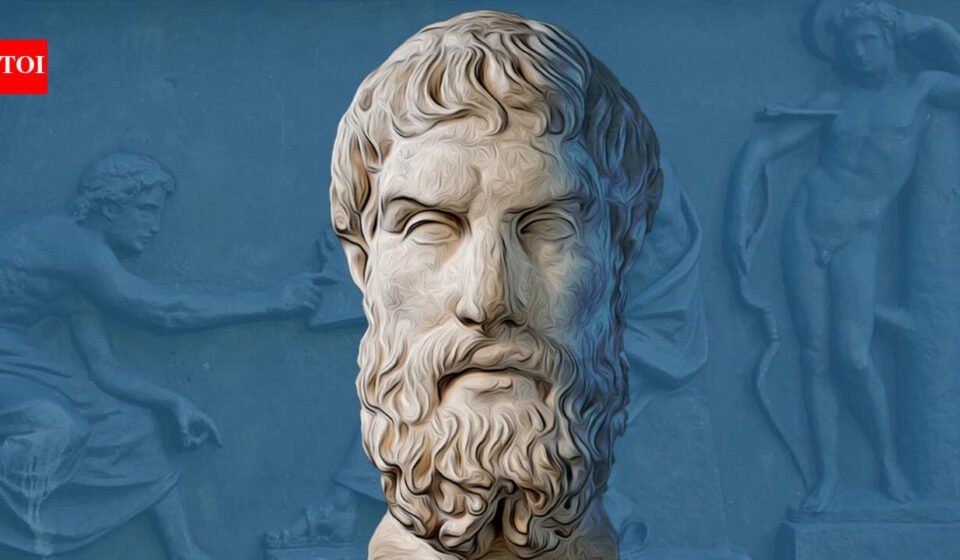
Epicurus’ quote of the day: “Death has nothing to do with us, for so long as we exist…” and a 2,300-year-old argument that destroyed man’s greatest fear

A middle-aged man woke up at two in the morning, his heartbeat racing, and he faced an unavoidable fact: One day, his consciousness will stop. The room was silent, but his mind was filled with the fear of no longer being there. Throughout history, this fear of nothingness has led humans to build massive monuments, compose epic poems, and develop complex ideas about the afterlife. However, a simple argument written by an ancient Greek philosopher provides a surprisingly clear answer to this fear.The Greek philosopher Epicurus provided a solution to this fear of death with a powerful idea: “Death has nothing to do with us, because as long as we exist, death is not here. When it does come, we will cease to exist. “This famous idea, often called the symmetry argument or the non-existence argument, changed the way people think about death. Rather than viewing death as something painful that we experience, Epicurus viewed death as something that we simply cannot experience. Death and consciousness cannot exist at the same time. A person cannot realize that they have died, just as they cannot experience a state of complete unconsciousness. This quote remains influential today because it removes the horrific image people usually attach to death and establishes a simple separation between life and nothingness.
Letters from the garden
Epicurus explained this argument in his Letter to Menochuswritten in the third century B.C. This was the Hellenistic period, when Greek city-states lost much of their independence after the conquests of Alexander the Great. People face economic struggles, political uncertainty, and major social changes. Traditional religious beliefs are also changing, with many fearing punishment from unpredictable gods or suffering in the afterlife.Far from the formal school of Plato and Aristotle, Epicurus created his own philosophical community outside Athens, called the Garden. Unlike many other schools of the time, the Garden welcomed women, slaves, and poor workers. Epicurus wrote his teachings not as complex academic texts for scholars, but as practical guides to help ordinary people achieve inner peace.he believesThanatophobiaThe fear of death is one of the greatest causes of human suffering. In the Letter to Menoeus, he explains that fear of death and the afterlife leads people to make desperate choices, seek unnecessary wealth, and lose the happiness of everyday life. By showing that death is simply the end of feelings, he hopes people can escape fear and live a calmer, simpler life in the present.
completely senseless physics
Behind this famous argument is Epicurus’s materialistic cosmology. He developed the ideas of Democritus and believed that everything in existence was made up of physical atoms moving in a vacuum. According to Epicurean philosophy, the human soul is not an eternal spirit but a physical arrangement of tiny atoms connected to the body.When the body dies, these atoms separate and scatter, like smoke disappearing into the air. Since sensation and consciousness require a functioning body and brain, death means the complete end of perception. There is no pain, darkness, loneliness or regret because no one can experience these things.The Roman poet Lucretius later expanded on this idea in his first-century BC work On the Nature of Things. He introduced the concept of prenatal symmetry by asking people to think about the endless hours before birth. Humans feel no sadness or fear about the millions of years that preceded our existence. Therefore, Lucretius argued, they should not worry about a similar state of non-existence after death.
Antidote to the Modern Anxious World
Applying this ancient idea in 2026 offers an effective way to deal with modern fears of death and health. Psychologists who study anxiety disorders often help people who struggle with fears of illness, aging, and death. Modern technology allows people to constantly monitor their bodies through health apps, medical tests, and genetic information, creating a culture focused on preventing decline.Epicureanism works as a psychological reset to this ongoing fear. In palliative care and grief care, some professionals use similar ideas to help people facing serious illness. Patients are encouraged to focus on their current lives, relationships, comfort levels, and meaningful moments rather than focusing on a future state they will never experience.This idea also applies to modern digital life. Social media platforms often highlight disasters, threats, and stories of death because they attract attention. The philosophy of Epicurus helps reduce the power of these fears by reminding people that they cannot experience future states of non-existence. Instead of worrying about the distant future, people can focus on creating what Epicurus called “peace of mind”—a state of deep inner peace.
Oeno Anda stone wall
The lasting influence of Epicurean philosophy can be seen in the ruins of a huge stele in modern Turkey. In the second century AD, a wealthy man named Diogenes of Oenoanda used his wealth to carve the teachings of Epicurus on a huge wall more than eighty meters long. He placed these writings in public areas so that ordinary people could read them and find comfort from their fears.The message of these carvings is that death should not frighten the living or the dead. Although the physical walls have been destroyed over the centuries, the argument itself remains strong. Life exists only in the present moment of consciousness. By understanding that death is not a painful experience, but simply the absence of experience, people can stop fearing the unknown and fully appreciate the life they have now.