

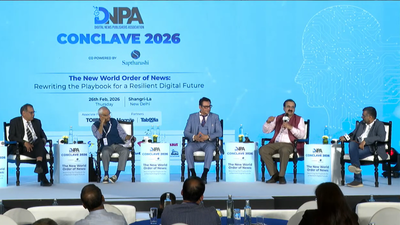
At the 4th Digital News Publishers Association (DNPA) Conclave 2026, industry leaders and policy experts gathered to discuss the country’s current regulatory environment and its impact on the media industry and publishers. On whether these conditions are a barrier to publisher survival or a matter of mechanism, Rajnish Gupta, partner and leader, economic policy, India, EY, said, “It depends on the angle from which you look at the problem.” He emphasized that it needs to be understood that the results of each policy will vary from person to person, saying “we are in an evolving space, it is not fixed. For example, if you are a platform, you may not like the guidelines around these intermediaries.” From a digital media perspective, in the age of artificial intelligence and deepfakes, the credibility, research, and authenticity of work are all called into question. ” Highlighting his experience working through different media platforms, Shivnath Thukral, VP Public Policy and Government Affairs at PhonePe (former VP Public Policy at Meta) said, “It’s hard for me to complain that policy didn’t become a driving factor.” He went on to say, “There must be a reason why Facebook, Google and all other platforms have the largest market base in India. There must be a reason why the Reserve Bank of India, with the support of the Indian government, is committed to policy support. India has the largest digital payments ecosystem,” adding, “Regulation follows innovation. Regulation of the digital ecosystem, including digital media, creates a lot of room for innovation.”“Highlighting the importance of regulation for a good economy, Supreme Court lawyer Vivek Narayan Sharma said: “There is no question of absence of regulation and operations, for a good economy and a stable economy, regulation must be in place. If they are not in place, everything will become chaotic and everyone will do what they want and there will be no control. “Sharma also addressed the important issue of how much control should be given and to what extent. “Controls should be put in place on the basis of fundamental rights under the constitution. So regulation is there for a purpose so that people can run their own businesses, so these are very, very important regulations,” he said.Pavan Duggal, founder and chairman of the International Cybersecurity Law Commission, added another perspective, saying “Don’t wait for regulation.” He added, “Current regulation is neither adequate nor sufficient, nor can it be called over-regulation.”“These are not enough, so if you think this is the end of the rules on this topic, it’s certainly not… but we need to make sure that we are actually complying with the rules that are in place,” Dougal said of the centre’s newly introduced rules on artificial intelligence content.


 Conclave 2026, industry leaders and policy experts came together to discuss the current regula.)