
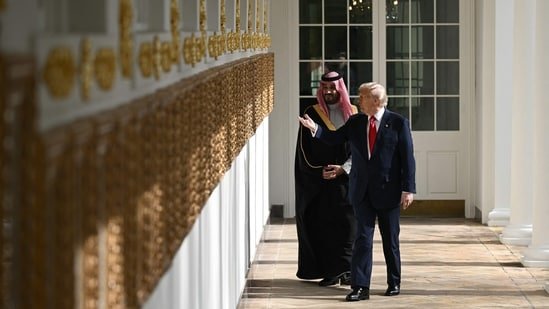
The United States and Saudi Arabia on Wednesday signed a long-negotiated civilian nuclear cooperation agreement, clearing the way for American companies to build reactors in the kingdom. Unlike Washington’s model, this leaves a path for Riyadh to enrich uranium on its own soil.
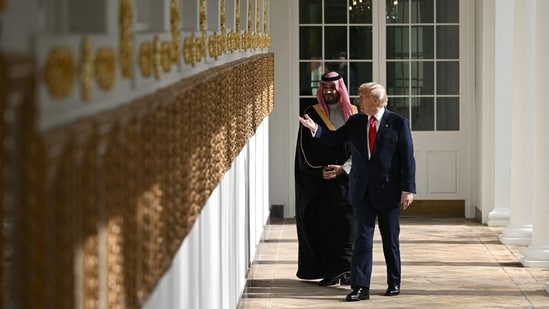
However, less than 24 hours later, the President of the United States Donald Trump adds a condition He said the agreement would only come into effect if Saudi Arabia joins the Abraham Accords and normalizes relations with Israel.
In the same Truth Society post, Trump also asserted that “no material enrichment will occur” — a statement whose scope is unclear, as it did not specify whether he was referring to weapons-grade enrichment or ruling out the possibility entirely.
White House press secretary Carolyn Levitt told reporters that if Saudi Arabia does not join the deals, “the deals will fail.” Saudi Arabia has not recognized Israel and has not commented publicly on Trump’s illness in light of Tel Aviv’s military operations in Palestine.
Also read: Explosions near Erbil airport, attacks on bases and rising tensions in the Gulf
What is known?
The agreement was signed by U.S. Energy Secretary Chris Wright and Saudi Energy Minister Prince Abdulaziz bin Salman, along with a separate bilateral safeguards agreement. The agreement was concluded under Section 123 of the U.S. Atomic Energy Act, which is the standard framework for U.S. overseas civilian nuclear cooperation agreements. Washington has similar agreements with more than 50 countries, but the scope varies.
Reuters reported, citing the terms, that the deal would last about 30 years and be worth tens of billions of dollars. It allows Saudi Arabia to enrich uranium and reprocess spent nuclear fuel—both possible ways to produce weapons-grade material. The concession is significant, especially since neighboring the United Arab Emirates (UAE) abandoned both agreements when it signed a similar deal with Washington in 2009.
The deal does not require Saudi Arabia to sign an International Atomic Energy Agency (IAEA) additional protocol that allows for rapid inspections of undeclared sites – contrary to Washington’s demands on Iran.
A two-year feasibility study will be conducted before any enrichment facility. The reactor built under the agreement is likely to be Westinghouse Electric’s AP1000 model.
Congress has 90 days to review the deal, and a two-thirds vote is needed to override a presidential veto.
Wright said in a statement that the agreement would “uphold the highest standards of nuclear security and nonproliferation while relying on the best nuclear technology and scientists in the world.” U.S. Secretary of State Marco Rubio told reporters in Manila that any deal “will have safeguards in place to make sure it doesn’t turn into a weapons program.”
What else is unknown?
The full text of the agreement has not yet been released publicly.
The Wall Street Journal reported that a provision could allow U.S. companies to build uranium enrichment facilities in Saudi Arabia; although the Energy Department made no mention of this provision in its public statements. AFP reported that the department did not respond to inquiries when asked about the matter.
The International Atomic Energy Agency, which is required to authorize the verification measures, said it was awaiting formal requests from Washington and Riyadh, Reuters reported.
Trump further confused the status of uranium enrichment in a Truth Society post that said, “The Civilian Nuclear Deal (which does not enrich the material!) … only addresses non-military uses, such as what Iran and the UAE (and others) already have.”
Reuters pointed out that it is unclear whether Trump is specifically referring to weapons-grade enrichment – reactor fuel is usually enriched to up to 6% uranium-235, while weapons-grade material is about 90% – or to exclude enrichment entirely.
Also read: The U.S.-Iran war continues, and oil prices exceed US$100 due to route control measures
Saudi Arabia caught off guard
Trump’s conditions for Israel were not included in the deal announced Wednesday.
Levitt said Trump has discussed Abraham Accords There have been previous contacts with the Saudi leadership, but she is not aware of any conversations between the president and Crown Prince Mohammed bin Salman since taking office. Asked whether Israeli Prime Minister Benjamin Netanyahu had asked for conditions, she told reporters: “As far as I know, no.”
Netanyahu’s office welcomed the move, saying in a statement that “Saudi Arabia’s accession to the Abraham Accords would be a historic leap for peace in the Middle East.”
Saudi Arabia has ruled out recognizing Israel without progress towards Palestinian statehood, a position rejected by the current Israeli government.
Ha Heller, a senior associate fellow at Britain’s Royal United Services Institute, told AFP that if Washington “tries to force Riyadh to normalize (relations with Israel), the outcome is unlikely to be good”.
“Would the Saudis decide to do a U-turn on what they’ve been saying for the last three or thirty years? It’s quite dubious,” Hellier added.
Transaction case
Supporters of the U.S. government argue that the agreement is a commercial and strategic necessity.
Jennifer T. Gordon, director of the Nuclear Energy Policy Initiative at the Atlantic Council, told AFP the deal “is a victory for the United States over Russia and China.” Gordon believes that Riyadh will develop its nuclear program anyway, and the only real question is who will deliver it.
Saudi security analyst Hesham Alghannam told AFP the deal was “a landmark achievement by any measure” for Riyadh.
“The alternative is not a Saudi Arabia without nuclear ambitions, but a Saudi nuclear program based on Russian or Chinese supply chains, without the visibility of the United States, without the commercial foothold of Westinghouse, and without the structural influence,” he said.
Paul Dickman, chairman of the American Nuclear Society’s foreign affairs committee, told AFP he was confident the deal would not create “additional proliferation challenges” while stressing the need for transparency in the final text.
Also read: Shipping disruptions through Hormuz and Mandeb: why narrow waterways matter
case against
Kelsey Davenport, director of nonproliferation policy at the Arms Control Association, urged lawmakers on both sides of the aisle to “reject or modify” the deal to avoid “opening a wider door to nuclear proliferation in the Middle East,” Reuters reported.
Alexander Bollfrass of the Institute for International and Strategic Studies in London told The Associated Press that “what’s revolutionary about this deal is that rather than requiring Saudi Arabia to comply with the highest possible safeguards, the standard safeguards of international oversight, the United States is willing, at least in theory, to transfer highly sensitive technology without the same level of oversight that one would expect.”
Henry Sokolsky, executive director of the Center for Nonproliferation Policy Education, told Bloomberg that the administration is “pushing a magical idea” that the safeguards will prevent the Saudis from enriching weapons. “The reality is there is no protection,” he said.
In Congress, opposition cuts across party lines. Democratic Senator Edward Markey said the deal would allow “a belligerent dictatorship” to develop nuclear weapons technology under the cover of a war over Iran’s nuclear program.
“This deal will make us all less safe,” he said.
Sen. Bernie Sanders posted on
Democratic Senator Chris Murphy said the deal “will trigger a nuclear race in the region and further prevent Iran from limiting its own programmes”.
“The only difference I see here is that Westinghouse made a lot of money on this deal, and the Iranians didn’t enrich American companies,” Rep. Brad Sherman said at a House Foreign Affairs Committee hearing, according to the Associated Press.
Mark Champion argued in a Bloomberg opinion column that the strategic gains did not make it clear either of two tests he said should apply to any nuclear deal in the region: assuring neighbors that it is not a weapons program and maintaining defense capabilities if there is a change in Riyadh’s leadership.
Champion cited John Calabrese of the Middle East Institute in Washington as saying that the question is “whether the benefits of a U.S.-led deal — greater transparency, safeguards and influence — outweigh the risks of encouraging regional nuclear competition,” concluding: “No.”
geopolitical impact
The top priority is Iran. The United States is fighting a war with Tehran, in large part to prevent Iran from enriching nuclear material.
Gregory Brew, a senior analyst at the Eurasia Group, told AFP that Washington’s granting enrichment rights to Saudi Arabia would have a huge impact on the region and particularly on Iran, which has argued for decades that it retain enrichment rights under its non-proliferation treaty obligations.
The United Arab Emirates is the second flashpoint. The 2009 deal with Washington bans domestic enrichment activities but allows Abu Dhabi to seek amendments if Washington gives another regional country a better deal.
Israeli Energy Minister Eli Cohen told Tel Aviv’s 103 FM radio station that Israel’s focus would be uranium enrichment: “Will this happen? Under what conditions will it happen? Who will oversee it?”
Allison Minor, director of the Atlantic Council’s Middle East Integration Project, told AFP that “by opening the door to uranium enrichment in Saudi Arabia, the nuclear deal sends a strong message to Tehran” and that the statement should be read as “part of Riyadh’s broader strategy to manage the shock waves of a war with Iran.”