

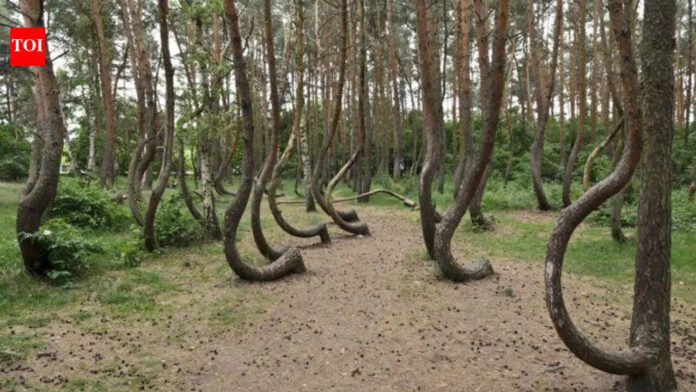
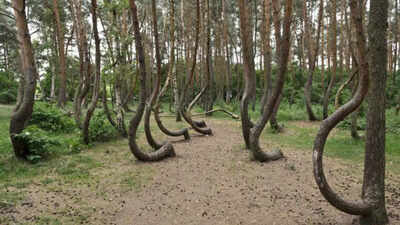
The Crooked Forest (Krzywy Las) is located in northwestern Poland. This is a protected forest with approximately 400 Pinus sylvestris trees that grow in an unnatural way. The trees were planted around 1930, and each tree has a sharp 90-degree bend at its base. All of the trees face straight north, and most of them then curve toward the sky. Local folklore attributes the trees’ shapes to blizzards or World War II tanks rolling over them, but researchers from the Grifino Forest District and the University of Pennsylvania point to human intervention as the cause of the trees’ bends and/or designs. One of the leading theories among scientists is that local foresters systematically manipulated saplings so that they could produce wood with “natural curves” for use in boat building or furniture. When the Nazis invaded Poland in 1939, the industrial use of this tree was most likely abandoned; however, the mystery of this “J-shape” remained.
Why are these 400 trees excluded from nature?
According to the Grifino Forest District, chaotic and irregular bends occur in all directions due to natural forces such as wind or soil movement, and do not cause all trees to bend in the same direction. The absolute consistency of the north direction throughout the 0.3 hectare grove indicates intentional mechanical intervention rather than random environmental factors, meaning that the entire 0.3 hectare grove has undergone systematic mechanical intervention.According to analysis by the Center for Russian and East European Studies (REES) at the University of Pennsylvania, the trees’ distinctive “J” shape suggests they have been held down by man-made stakes or weights for years while growing horizontally 1-3 meters before turning toward the sky.
Why the Secrets of the Crooked Forest Disappeared
According to the prevailing scientific hypothesis, these trees were created through the use of bending wood techniques as part of an industrial system and not as a result of nature.Before the development of synthetic materials and products, foresters would manipulate trees to provide a predetermined curvature (i.e., shape) as the tree matured. This “bentwood” wood has tremendous structural integrity and is used to build curved furniture such as boat ribs, sled runners, barrels, and rocking chairs.A historical focus on the forest area published by the University of Pennsylvania indicates that the project was likely abandoned due to the Polish invasion in 1939. When local residents of Grifino were displaced or killed during World War II, the specific knowledge and tools used to shape the woods were lost.
Why Nature and War Didn’t Shape the Crooked Forest
A popular urban legend suggests that World War II tanks crushed saplings during battle, but the Grifino Forest District states that there is no evidence of traumatic bark scarring or mechanical damage to the trees, leading to the belief that the tanks crushed the trunks. Furthermore, it was impossible for the tanks to keep 400 trees alive and all aligned with the north.As for the snow theory, while heavy snow may “bend” young trees, it often results in “spiraling” or chaotic patterns. This cannot explain the natural occurrence of trees curving uniformly at 90 degrees from top to bottom throughout the grove, nor does it account for the entire grove reaching the same growth milestone (7-10 years) at the same time to produce such a synchronized curvature.
Survival Biology, Geotropism
Scientists study how these Scots pine trees use geotropism. During periods of physical restraint, they produce “compressed wood” at the base of the trunk, which reorients itself vertically through phototropism each time the restraint is removed or decays.The entire grove is now protected as a natural monument, and the Grifino Forest District has launched a reforestation program to re-establish a “new” Crooked Forest near the original Crooked Forest in order to continue studying the phenomenon.


, a protected grove of approximately 400 Scots pines (Pinus sylvestris) that grow up in a w.)