
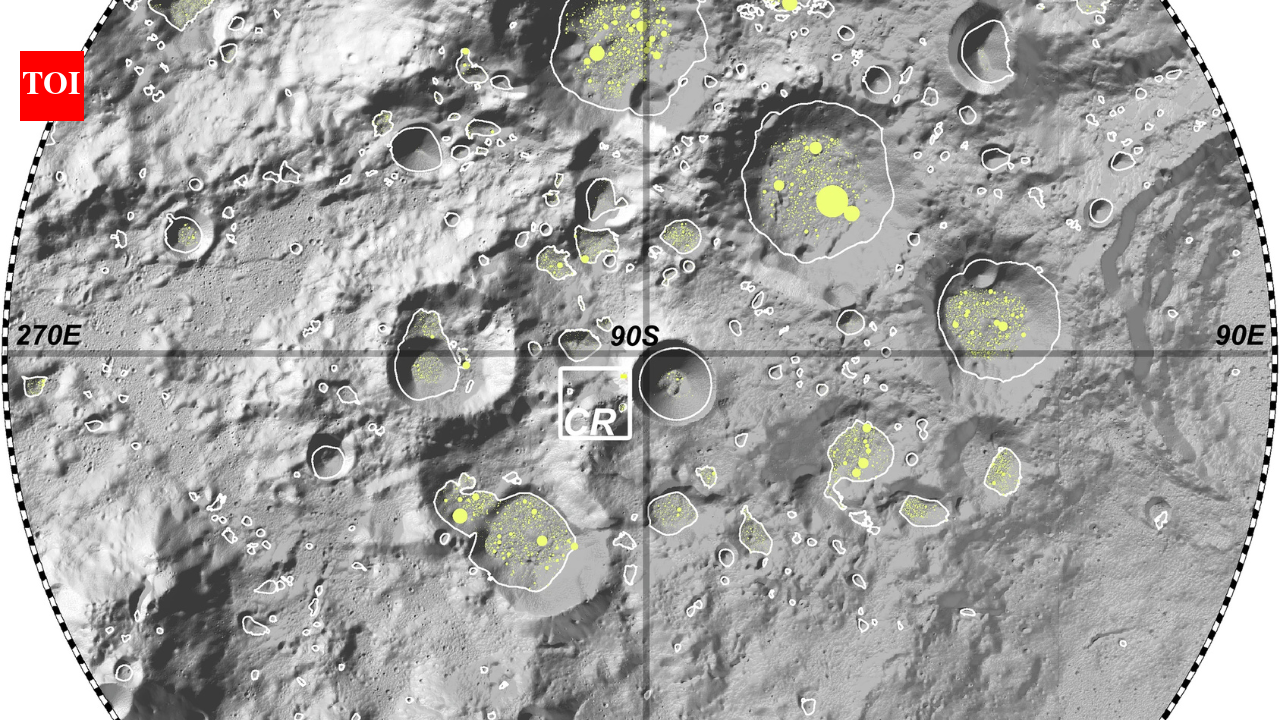
New Delhi: A new international study involving researchers from the Physical Research Laboratory (PRL), IISER and the Institute of Remote Sensing suggests that water ice deposits in the permanently shadowed regions of the moon are much more stable than previously thought.“The Moon’s Permanently Shadowed Regions (PSRs) are capable of preserving water ice and other frozen volatiles for billions of years if temperatures are kept low enough. Water ice is preserved in the Moon’s south pole PSRs, which have experienced multiple impacts. (However) 74 percent of the PSRs were not affected by impacts,” said the study, “Impact on the Moon’s Permanently Shadowed Regions,” which was published April 2 in the journal Nature.The findings come as countries race to launch manned lunar missions, such as the ongoing Artemis 2 mission and India’s manned lunar mission by 2040, with the goal of establishing a lunar base in the future.Using high-resolution orbital images and impact models, the team mapped millions of tiny craters ranging in size from 1 to 20 meters across the PSR between 85° and 90° south latitude. The research was also aided by data generated by NASA cameras and the Isro Chandrayaan-2 orbiter. “In this study, 5 m-7 km diameter craters were mapped using ShadowCam in a subset of the PSR larger than 1 km2 in the region located between 85°–90° south latitude, and 1–20 m diameter craters were mapped using ShadowCam (NASA) and the Chandrayaan-2 Orbiter High Resolution Camera (India) in the connecting ridge region near the lunar south pole, and estimated counts were generated,” the study said.The study further said: “Despite millions of impacts to the PSR and volatiles released from craters, the lunar south pole region still has the potential to preserve shallow ice, making it a promising target for future India’s Chandrayaan-5/LUPEX mission.”Research suggests that small craters in these dark regions may have disturbed ice buried beneath the surface. It also says that in areas without craters, natural surface stirring (called “horticulture”) can mix the ice vertically, bringing it closer to the top. This makes these places good targets for future missions to explore and exploit lunar ice.The Chandrayaan mission was the first to confirm the presence of water on the moon. Chandrayaan-1 (2008) detected lunar water for the first time, Chandrayaan-2 confirmed its stability in the polar regions, and Chandrayaan-3 found further evidence of hidden buried ice, marking a key step in future exploration. Chandrayaan-5, also known as the Lunar Polar Exploration (LUPEX) mission, is a joint project of Isro and Japan’s JAXA and is scheduled to be launched around 2027-28. It aims to land in Antarctica, using heavy-duty Japanese rovers and Indian landers to locate and analyze water ice.