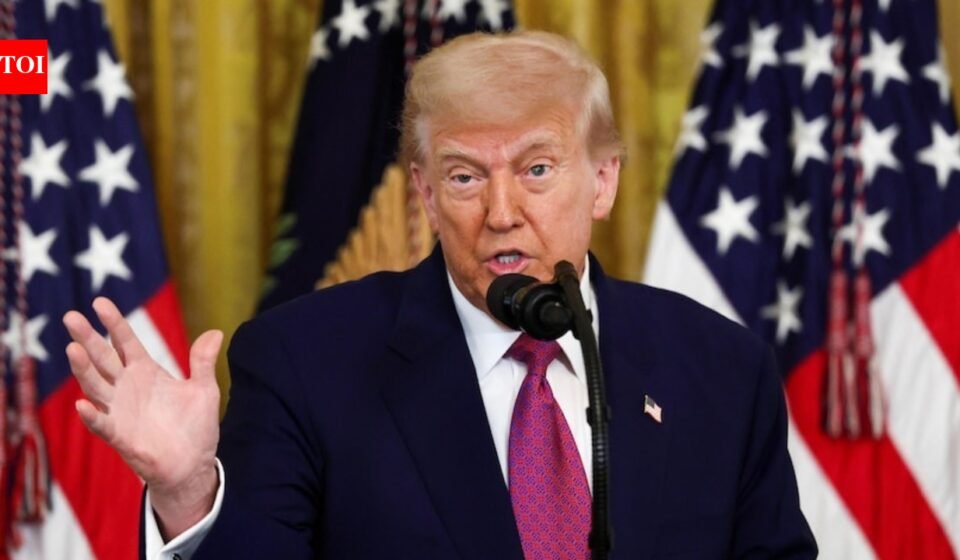

President of the United States Donald Trump Washington said on Monday it was in “good talks” with Iran and expressed hope the talks would lead to a deal. But he warned that the United States would resume military strikes if diplomacy failed.Trump told reporters that a deal was indeed possible but made clear that military action remained an option. “We’re having good negotiations. I think there’s a good chance something will happen, and if it does, great, if not, we’ll go back to what we were doing two days ago,” he said.Later, speaking at a campaign rally in Michigan, Trump took a tougher tone, saying incentives alone would not convince Iran.“You cannot bribe them. You have to defeat them and we will defeat them. But we will see how it turns out. Right now, very friendly negotiations are taking place,” Reuters quoted him as saying.Despite Trump’s remarks, tensions remain high in the region. Saudi ArabiaJordan and Iraq reported drone attacks on Monday, a sign that hostilities have not yet completely subsided despite the suspension of U.S. bombing campaigns.Washington on Saturday halted two weeks of air strikes against Iran, an unexpected policy shift by Trump after nearly five months of conflict. Iran said it was not abandoning diplomacy but denied reports that it was seeking talks with Washington.Foreign Ministry spokesman Esmail Baghai said the two sides continued to exchange information through mediators, but insisted that Iran’s claim that it was demanding talks was “fabricated.” “It’s not in our DNA,” he said.A senior Iranian official earlier told Reuters that Tehran would suspend attacks as long as Trump maintained Iran’s stance. ceasefire announced by the United States.However, Iran’s Central Military Command later accused the United States of threatening ships and oil tankers in Iranian waters and trying to impose what it called an illegal naval blockade, saying it was a further escalation of the conflict.Saudi Arabia said it intercepted drones targeting oil facilities, including sites in Riyadh. Saudi Arabia claimed the drones were launched from Iraq by Iranian-backed armed groups and said it reserved the right to respond.Meanwhile, Yemen’s Iran-backed Houthi movement has claimed responsibility for Saudi Arabia’s east-west oil pipeline to the Red Sea port of Yanbu. The group said the attack was in retaliation for a Saudi drone campaign.Tehran also insists it still controls the Strait of Hormuz, one of the world’s most important oil shipping routes. The issue remains a major point of disagreement, with Washington insisting that commercial ships should be allowed free passage while Iran says it has the right to monitor traffic in the waterway.The easing of military action and Trump’s comments about possible negotiations caused a sharp drop in global oil prices. U.S. crude fell more than 8% to $81.98 a barrel, and Brent crude fell more than 9% to $87.77 a barrel.The conflict has also become a political issue in the United States ahead of the November midterm elections. A Reuters/Ipsos poll over the weekend showed Trump’s approval rating rising to 37%, although only about a third of Americans support military action against Iran. Many interviewees said the president failed to clearly explain the goals of the war.According to Reuters and multiple US media reports, Trump’s decision to suspend the bombing was based on the advice of military commanders, who believed that the operation had reached the limit of what could be achieved. Officials reportedly warned that the military was running out of suitable targets and expressed concern about running out of aviation munitions.Trump rejected suggestions the U.S. was facing an ammunition shortage, saying stockpiles were being replenished rapidly after supplies were supplied to Ukraine. He added that he wanted more of the military’s most advanced weapons. Iranian state media also claimed that six foreign ships trying to cross the Strait of Hormuz without permission were turned back on Monday.The latest phase of the conflict began after the United States launched a new round of airstrikes in response to Iranian attacks on shipping using a Washington-promoted shipping route off the coast of Oman. Iran insists ships use shipping lanes closer to its coastline and says it has the right to regulate transit and impose fees.A two-week U.S. bombing campaign has killed dozens of people in Iran and damaged military installations as well as bridges and tunnels in the country’s south. Four U.S. service members were killed in retaliatory attacks on U.S. bases in neighboring countries, while Iran also targeted civilian infrastructure in the Gulf state, saying the attacks were in response to U.S. military operations.Although Washington and Tehran agreed in June on a negotiating framework to resolve issues including Iran’s nuclear program by the end of August, the two sides remain at odds over the interpretation of provisions regarding navigation in the Strait of Hormuz.