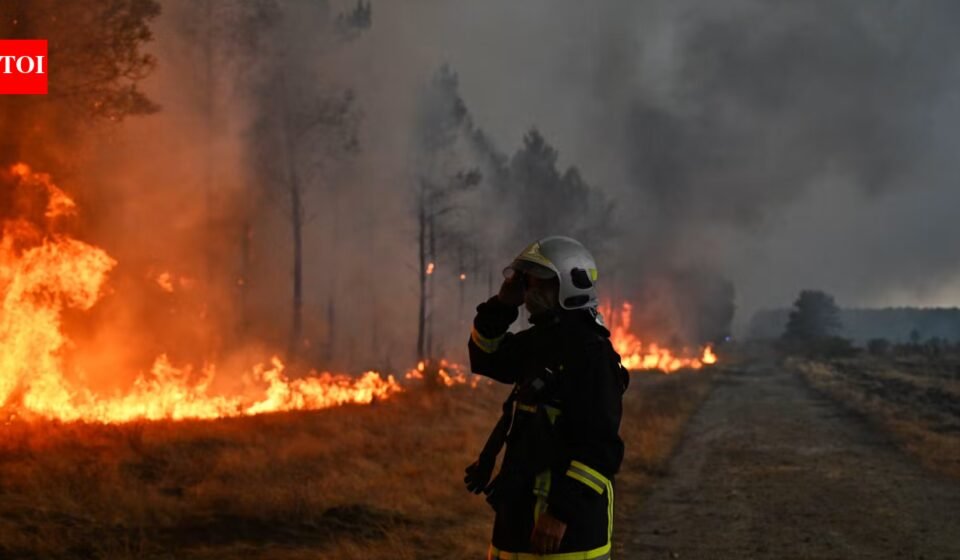
Canada’s 2023 wildfires burned 15.1 million hectares of land and released 554 million tons of carbon; scientists found most of it came from soil and peat under trees

Underground storage of fertile soil and thick peat is the primary fuel behind record emissions from Canada’s 2023 wildfire season. Instead of standing trees and leaves, the carbon locked up beneath the forest floor is 76 percent of all carbon released by fires.An estimated 15.1 million hectares of land were burned during the fire season, according to a study titled “Three-quarters of carbon emissions from Canada’s record-breaking 2023 wildfires attributed to soil and peat burning” published in the journal Geophysical Research Letters. This area burned is seven times larger than Canada’s 20-year average. Throughout the season, fires released approximately 554 million tons of carbon into the air, accounting for nearly a quarter of all global wildfire emissions that year.The findings reveal significant changes in the way fires burn in the north, proving that hot weather is directly burning ancient underground carbon stores.
Centuries of stored carbon lost in underground fires
Canadian soils and peatlands contain approximately 20% of the world’s soil carbon. Peatlands cover approximately 1.1 million square kilometers across the country. These include vast wetland areas like the Hudson Bay Lowlands, which are the world’s second largest peatland complex and contain an estimated 30 billion tons of carbon.In the past, moist peatlands provided a natural barrier to the spread of fire. However, prolonged heat waves and droughts in recent years have caused water levels to drop, drying out the thick moss and soil. This drying process turns land that once blocked fire into a vast source of smoldering fuel.“Canada’s peatlands and soils store 20% of the world’s soil organic carbon,” explains Alemu Gonsamo, associate professor in McMaster University’s School of Earth, Environment and Society. “The risk of future wildfires is not just the loss of forests, but the release into the atmosphere of massive amounts of carbon that has accumulated underground for thousands of years.”When fires occur during these dry periods, the flames do more than just burn surface vegetation. Instead, they penetrate deep into dry layers underground.“When fires occur under these conditions, they penetrate deep into the peat and soil, releasing carbon that takes thousands of years to accumulate during a fire season,” Gonzamo said.
The transition from carbon storage to carbon release
In 2023, deep burns in peatlands alone were responsible for one-third of all wildfire carbon emissions in Canada. These underground fires present unique problems to firefighters and forestry teams.“For many years, our main focus has been on burning trees. This study shows that we also have to pay attention to what’s happening below the surface,” Gonzamo said. “While forest management remains important, its impact is limited because many fires occur in remote, unmanaged areas. Prolonged hot and dry conditions allow smoldering ground fires to persist and release large amounts of stored carbon.“These underground fires can smolder beneath the surface for weeks or months, making them difficult to extinguish using seaplanes or ground crews. As a result, northern lands that have stored carbon for thousands of years are now releasing it into the air.“What we’re seeing is these landscapes shift from storing carbon to releasing large amounts of carbon during extreme wildfire seasons,” Gonzamo said.Once this carbon enters the air, it further contributes to global warming, creating a hotter environment and setting the stage for more severe fires in the future.
Climate impacts require global action
The overall impact of the 2023 Canadian fire season is significant. The total emissions from the fires, measured in carbon dioxide, are approximately three times the total human-made greenhouse gas emissions reported in Canada in 2022.Because the main causes of these deep-burning fires are rising global temperatures and dry weather, local firefighting efforts alone cannot stop underground burning.“To slow climate change and curb growing wildfire emission intensity in Canada and elsewhere, there is no alternative but to reduce global greenhouse gas emissions,” Gonzamo said.“Addressing the root causes of increasingly severe fire seasons requires coordinated global action on climate change. This cannot be done by Canada alone.”
Other key facts from the study
To measure the true depth of the disaster, a research team led by McMaster University scientists Zilong Zhong, Alemu Gonsamo and Chinyere Ottah combined satellite tracking, ground-based field measurements and machine learning models.Detailed analysis showed that underground soil burning produced about 412 million tons of carbon, while trees and vegetation above ground contributed only 142 million tons of carbon. After being converted into carbon dioxide, the total amount of carbon dioxide exceeds 2 billion tons.The findings also expose gaps in official climate tracking. Because many fires occur in remote and unmanaged northern regions, their massive emissions are largely excluded from Canada’s official national greenhouse gas inventory. However, their atmospheric reach is global, with smoke from the 2023 fires spanning thousands of kilometers across North America to reach Western Europe.