NEW DELHI: A month ago, Pandit Ramkishan sat on a Buddhist altar in Rajasthan and demanded better quality water for his hometown Bharatpur. One of India’s oldest former members of parliament (he entered Parliament in 1977), he told The Times of India on Friday, a day before his 100th birthday, that he will always be a socialist. “This is what I learned from Ram Manohar Lohia.”Sitting at his home in Bharatpur, the veteran, who likes to call himself “Lohia’s oldest disciple,” speaks with the authority of a man who has not only witnessed history but shaped it. Before his latest fall and brief hospitalization, he held three meetings a week.What keeps him going is unfinished business.“The day I stopped thinking about a better India, I stopped living. I am alive now and my voice will be heard,” he insisted. “The values we fight for – equality, integrity, dialogue – are under pressure. We need to speak out.” That’s what his aptly titled autobiography, published last year, says – Main Zinda Hoon.
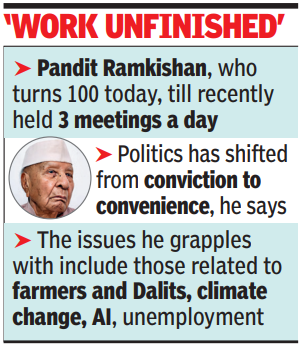
First half of life defined by ideology, second half eroded: PanditjiBut why continue with those physically demanding annoyances, sitting in the sun, sometimes without food and water, with failing knees and carrying the weight of a century? “It comes naturally to me,” Pandit Ramkishan said simply.a participant quit india movement “Shaped by Lohia and Jayaprakash Narayan”, Panditji as he was affectionately called, was imprisoned during the Emergency in 1942 and said he became wiser from the experience.He was not born into politics, but was a farmer’s son, for whom independence meant “freedom from fear, freedom from ‘lagaan’ and scarcity, freedom from institutions that keep the common man on edge”.He recalled searching for Mahatma Gandhi as a young man. As a student in Bharatpur, one day he traveled to Delhi with a few coins collected by his friends in the hope of hearing Gandhi speak. Panditji was not impressed. “We’re always looking for revolutionary ideas.”Today, he believes, the idea of freedom itself is not resolved. If the first half of his life was defined by ideology, he says, the second half has been eroded. He believes that politics has shifted from belief to convenience.After the split of the socialist bloc, Panditji left the Congress party and never returned. He remembers multiple attempts to bring him to power, including an offer to be the leader of Rajasthan. He refused. “It’s difficult but necessary… Opportunity or pressure should never override principle.”So, what is the modern problem he is solving now? “Quite a bit,” he said. “From farmers and Dalit issues to climate change, unemployment and artificial intelligence.” What disturbs him, however, is “what politics has lost now”. He told a story. “I was contesting against Union Minister Babu Raj Bahadur, who had stopped to help me mid-campaign when my car broke down. We were campaigning, but there was no animosity.“Today, opponents are seen as enemies rather than part of governance, he said. “Criticism is meant to strengthen democracy — not to incur hostility.”Is there hope for him?Panditji paused. There is a sense of pessimism when he talks about community polarization and political opportunism. But it’s also an attitude that refuses to give up. “The solutions will not come from political parties. Ordinary people must understand what affects the progress of the country and, by extension, their own progress,” he said.