
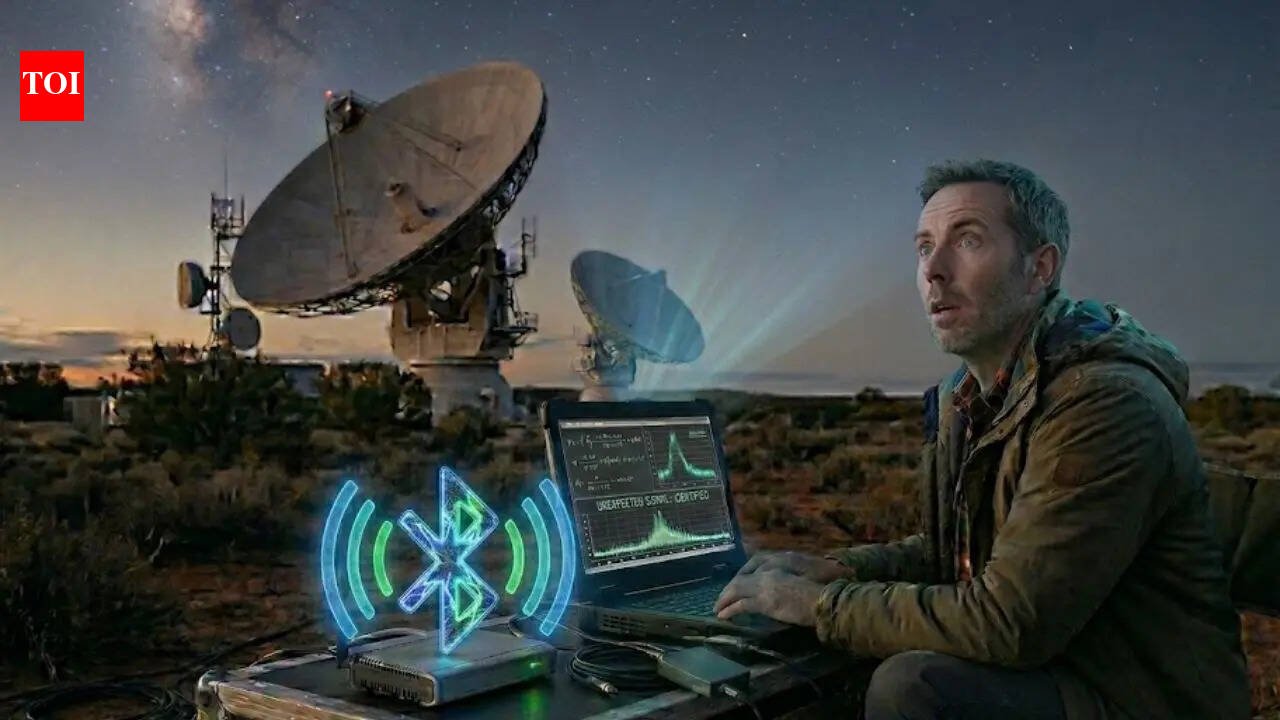
 They developed sophisticated mathematical techniques to filter out cosmic noise, specifically using the Fast Fourier Transform. Rather than becoming obsolete, these formulas are critical to high-speed indoor networks. This unexpected shift solved the problem of multipath interference and laid the foundation for technologies like Wi-Fi and Bluetooth. Today, billions of people around the world rely on this breakthrough to stay connected.
failed radar experiment Helped invent Wi-Fi
According to published reports Commonwealth Scientific and Industrial Research Organizationthe adventure begins at Parkes Observatory. Researchers there use radio telescopes, which work similarly to radio interferometry, to detect pulses from distant parts of the universe. But they face a challenge: echo. These are radio waves that bounce back from cosmic dust, obscuring the data. In order to solve this problem, a special technology has emerged that can process multi-carrier modulated signals simultaneously.Although the expected star was not found at the end of the experiment, another discovery emerged. The team’s signal processing mathematics proved useful for mitigating multipath distortion reflected from office walls and furniture here on Earth. As a result, this insight led to a 1992 patent that laid the foundation for the fast, stable Wi-Fi we rely on today.
How Fast Fourier Transforms Can Save Wi-Fi
As noted in Wireless LANs & Evolution magazine, at the heart of this breakthrough is the Fast Fourier Transform. In radio astronomy, it helps separate signals from background noise. Today, in wireless communications, this mathematical principle allows Wi-Fi routers to divide a single signal into multiple smaller sub-channels. This division prevents data collisions when signals reflect off indoor walls and other surfaces. Interestingly, without this once seemingly unsuccessful astronomical tool, wireless speeds would become too slow and unreliable for streaming or professional tasks.
How a ‘failed’ experiment went global
After the CSIRO team made their initial findings, they turned their findings into a prototype for a wireless local area network (WLAN), according to the National Museum of Australia report. The technology was integrated into the IEEE 802.11 standard, which is today’s Wi-Fi. What started as a “failed” experiment turned into something extremely valuable. It resulted in major legal settlements with major tech companies, firmly establishing Australia as the birthplace of modern wireless connectivity.
The star-finding principle powers Bluetooth
Historically, radio astronomy radar technology developed principles that now power Wi-Fi and modern Bluetooth. Radio waves interact with their surroundings in specific ways. What astronomers considered a commercial hub at the time actually paved the way for today’s wireless world. Devices can now connect without cables, transforming digital communications and global business.