
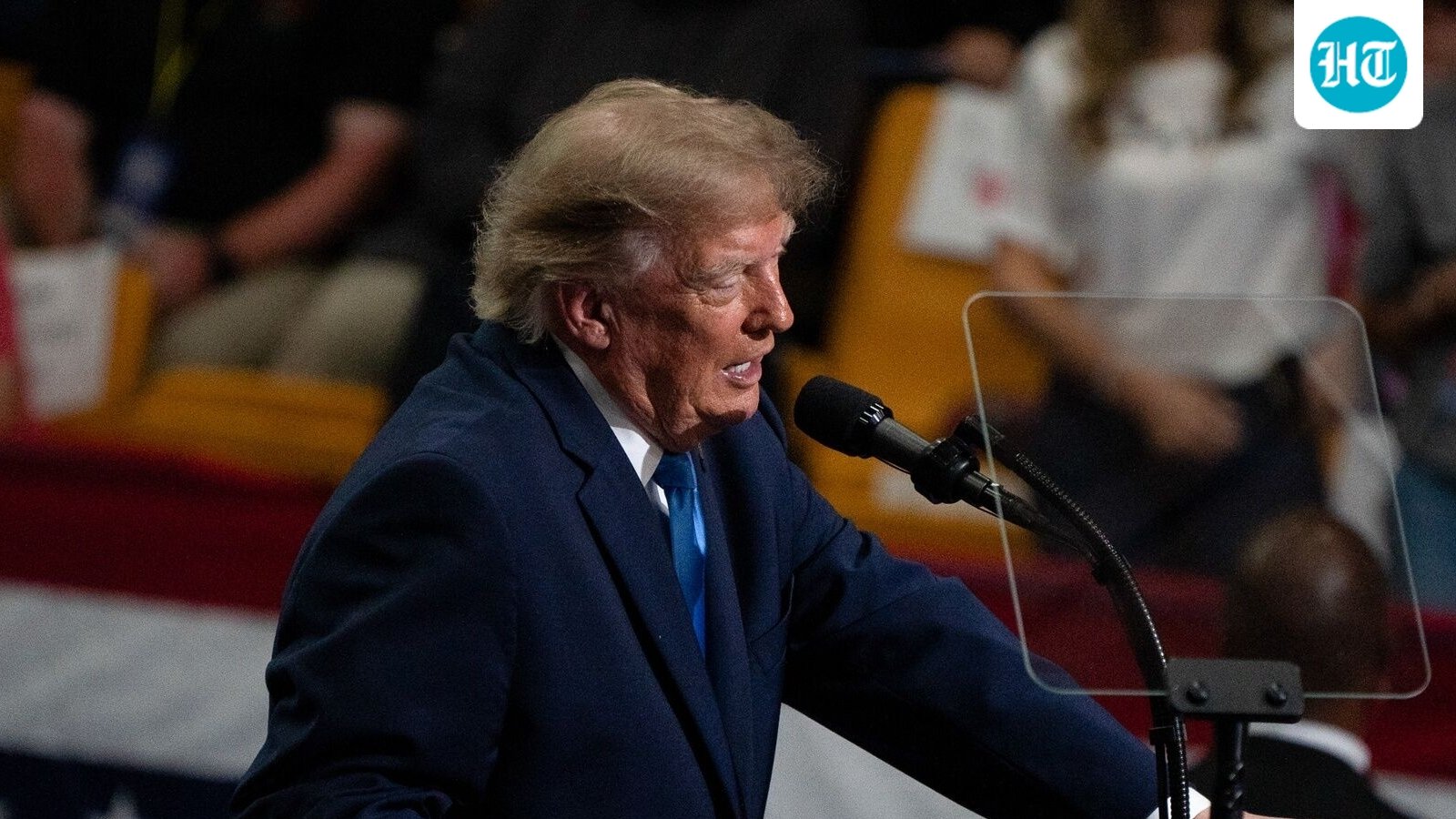
United States President Donald Trump on Sunday announced the formation of ‘Super Intelligence Force (SIF)’, saying it would help ensure American lead in the artificial intelligence race.
Trump, who rechristened artificial intelligence as “super intelligence” last month, has also earlier dismissed risks associated with the tech and reiterated multiple times that warnings against AI were a “hoax.”
Naming director of national intelligence Jay Clayton as his administration’s AI czar, the US President said the SIF would help the US government coordinate with stakeholders, and would report directly to him and his Chief of Staff, Susie Wiles.
ALSO READ: Elon Musk backs SpaceXSI rebrand as Trump pushes ‘SI’ over ‘AI’: What it means for Grok
What did Trump say about the SIF?
Announcing the formation of the Super Intelligence Force after the White House Accord, Trump said it would be “tasked with coordinating the effort of the Federal Government to ensure that America continues to lead the World in Super Intelligence.” The US President reiterated a point he has made earlier, claiming that the technology was “bigger than the Industrial Revolution, and the Internet, and will protect the interests, and improve the lives, of all Americans.”
“The Super Intelligence Force will coordinate the Federal Government’s engagement with Consumers, Public Interest Groups, Religious Organizations, Critical Infrastructure Providers, and Super Intelligence Companies,” Trump said. He added that the SIF would, apart from Clayton, be led by Andrew Ferguson, chairman of the federal trade commission, Emil Michael, chief technology officer and under secretary of war for research and engineering, and Scott Kupor, director of the office of personnel management.
ALSO READ:Trump’s Ohio rally: How gas prices and AI data centres could shape November 2026 midterm elections
What Trump, AI CEOs agreed to in AI safety pact. Why now?
Trump, earlier this week, said tech executives agreed to establish voluntary standards for AI and reiterated his support for rapid expansion of data centers, Reuters news agency reported.
The companies agreed to work with “independent auditors” to assess whether AI systems are working as their designers intended, according to a copy of the agreement posted by Trump on his social media platform. The companies also said they would work to ensure their AI tools do not “hack or access technical systems in unintended ways.”
Data centers, which provide the computing power to train and run AI models, have drawn opposition in communities nationwide over concerns about electricity demand, utility costs and other local impacts. Concerns over AI increased recently after OpenAI and Anthropic reported their AI agents had gone rogue and hacked into other companies’ systems. Anthropic CEO Dario Amodei had, in a post on X, addressed challenges like “loss of control” over AI and called for pacing of development of new models. His call was backed by OpenAI boss Sam Altman and Tesla and SpaceX founder Elon Musk.
However, the US President had dismissed these concerns, saying “negative forces” were bringing these up.