

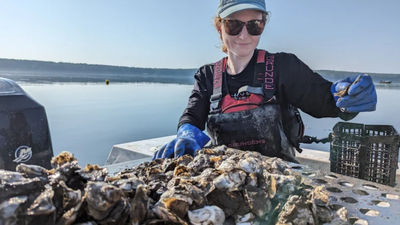
Engineers and aquaculture experts in mid-coast Maine are testing a solar-powered floating system that could change how oysters are farmed. The platform uses a vertical conveyor to move oyster baskets between coastal waters and the open air.The system, called 3D-COAST (3-Dimensional Cultivation of Oysters Automated with Solar Tumbling), is designed to produce up to 125,000 oysters each year from a single 8-by-25-foot floating raft. Its goal is to increase oyster production while greatly reducing the physical work required from farmers.The project is led by Luke Saindon, founder of Maine aquaculture company The World’s Your Oyster Co. (TWIYO), with help from regional scientific institutions.Funding records from the Northeast Sustainable Agriculture Research and Education (NE SARE) program show that $29,978 was awarded in 2025 under USDA project subaward FNE25-131. The funding supports the construction and testing of an improved commercial prototype through March 2027.
How the vertical system works
Traditional oyster farming methods often use floating bags or place oysters on the seafloor. These methods require large amounts of horizontal space and regular manual work, including flipping the bags to control unwanted marine growth.The 3D-COAST raft uses about 12 feet of water depth instead. Oyster baskets are attached to a vertical conveyor loop that is powered by two solar panels.The conveyor completes a full cycle every six hours. As the baskets move, the oysters are gently tumbled underwater and then brought to the surface, where they are exposed to sunlight and air.The tumbling helps shape the oysters. As their growing shell edges are chipped, the oysters can develop deeper and more rounded shells, which can receive higher wholesale prices.The regular exposure to air also helps remove unwanted organisms such as barnacles, sea squirts and algae. These organisms can build up on the cages and reduce the flow of water through the mesh.
Testing labor and costs
Oyster farming can require a lot of physical labor. Workers often have to lift heavy cages from the water, many of which become even heavier when covered with marine growth.According to project reports filed with SARE, the automated system is designed to reduce this physical work while also lowering operating costs.The current stage of the project is focused on testing how reliable the system is and measuring how much time it can save compared with traditional farming methods.TWIYO has also developed a custom MATLAB production model and desktop software. These tools allow farmers to test different stocking levels, labor requirements and possible payback periods using data collected from the floating raft.The project has three main goals:
- Build and operate the improved prototype in real coastal conditions and collect performance data.
- Track mechanical downtime during three-month operating periods to determine maintenance needs.
- Measure the number of labor hours required for every 1,000 oysters harvested and use the results to test farm-efficiency models.
Research support and environmental benefits
The 3D-COAST system has received support from several state and national research organizations.Early testing was supported by FocusMaine and the Maine Technology Institute (MTI). The project later received Small Business Innovation Research (SBIR) Phase I funding from the US Department of Agriculture (USDA).Other groups providing support or technical assistance include the Island Institute, the Maine Aquaculture Association, Maine Sea Grant and researchers at the University of Maine’s Darling Marine Center.The system could also help address the growing competition for space in coastal waters.Because the raft grows oysters vertically instead of spreading them across a large horizontal area, it could produce more oysters in a smaller footprint. This may reduce competition for water space among commercial fishermen, recreational boaters and waterfront property owners. The smaller footprint could also reduce the visual impact of oyster farms.Field testing of the prototype will continue through the 2026 growing season in mid-coast Maine. Final data on reliability, labor savings and overall efficiency are expected in early 2027.