
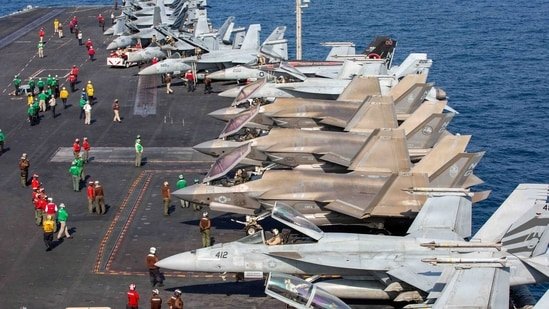
The United States says its first Americans have been killed in a war with Iran that has spread to countries across the Middle East and threatens to upend energy markets.

U.S. Central Command said on Sunday that three U.S. service members were killed and five others were “seriously wounded” in operations against the Islamic Republic, but gave no further details.
US President Donald Trump said in an earlier social media post that Iran’s supreme leader Ayatollah Ali Khamenei was killed on the first day of an attack by Washington and regional ally Israel. Tehran confirmed the news hours later, saying the government would hold 40 days of national mourning for the 86-year-old ruler who was killed in his office building.
“However, heavy, precise bombing will continue without interruption throughout the week or as long as necessary,” Trump said. Speaking on Sunday, Israeli Prime Minister Benjamin Netanyahu said Israeli forces were “attacking Tehran with increasing intensity and will only intensify in the coming days.”
The war spread across the Middle East on Sunday, with Iran firing waves of missiles at targets in multiple countries in response to initial attacks by the United States and Israel. Iranian shells hit buildings in Tel Aviv, while defense systems from Saudi Arabia, Qatar, Bahrain and Kuwait intercepted the incoming fire.
The main airport in Dubai, the world’s busiest aviation hub, came under attack, shutting down almost all civil air traffic in the Gulf. Dubai’s landmarks, including the luxurious Palm Jumeirah and Burj Al Arab hotels, were damaged in a series of explosions that rocked the financial center, as were Abu Dhabi’s skyscrapers. DP World has temporarily halted operations at Dubai’s Jebel Ali Port, according to a notice to customers seen by Bloomberg.
Both Israel and the United Arab Emirates announced death tolls. Iranian television reported on Saturday that the Islamic Republic’s air strikes had killed more than 200 people.
The conflict has reverberated across global energy markets. Oil prices have risen nearly 20% this year, mainly due to tensions between the United States and Iran, and OPEC agreed on Sunday to resume increasing production next month in response to expected further rises in crude prices. Oil markets were closed over the weekend.
Iran’s Tasnim News Agency stated that the Strait of Hormuz, an important oil and gas channel connecting the Persian Gulf and the high seas, has actually been closed, and tankers are increasingly avoiding the waterway. Two ships were reportedly hit off the coast of Oman, but Iranian Foreign Minister Abbas Araghchi said Iran had no intention of closing the route.
The assassination of Khamenei, the ruler of the Islamic Republic for more than three decades, has taken U.S. and Israeli efforts to suppress Iran’s regional influence to a new level. Iranian President Masoud Pezeshkian vowed “revenge and retaliation” for the killing, calling it a “legitimate right” and other officials vowed to step up the country’s military response.
Khamenei has not publicly named a successor, and the Assembly of Experts of the clerical body, which selects the supreme leader, must appoint a new successor. During this period, a council composed of the President, the head of the judiciary and a jurist from the Guardian Council assumes leadership responsibilities.
Videos from inside Iran flooded social media after news of the deaths broke, showing crowds dancing and chanting in celebration in the streets. Other clips show mourners. In Pakistan, at least nine pro-Iran protesters were killed in clashes with police as they tried to storm the gates of the U.S. consulate.
The UAE and Saudi Arabia have been outspoken in condemning the Iranian attack, a sign that Gulf Arab states are losing patience.
Anwar Gargash, a senior adviser to the UAE leadership, urged Iran to “return to sanity” via X, warning that the Islamic Republic was now isolated at a critical moment. Saudi Arabia summoned Iran’s ambassador in response to what it called a “blatant” attack on the kingdom.
Araghchi told Al Jazeera that Iran did not want anyone to step in for support and that the country was capable of defending itself, adding that Tehran was not starting a war. Oman, which served as a mediator in nuclear negotiations between the United States and Iran before the war, said Tehran was willing to make “serious efforts” that would help de-escalate the situation.
According to the Atlantic Monthly, Trump said he had agreed to dialogue with Iran’s new leadership.
The unfolding conflict could be a defining moment for the U.S. leader, potentially setting off a protracted regional war that could send energy prices soaring and cause more American casualties ahead of midterm elections in November. Trump said in a video posted on his Truth Social platform early Saturday that the attack was aimed at “eliminating the imminent threat of the Iranian regime” and urged the Iranians to “take over your government.”
Asked about oil prices on Fox News on Sunday, Trump said he was “not worried about anything” and that the Iranian people’s takeover was “progressing rapidly.”
Israel estimates its strikes destroyed hundreds of Iranian ballistic missiles and destroyed about half of the country’s weapons launchers, according to Israeli military officials.
About 200 Iranian missile launchers were destroyed and dozens more were rendered inoperable, said the official, who spoke on condition of anonymity discussing sensitive information.
Central Command said in a statement that the U.S. military successfully defended against hundreds of Iranian missiles and drones.
Targets included Islamic Revolutionary Guard Corps command and control facilities, Iranian air defense systems, missile and drone launch sites and military airfields, according to Central Command. Israel said the unit’s commander, Mohammad Parkpour, was killed.
Iranian media reported attacks on fortifications and civilian sites, including one that killed more than 140 people at a school in Hormozgan. According to reports, multiple large explosions occurred in the capital Tehran.
For U.S. Gulf allies such as the United Arab Emirates, Saudi Arabia and Qatar, the prospect of a weeks-long regional war is a nightmare. They have pushed hard for a diplomatic solution to the standoff between Iran and the United States over Tehran’s nuclear activities, fearing the ongoing chaos and flight closures could hit both countries’ economies and stymie tourists and foreign investment.
Trump said military action was needed after Iran refused to give up its nuclear weapons, which Tehran has repeatedly said it will not pursue. The latest round of talks took place on Thursday.
–With assistance from Eltaf Najafizada, Dana Khraiche, Galit Altstein, and Leen Al-Rashdan.
More stories like this can be found at Bloomberg
©2026 Bloomberg