
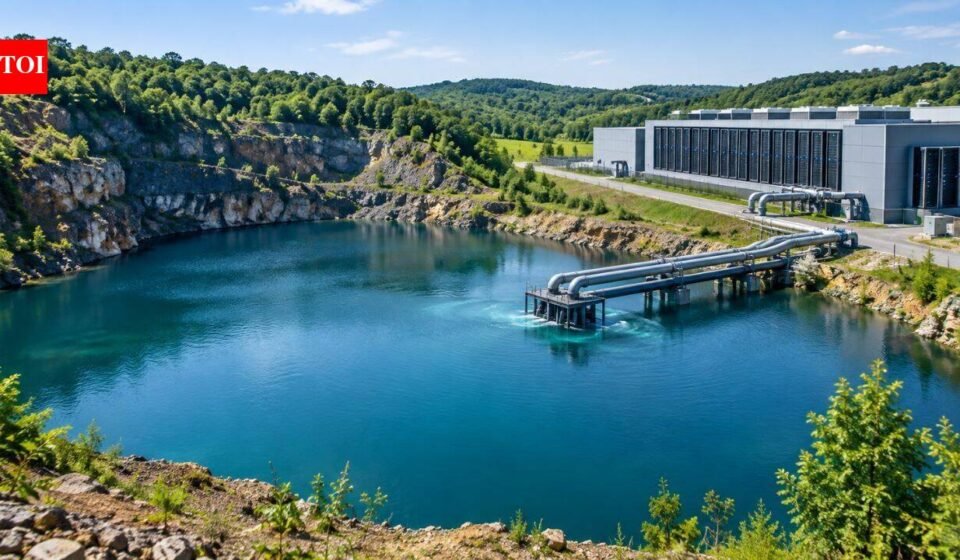
A 2026 study found abandoned US mine pools could cool AI data centres; one Pennsylvania site could handle 30.6 MW of heat

Scientists found that abandoned mine pools could potentially be reused to cool data centres. They developed a model to estimate how much heat these pools could absorb while maintaining suitable cooling conditions. Their detailed analysis of the Morea mine in eastern Pennsylvania found that its pool could support at least 9.5 MW of heat load with conventional air cooling and 30.6 MW with liquid cooling. The researchers also assessed abandoned mine lands across Pennsylvania to identify other sites that could have enough water surface area for similar data-centre applications.
How could abandoned mine pools cool data centres
The study titled ‘Repurposing abandoned mine lands for cooling data centers’ examined surface pools that remain in abandoned mine lands. The researchers investigated whether these pools could act as a source for removing heat produced by data centres.To assess this possibility, they developed a heat-transfer model. It considered how heat could move from the cooling system into the mine pool and how that heat could then be released through the water surface and water leaving the pool.The model was designed to determine the amount of heat a pool could receive without its temperature increasing beyond the conditions considered acceptable in the study.
Findings in Pennsylvania’s more mine analysis
The researchers used the Morea mine in eastern Pennsylvania as their detailed case study. They examined the site’s physical and environmental conditions to estimate its potential cooling capacity.The results showed that the mine pool could reliably support at least 9.5 MW of heat load when conventional air cooling was used. With liquid cooling, the estimated capacity increased to at least 30.6 MW.The results demonstrate how the cooling method can affect the amount of heat that a mine pool can accommodate. Liquid cooling allowed the modelled system to handle a substantially larger heat load than conventional air cooling.
Why is a mine pool’s size important for cooling data centre
The amount of water available is not the only factor determining whether a mine pool can provide cooling. The researchers found that the cooling capacity is influenced by the pool’s surface area, water temperature, air temperature, wind speed and water outflow.The limited size of some pools can become particularly important when a large amount of heat is introduced. As an example, the study found that a pool with 10,000-square-metre surface area and an average depth of 10 metres could experience a 1°C increase in water temperature in less than 12 hours under a 10 MW heat load if heat losses to the surroundings were ignored.This shows why the characteristics of individual mine pools need to be considered before determining their cooling potential.
Would the cooling capacity remain reliable in different conditions
The researchers tested the Morea mine model under different weather and hydrological conditions. Its estimated cooling capacity remained robust when those conditions were varied.The study also found that the calculated capacity was conservative. Under less restrictive conditions or when supplementary cooling systems were used, the cooling capacity could increase by 20% to 50%.These results indicate that the capacity estimated for the Morea mine could vary depending on how a cooling system is designed and operated.
The widespread potential for mine-pool cooling in the US
The researchers extended their analysis across Pennsylvania to identify other abandoned mine lands with potentially suitable pools.Their screening identified 160 abandoned mine lands with pool areas larger than 0.01 square kilometres that could have sufficient surface water area for data-centre applications.The dataset contained 5,586 abandoned mine lands in Pennsylvania, including 1,142 sites from known surface mines. More than 60% of the surface abandoned mine lands contained at least one pit pool, while 16% had a water surface area greater than 10,000 square metres.These figures indicate that mine pools with potentially useful characteristics exist at numerous locations, although the study’s detailed modelling was focused on the Morea site.
What challenges could limit the idea of mine cooling
The researchers identified several issues that would need to be addressed before mine-pool cooling could be adopted.Water quality is one concern, particularly at sites affected by acid mine drainage. Physical conditions can also make development difficult, with steep sidewalls and unstable slopes among the problems identified by the study.The researchers also pointed to limited long-term monitoring data and legal and liability issues. These factors could make it difficult to determine whether a particular abandoned mine is appropriate for data-centre development.The economic side also matters. The study found that mine-pool cooling could have a cooling cost similar to using naturally cold water and lower than cooling systems based on evaporative towers when treatment costs are supported by external funding.
Could mine pools become useful infrastructure
The study indicates that surface pit pools have theoretical, technical and economic potential as natural cold sources for data-centre cooling.The Morea mine provides the study’s clearest example. Its pool was estimated to accommodate at least 9.5 MW of heat load with air cooling and 30.6 MW with liquid cooling. The wider Pennsylvania assessment also identified 160 abandoned mine lands with potentially suitable pool areas.The researchers suggest that repurposing suitable abandoned mine lands could also support mine-land remediation. However, the suitability of each site would depend on its individual water, physical, environmental and economic conditions.


