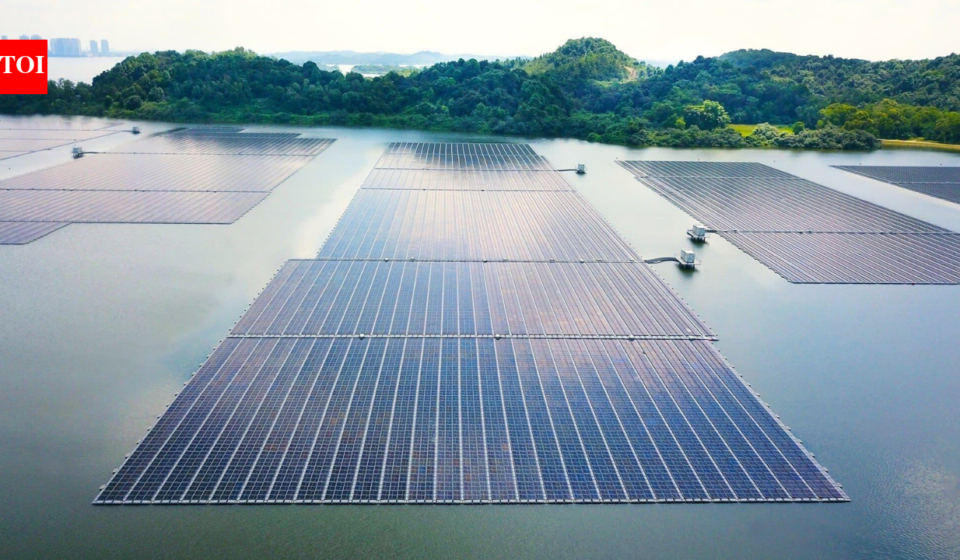
Singapore covered a reservoir with 122,000 floating solar panels; it now powers 5 water-treatment plants and cuts 32,000 tonnes of CO₂ every year

Singapore has turned part of a reservoir into a giant renewable-energy installation, covering about one-third of Tengeh Reservoir with more than 122,000 floating solar panels spread across 10 floating islands. The 45-hectare Sembcorp Tengeh Floating Solar Farm has a capacity of 60 MWp and generates electricity used to support five local water-treatment plants. The project is estimated to reduce carbon emissions by about 32,000 tonnes a year, while two-thirds of the reservoir remains open. Gaps between the floating panels allow sunlight and airflow to reach the water, and additional aerators help maintain dissolved oxygen levels. The installation was preceded by years of testing and environmental studies designed to determine whether large-scale solar generation could coexist with Singapore’s water infrastructure and surrounding ecosystem.
Why Singapore put solar panels on a reservoir
Singapore has limited land but receives abundant sunlight, making solar power one of its most practical renewable-energy options. The country’s water reservoirs offered another possible location for large-scale solar generation without requiring large areas of additional land. PUB began investigating floating solar technology and eventually selected Tengeh Reservoir for a major demonstration. The idea was to make existing infrastructure serve two purposes at once, allowing the reservoir to continue functioning as part of Singapore’s water system while its surface also supported renewable-energy generation. The approach became particularly relevant in a densely populated city-state where land must accommodate housing, industry, transport, nature areas and other competing needs.
The 60 MWp farm covers only one-third of the reservoir
The Sembcorp Tengeh Floating Solar Farm covers approximately 45 hectares and contains more than 122,000 solar panels arranged into 10 floating solar islands. With a capacity of 60 MWp, the installation occupies about one-third of Tengeh Reservoir’s surface. The remaining two-thirds is deliberately left open, allowing wildlife to continue using the uncovered sections of the reservoir. The solar arrays themselves are not a continuous sheet either, with gaps incorporated between the panels. These spaces allow sunlight and airflow to reach the water and help reduce the potential effects of covering such a large aquatic surface. The farm was officially opened in July 2021 after construction began in August 2020.
Singapore first tested floating solar with a smaller system
The giant installation followed a much smaller experiment at the same reservoir. In 2016, PUB and Singapore’s Economic Development Board launched a 1 MWp floating solar testbed at Tengeh Reservoir to examine how different technologies performed in local conditions. The testbed featured 10 different types of floating structures and solar modules from nine companies, allowing researchers to compare their performance over time. The experiment was important because Singapore needed to understand not only how much electricity floating panels could produce, but also how they would interact with a reservoir that forms part of the country’s water infrastructure. The testbed ultimately provided the technical and environmental experience needed before the much larger project was developed.
The floating panels performed better than typical rooftop systems
The testbed also produced an encouraging result for solar generation. PUB reported that the floating solar systems performed between 5% and 15% better than typical rooftop solar photovoltaic systems in Singapore. One factor was the cooler environment around the reservoir, since solar panels generally become less efficient as their operating temperature rises. The unobstructed exposure to sunlight also helped the systems generate electricity. The finding gave Singapore additional evidence that floating solar could be more than simply a way of putting panels somewhere where land was unavailable. Under suitable conditions, placing solar modules over water could also offer an efficiency advantage compared with some conventional installations.
Scientists studied the environmental risks before scaling up
Putting tens of thousands of solar panels onto a drinking-water reservoir raised obvious questions about what the installation might do to the aquatic environment. PUB therefore carried out engineering and environmental studies before proceeding with the full-scale farm. Between 2015 and 2018, researchers examined issues including biodiversity, water quality and environmental conditions, while modelling was used to assess potential effects. Nature groups were also consulted during the process. The earlier floating solar testbed provided an opportunity to observe what happened under real conditions rather than relying entirely on predictions. PUB says the testbed showed no observable change in water quality and no significant impact on surrounding wildlife, findings that helped support the development of the larger installation.
Gaps between the panels let sunlight and air reach the water
The design of the solar farm incorporates measures intended to reduce its effect on the reservoir. The panels occupy only part of the surface, leaving approximately two-thirds of the reservoir uncovered. Within the floating arrays, spaces between panels allow sunlight to reach the water while also permitting airflow across the surface. This is important because covering a water body extensively could otherwise alter conditions at the surface and below it. Leaving large areas open also means that wildlife can continue to forage and hunt across parts of the reservoir. Rather than treating the water surface as available space to be completely filled with solar panels, the project was designed around maintaining a balance between energy generation and the reservoir’s existing environmental functions.
Aerators help maintain oxygen levels in the reservoir
Another safeguard involves the water’s dissolved oxygen. PUB and Sembcorp installed additional aerators around the project to help maintain healthy oxygen conditions in the reservoir. Aeration moves and mixes water while increasing contact between the water and atmosphere, helping maintain suitable dissolved oxygen levels. This became part of the wider environmental management approach for the solar farm. The use of aerators, combined with open water and gaps between the panels, was intended to minimise potential changes to the reservoir caused by the floating infrastructure. The project therefore relies not on a single environmental measure but on several safeguards working together.
PUB continues monitoring water quality
Environmental monitoring did not end when construction was completed. PUB monitors reservoir water using online sensors alongside regular sampling and testing. The agency has also described an environmental management and mitigation plan covering water quality, sediment quality, biodiversity and noise. Monitoring before, during and after construction allows PUB to identify changes that might require a response. This ongoing oversight is particularly significant because Tengeh is part of Singapore’s water infrastructure. The project therefore has to demonstrate that renewable-energy generation can operate alongside the country’s requirements for water management. Continuous monitoring provides a way of checking whether the conditions observed during the earlier test phase remain consistent as the much larger solar installation operates over time.
The electricity helps power Singapore’s water system
The project’s most distinctive feature is the direct connection between renewable electricity and water treatment. PUB said the 60 MWp floating solar farm generates enough electricity to support Singapore’s five local water-treatment plants, offsetting approximately 7% of PUB’s annual energy needs at the time of the project’s opening. This creates a direct link between the country’s clean-energy and water strategies. Water treatment requires substantial amounts of electricity, so generating renewable power for those operations can help reduce the carbon footprint associated with producing Singapore’s water supply. Instead of simply adding renewable electricity to the wider energy system, the project places clean-energy generation directly alongside one of the country’s most important infrastructure needs.
The farm cuts about 32,000 tonnes of carbon emissions a year
PUB and Sembcorp estimate that the project reduces carbon emissions by approximately 32,000 tonnes annually. The figure was compared with removing around 7,000 cars from Singapore’s roads. The farm can also generate an amount of electricity equivalent to the annual consumption of about 16,000 four-room HDB flats. These comparisons illustrate the scale of a project that uses a relatively small portion of a reservoir’s surface for electricity generation. The emissions reduction is particularly relevant to Singapore’s broader effort to lower the carbon intensity of its water and energy systems while continuing to meet the needs of a densely populated city-state.
The floating structures were designed for Singapore’s climate
The equipment supporting the solar panels also had to withstand Singapore’s hot, humid and highly exposed environment. The floating structures use high-density polyethylene, or HDPE, which PUB and Sembcorp describe as food-grade, recyclable, UV-resistant and corrosion-resistant. These characteristics are important because the floats remain exposed to sunlight and water throughout their operating life. The solar panels also use an anti-reflective coating to reduce glare and reflection from their surfaces. Materials and design therefore formed part of the project’s environmental planning, with the system built specifically for long-term operation in an aquatic environment rather than simply adapting conventional land-based solar infrastructure.
Building the farm required new construction techniques
Construction of the full-scale solar farm began in August 2020 and was completed in less than a year, despite taking place during the COVID-19 pandemic. Sembcorp developed a custom-built jig to speed up the assembly of solar panels, with the company saying the technique increased the panel assembly rate by up to 50%. The project also used specialised technology to inspect the panels after installation. Sembcorp worked with Quantified Energy Labs, a National University of Singapore spin-off, to deploy drone-based electroluminescence imaging. The technology can identify defects in solar modules, allowing problems to be located without requiring conventional inspection of every panel individually.
Tengeh became a model for using water surfaces for solar power
The project has since formed part of Singapore’s wider experimentation with floating solar. PUB has also deployed smaller floating solar installations at Bedok Reservoir and Lower Seletar Reservoir. These systems occupy much smaller portions of their respective reservoirs but allow Singapore to continue testing how solar technology can coexist with water infrastructure. PUB has also examined the potential for additional floating solar installations. The broader strategy reflects the same basic problem that prompted Tengeh in the first place. Singapore needs to expand renewable-energy generation, but large areas of undeveloped land are scarce. Using selected water surfaces provides another option without requiring the country to dedicate large new areas of land exclusively to solar farms.
A reservoir became both a water asset and a clean-energy asset
The significance of Tengeh Reservoir extends beyond the number of panels floating on its surface. Singapore took an existing piece of water infrastructure and added another function without abandoning its original purpose. The project was tested on a smaller scale, subjected to environmental studies and then expanded to 60 MWp while leaving most of the reservoir open. Its electricity supports five water-treatment plants, while monitoring, aeration and careful spacing are used to limit potential environmental effects. The result is an unusual example of infrastructure doing two jobs at once, with the same reservoir helping secure Singapore’s water needs while also producing renewable electricity. It shows how a country with little spare land can look to existing spaces for new climate solutions without giving up their original purpose.