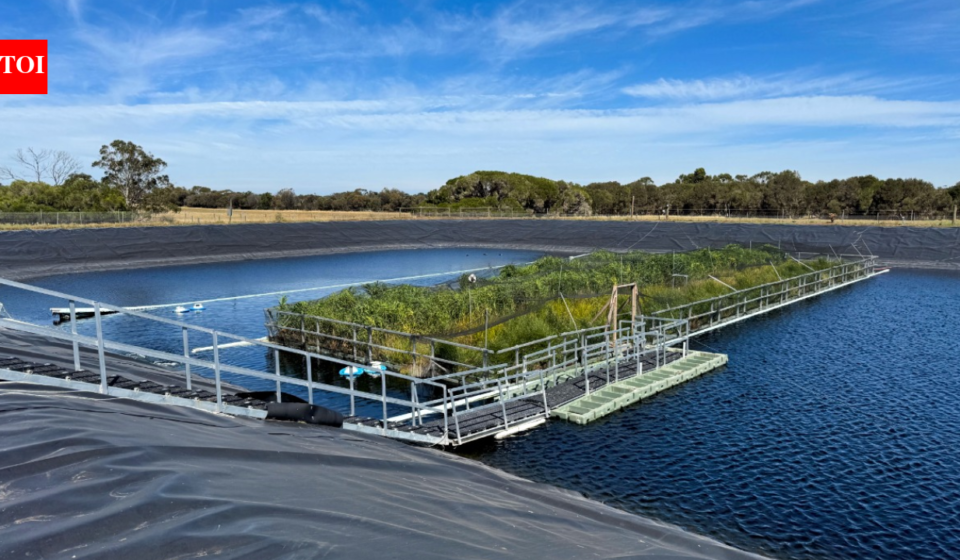
In 2023, Australia put a 330-square-metre floating wetland on a wastewater lagoon; two years later researchers found methane emissions had fallen by up to 66%

Installing a floating wetland planted with native vegetation on an Australian municipal wastewater lagoon cut methane emissions by up to 66 per cent, according to the results of a two-year field trial. Published on 25 August 2026 in the Journal of Environmental Management, the peer-reviewed study looked at how constructed floating wetlands affect greenhouse gas emissions from open water storage. The trial was carried out at a Westernport Water treatment facility on Phillip Island, Victoria, by researchers from RMIT University, Australia’s national science agency CSIRO, and Westernport Water. The trial measured emissions continuously using “Pondi”, a solar-powered sensor system developed by RMIT with partners from Deakin University, The University of Queensland and Leading Edge Engineering Solutions. During the monitoring period, carbon dioxide emissions fell by up to 36 per cent, while nitrous oxide levels dropped by 18 per cent compared with a control lagoon without a floating platform. Wastewater treatment around the world produces about 1.6 per cent of human-caused greenhouse gas emissions. Much of this comes from high nutrient levels that encourage gas-producing microbes to grow in stagnant ponds.
Native plants and sub-surface root dynamics
For the trial, researchers installed a 330-square-metre floating platform, about the size of one and a half tennis courts. It was planted with Australian native wetland species, including Phragmites australis, Baumea articulata and Bolboschoenus caldwellii. As the reeds and sedges grew on the floating pontoons, their roots extended directly into the nutrient-rich water below. The site needed regular maintenance to remove invasive weeds and manage local bird populations, but the roots quickly developed complex habitats for microbes and other organisms. Dr Lukas Schuster, lead author of the study and a researcher at RMIT University, said the root systems supported useful microbial communities that could process pollutants and gases in the water. “This is the first time we’ve had evidence on this scale that supporting microbial communities in the root systems of wetland plants can reduce wastewater emissions without relying on high-tech solutions,” Dr Lukas Schuster said. “It’s a strong demonstration of how nature-based approaches can transform wastewater treatment into part of the climate solution.” Clear reductions in greenhouse gas emissions were seen four months after the platform was installed, even though overall nutrient levels in the water remained largely unchanged during the study.
Decarbonising water sector infrastructure
The methane cuts recorded during the Phillip Island trial could be useful for water utilities working towards net-zero targets. Although methane remains in the atmosphere for less time than carbon dioxide, it has a much stronger warming effect over shorter periods. Open wastewater lagoons often have low-oxygen conditions that speed up the breakdown of organic matter and methane production. This means simple ways to reduce emissions can be difficult to introduce across municipal water systems. Dona Tantirimudalige, Managing Director at Westernport Water, said floating platforms could allow utilities to improve existing treatment facilities without major rebuilding work. “The outcomes provide a strong foundation for further work to test performance across additional lagoon types and operating conditions,” Dona Tantirimudalige said. “Building this evidence base is important for utilities as we continue to develop credible and cost-effective emissions abatement pathways.” Researchers also found that the plant roots could work as natural filters, taking in heavy metals and suspended pollutants before treated water flows into nearby marine or freshwater areas.
Scaling biological platforms across agricultural sites
After the results from the municipal wastewater lagoon, water researchers at RMIT’s Centre for Nature Positive Solutions began wider trials across regional Victoria. Working with Melbourne Water and the Bass Coast Landcare Network, researchers are placing floating wetland pods in farm dams across the Bass Coast. Australia has an estimated 1.8 million farm dams, which together are a significant source of agricultural methane because of livestock runoff and stagnant water. Dr Martino Malerba, a co-author of the study and RMIT water researcher, said biological water treatment methods could be used in many different settings. “Floating wetlands harness the power of nature to help restore balance in aquatic systems,” Dr Martino Malerba said. “By supporting microbial communities in the root systems of wetland plants, we can improve water quality without relying on high-tech solutions.” Testing on regional farm dams is still underway to find out whether similar reductions in emissions and improvements in water quality can be achieved across privately owned agricultural properties.