
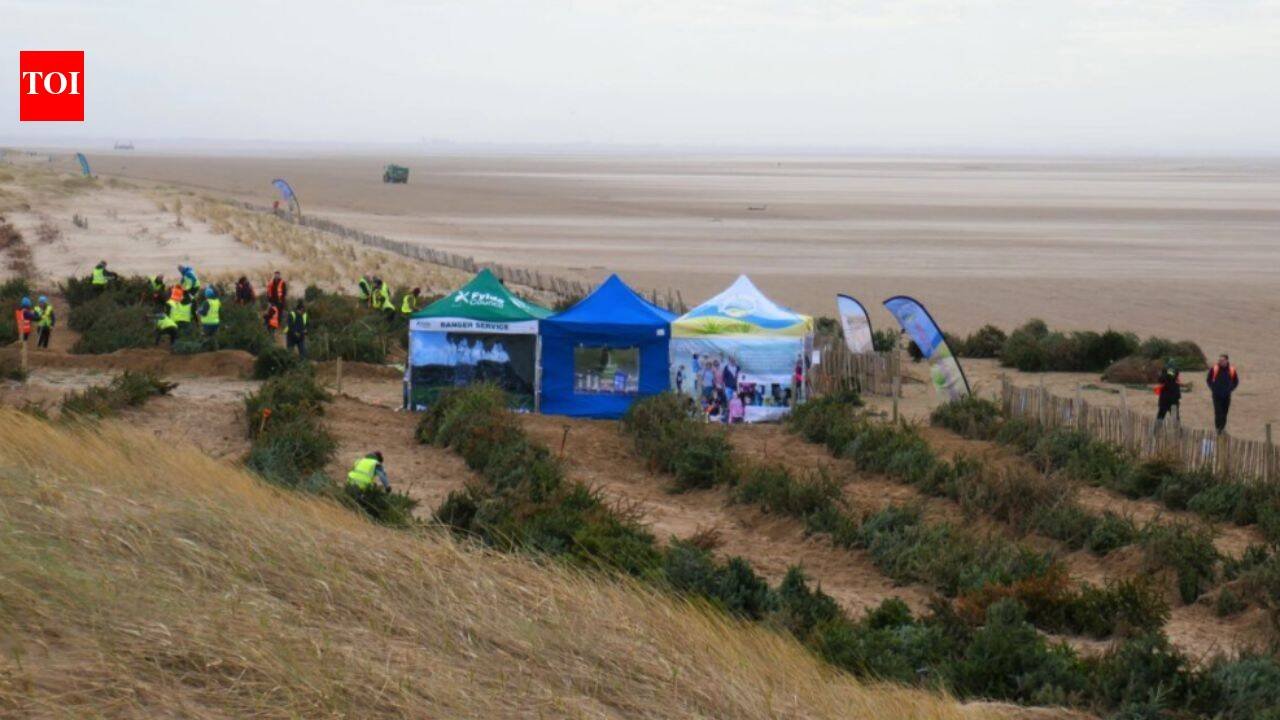
Discarded Christmas trees are being used to help protect homes and businesses along the Fylde Coast in Lancashire, UK. Since the project began in 2013, old Christmas trees have been placed on St Annes beach to trap wind-blown sand and help build wider sand dunes.According to Fydle Council, the annual work is part of the Fylde Sand Dunes Project, which aims to restore and conserve the coastal dunes. Fylde Council, Lancashire Wildlife Trust and Blackpool Council work together on the project, which is funded by the Environment Agency.The idea is simple. Trees are placed in front of the existing dunes, where their branches slow down the wind and trap sand. As more sand collects around the trees, the mound grows and can eventually become part of a new dune.The project has already produced a visible change. Last year, more than 2,000 Christmas trees were collected from residents and used in the planting work. According to the council, this helped create a 90-metre increase in the width of the Fylde Sand Dune system.
Christmas trees build dunes
Sand dunes naturally develop when wind-blown sand is trapped by an obstruction on the beach. At first, the collected sand can be unstable and may collapse. Plants can then begin growing in small pockets of sand and help hold the material in place.At St Annes, discarded Christmas trees act as the first obstruction. Their branches catch sand carried inland by the wind. Over time, more sand becomes trapped around the trees, allowing the dune to grow.The process then continues naturally. Pioneer grasses such as sand couch and lyme grass can grow in the dunes. Marram grass can later become more dominant as sand builds around it. Its growth helps stabilise the new dune, allowing more plants to establish.As the plants grow and spread, they help hold more sand in place. Eventually, organic matter from plants that die and decay builds up. The dune becomes more stable and develops into a habitat with different plants and animals.
Why dunes matter
Dunes act as a natural, or ‘soft’, sea defence. During storms, they absorb some of the energy from the sea. Wider dunes are more effective at providing this protection. The dunes help reduce the risk of erosion caused by storm surges, which happen when strong winds combine with high tides.However, the dunes along the Fylde Coast are much smaller than they once were. According to the Fylde Council, more than 80% of the dunes have been lost over the past 150 years because of coastal development.The remaining dunes are now squeezed between the sea and nearby towns. This makes protecting and extending them important for both coastal communities and wildlife.Amy Pennington, Lancashire Wildlife Trust’s Fylde Sand Dunes Project Senior Engagement Officer, said the dunes provide habitat for a wide range of plants and animals and also act as a soft sea defence.“The sand dunes along the Fylde Coast are home to a diverse and specialised ecosystem, hosting a variety of unique plants and animals,” she said.
A habitat for plants and wildlife
The dunes have been designated as a Biological Heritage Site and are also a Site of Special Scientific Interest (SSSI). They support specialised plants and animals that are adapted to the dry and shifting conditions of a sand dune environment.Species found in the dunes include dune helleborine orchids, Isle of Man cabbage, dune pansies, sea holly and round-leaved wintergreen. Wildlife includes the grayling butterfly, mining bees, common lizards, skylarks, linnets and reed buntings.The environment changes as the dunes develop. Areas closer to the beach can have alkaline conditions because the sand contains pieces of sea shells. Further inland, the ground can become more acidic as the dune matures, allowing different plants to grow.As part of the project, volunteers also remove invasive plants, plant dune grasses and install paling fences to trap wind-blown sand. In addition, wetland ‘slacks’ are being created behind some dunes to support more plants and wildlife.According to Councillor Tommy Threlfall, Fylde Council’s Lead Member for Environment, the project had continued for more than a decade.“Every Christmas tree donated by our residents becomes part of something truly special,” he said. “We’re not just recycling trees, we’re building natural defences that will protect our coastal communities for generations to come,” he added.The project continues to rely on volunteers and local support. In February 2026, volunteers from across Lancashire were due to gather at St Annes beach to plant more than 2,000 donated Christmas trees.
What aspect of the Fylde Sand Dunes Project do you find most appealing?
3k+ users shared opinion today
5k+ users already voted today
3k+ users shared opinion today