


Dry air is not completely without water. There is moisture suspended in the atmosphere even when rainfall is scarce, and 13-year-old Aniket Sarkar wanted to find out whether some of it could be recovered for agriculture. His idea led to a low-cost atmospheric water capture system built with ordinary materials, giving him a way to explore how moisture could be collected without depending entirely on traditional water sources. The project was developed with farmers in dry regions of the American Midwest and West in mind, where limited water supplies can create difficult conditions for growing crops.Aniket later entered the 3M Young Scientist Challenge with the prototype, using the competition as an opportunity to present his work and continue thinking about how the design might be improved. It is an early-stage invention rather than a finished agricultural technology, but the project has already given the young inventor a clear direction for his interest in environmental engineering.
How Aniket Sarkar’s low-cost system captures water from dry air for farmers in arid regions
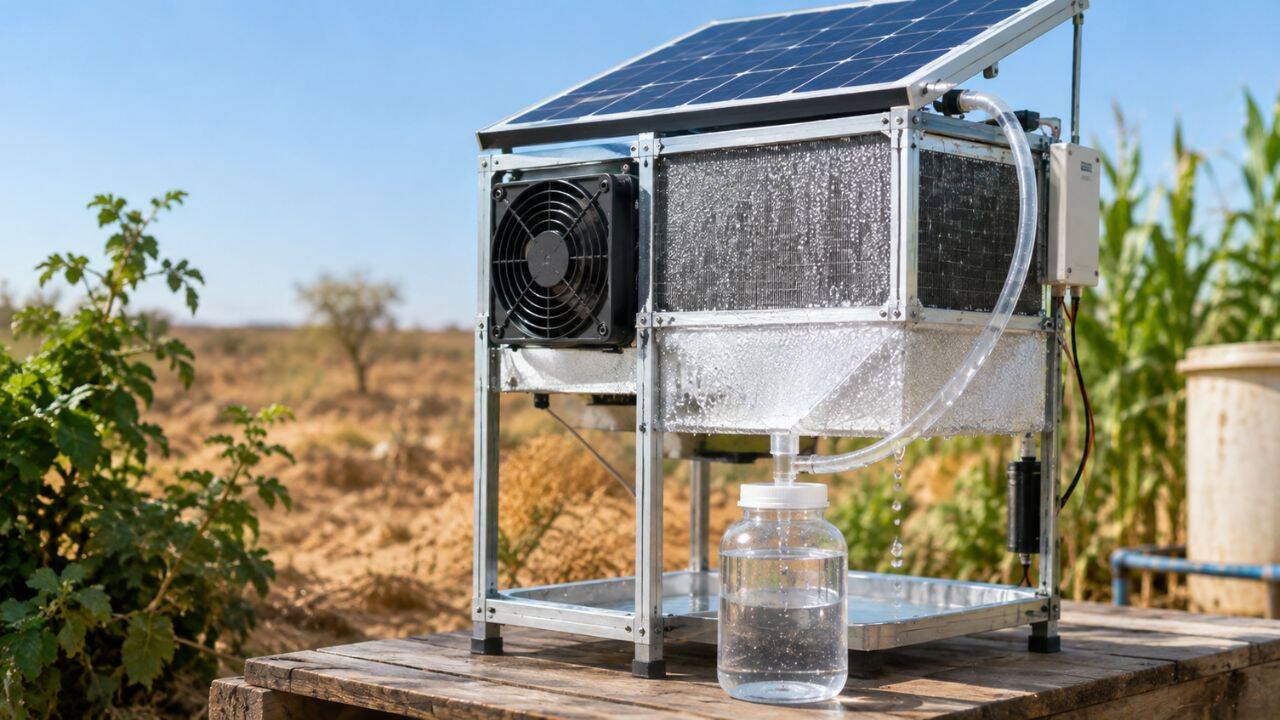
Water shortages can make farming difficult long before the land appears completely barren. In dry regions, farmers have to work with limited water supplies while still trying to maintain crops. Aniket’s project approaches the problem from a different direction.Rather than relying entirely on groundwater, rainfall or conventional water infrastructure, his system is intended to draw moisture directly from the surrounding air. The principle is straightforward, although turning it into a practical machine is considerably harder.His prototype was developed as a low-cost atmospheric water collection system. The project was built using everyday materials rather than expensive specialist equipment, allowing Aniket to experiment with the concept without requiring a large laboratory setup.The atmosphere contains water vapour even when conditions feel dry, and Aniket’s invention is designed around capturing some of that moisture.
From a simple prototype to the 3M Young Scientist Challenge
The first version of the system gave Aniket something tangible to work with. Instead of keeping the idea as a drawing or theoretical proposal, he could test how the components behaved together and consider what would need to change in a future version.That is part of what drew him to the 3M Young Scientist Challenge. The competition gave him a way to present the project publicly while also continuing to develop it.Aniket entered because he already had both a problem he wanted to address and an early prototype. The challenge offered a setting where he could put the concept in front of a wider scientific audience and see how other young students were approaching practical problems of their own.There was also the prospect of working with an experienced mentor. For a project still at the prototype stage, that kind of guidance could help answer questions that are difficult to resolve alone, particularly around improving the design and making a small experimental system more useful outside a controlled setting.
Why the farmers’ problem caught his attention
The intended application is closely tied to changing conditions in agriculture. Large parts of the American Midwest and West already experience periods of limited rainfall and dry conditions, placing pressure on the water needed for crops.Aniket’s approach is to look at an underused source: atmospheric moisture. Collecting useful quantities of water from air can be technically demanding, particularly when humidity is low. The amount of moisture available varies with temperature, location and weather conditions.Those limitations make the engineering problem more complicated. A device that works under one set of atmospheric conditions may perform very differently somewhere else. Making such a system inexpensive, efficient and practical enough for agricultural use would require considerable further development.For now, Aniket’s prototype represents an early attempt to explore whether the idea can be pushed further.
How rocketry, robotics and STEM projects led Aniket to water innovation
The atmospheric water project is part of a wider interest in engineering for environmental problems. During elementary and middle school, Aniket took part in activities involving rocketry, robotics and STEM competitions.Those experiences helped shape the way he approaches problems. Rather than seeing an environmental challenge as something that belongs only to scientists or governments, he has been interested in the engineering question of what could actually be built.That interest also influences how he thinks about the future of his water-capturing device. He has described the current invention as something that could continue evolving from a simple construction into a more advanced technology.
What is Aniket’s favourite invention of the past century
When asked about the invention from the past century that interests him most, Aniket points to 3D printing.His interest is partly connected to what technology makes possible for young inventors. A 3D printer can turn a digital design into a physical object without requiring a conventional manufacturing facility. That makes experimentation more accessible, especially when a prototype needs to be changed repeatedly.He is also interested in how the technology has moved beyond its early association with plastic objects. Modern 3D-printing techniques can work with a growing range of materials and have been explored for applications ranging from construction to food production.For Aniket, that broader potential is what makes the technology particularly interesting. He can imagine 3D printing being used for temporary structures following natural disasters, components for renewable-energy equipment and, eventually, technologies associated with future space exploration.
From capturing water to solving bigger environmental problems
“I hope to be an environmental engineer helping to contribute to the solutions of the most crucial problems of society.” The direction fits closely with the project he has already chosen to work on. His interest lies in environmental problems where engineering could offer practical ways for people to adapt to changing conditions.Climate change is one area he expects to focus on, particularly the challenges faced by communities dealing with its effects. That could mean developing technologies that help people adapt to environmental changes, as well as working on solutions aimed at reducing the causes of those problems.