
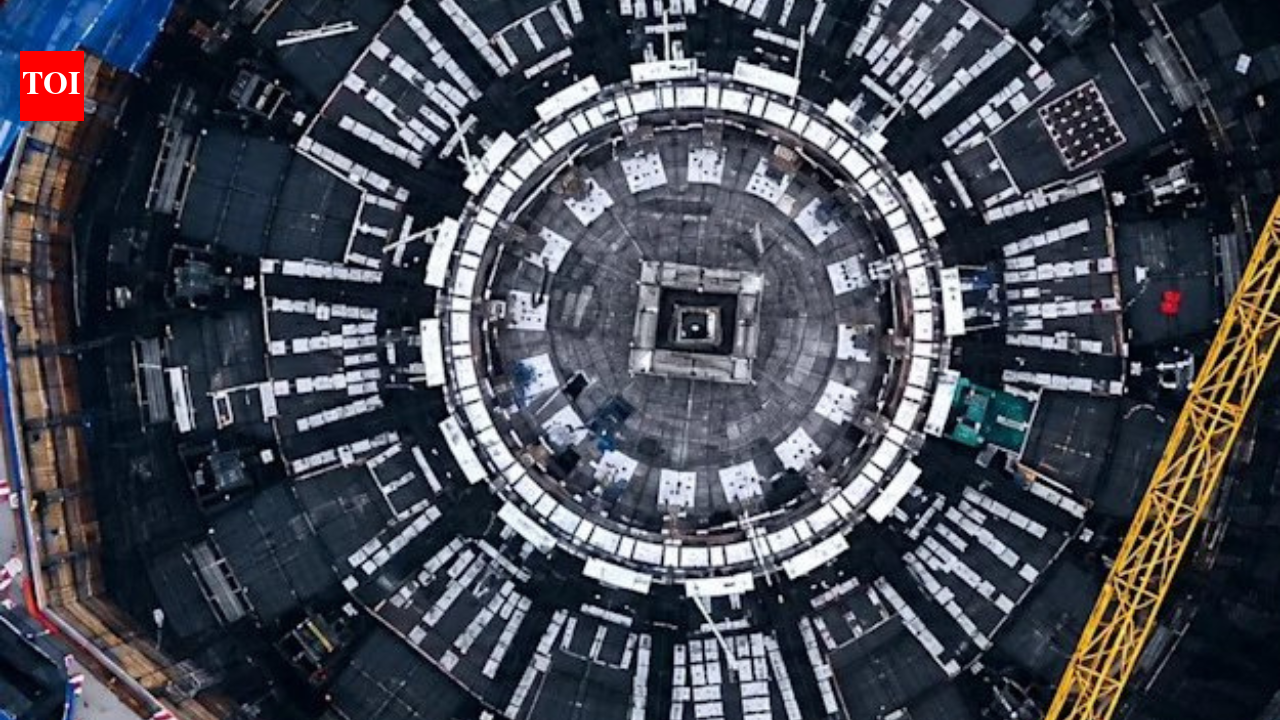
China has completed construction and testing of a giant 582-ton superconducting magnet designed for its next-generation “artificial sun” program, Xinhua News Agency reported, reaching a major milestone in its pursuit of commercial nuclear fusion. At 21 meters long, the toroidal field magnet is the largest of its kind ever built for a controlled fusion reactor. The magnet, developed by the Chinese Academy of Sciences Institute of Plasma Physics (ASIPP) in Hefei, is designed to confine plasma heated to more than 100 million degrees Celsius, which is about six times the temperature of the sun’s core. The breakthrough is expected to support China’s long-term goal of demonstrating controlled nuclear fusion power generation around 2030, according to the project’s roadmap.
Giant magnets power China’s next generation of ‘artificial sun’
The newly completed magnets are toroidal field (TF) superconducting magnets, one of the most critical components of the tokamak fusion reactor. Weighing 582 tons and 21 meters long, it is larger than any similar magnet built for fusion facilities.The magnet was developed for China’s Burning Plasma Experimental Superconducting Tokamak (BEST) project, the country’s next-generation experimental fusion reactor. Engineers completed construction, factory acceptance and full parameter testing in Hefei, one of the biggest engineering achievements of China’s fusion project.
Why do fusion reactors need such large magnets?
Nuclear fusion requires heating hydrogen plasma to temperatures in excess of 100 million degrees Celsius, hotter than the center of the sun. No known material can physically contain a plasma at such extreme temperatures.Instead, powerful superconducting magnets create an intense magnetic field that levitates the plasma in a donut-shaped vacuum chamber called a tokamak. Toroidal field magnets prevent superheated plasma from contacting the reactor walls, allowing the fusion reaction to continue safely while minimizing damage to the reactor.
How superconducting technology could make fusion possible
Unlike ordinary electromagnets, superconducting magnets have almost zero resistance when cooled to extremely low temperatures. This allows them to carry huge currents while consuming less energy.China also successfully tested the high-temperature superconducting central solenoid, another key component often referred to as the “heart” of the tokamak. A central solenoid generates the plasma current needed to start and sustain the fusion reaction, working with a toroidal field magnet to keep the plasma stable throughout the experiment.
How does this magnet differ from previous designs?
According to Chinese researchers, the volume ratio of the new ring-shaped magnetic field magnet is about 1.3 times that of the equivalent magnet designed for the French international ITER fusion project. It also stores three times more magnetic energy, allowing it to generate stronger magnetic fields to confine plasma.The six-year development program involves breakthroughs in superconducting conductor manufacturing, structural engineering, cryogenic technology and quench protection. Researchers say the project has resulted in dozens of patents and new industry standards for large superconducting magnet technology.
How China’s “Artificial Sun” Plan Developed
China’s Experimental Advanced Superconducting Tokamak (EAST), widely known as the “artificial sun,” has set several world records by sustaining super-hot plasma for longer periods of time. EAST is a research platform where scientists can test technologies needed for future commercial fusion reactors.The newly completed magnets are suitable for the BEST reactor, not the current EAST machine. BEST’s goal is to go beyond laboratory experiments to demonstrate sustained burning plasma and ultimately generate electricity through controlled nuclear fusion.
When will fusion power become a reality?
China expects construction of the BEST experimental reactor to be completed in 2027. If development goes as planned, researchers hope to demonstrate controlled fusion power generation around 2030.Although commercial fusion power generation remains one of the world’s greatest scientific and engineering challenges, each advancement in superconducting magnet technology brings researchers closer to producing virtually unlimited clean energy with minimal long-term radioactive waste and no carbon emissions during operation.
Why fusion is considered the future of clean energy
Unlike traditional nuclear fission, which splits heavy atoms to release energy, nuclear fusion combines light hydrogen isotopes to create huge amounts of energy. The process produces no greenhouse gas emissions during operation and produces far less long-lived radioactive waste than existing nuclear power plants.Scientists around the world consider fusion one of the most promising long-term solutions to growing global energy needs. China’s latest achievement shows that the global race for nuclear fusion is rapidly progressing, bringing the vision of an “artificial sun” that can power cities one step closer.