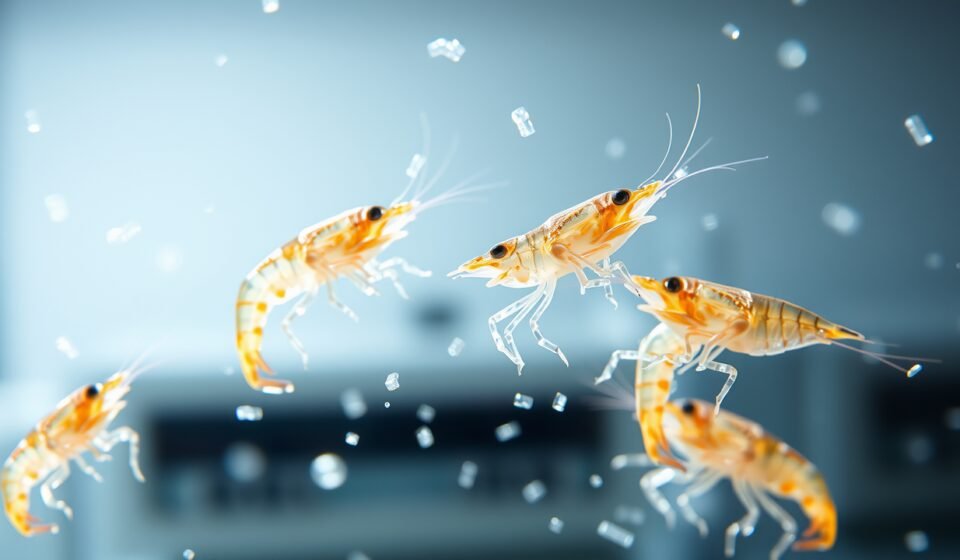
Scientists are teaching shrimp to eat in zero gravity, which could change how astronauts grow food in space

Providing food for astronauts on long-duration missions remains one of the thorniest problems in space exploration because food cannot simply be grown as it is on Earth. A team of researchers at Japan’s Okayama University of Science has been investigating whether seafood, one of the oldest and most widely eaten foods on Earth, could actually be part of the solution. Their new study, recently published in the journal Microgravity Science and Technology, examines how shrimp behave and feed in simulated microgravity, providing an early but promising signal that crustaceans could become part of the future food chain for astronauts living on the moon or elsewhere.
Why testing animals in microgravity is so difficult
Most microgravity experiments on Earth rely on drop chambers or parabolic flights, both of which only provide a few seconds of true weightlessness, too short a window for meaningful behavioral testing. The International Space Station allows longer exposures, but access is expensive and space is extremely limited. To solve this problem, the team turned to a device called a gyrator, which rotates its contents to eliminate gravity by constantly repositioning itself, simulating some of the effects of microgravity. According to the title On-site observation of shrimp feeding process in microgravity environmentpublished by researcher C. Yokota and colleagues, standard gyroscopes typically spin only 10 to 25 revolutions per minute, which is too slow for agile animals that can simply reorient themselves before simulated weightlessness takes effect.
Building faster gyrators for complex animals
To solve this problem, the researchers designed a custom-made gyrator that spins at about 130 revolutions per minute, or more than two revolutions per second. This rapid rotation doesn’t give animals like shrimp enough time to readjust their bodies to Earth’s gravity before their orientation changes again, effectively creating a state of pseudo-gravity indoors. According to official announcement Okayama University of Sciencethis is the first study to use this high-speed rotating device to observe the feeding behavior of live shrimp under simulated microgravity conditions.
Watch baby shrimp spin while trying to eat
In the main experiment, juvenile Kuruma shrimp were placed in a sample box equipped with a digital camera and light source, and then subjected to simulated microgravity for fifteen minutes while the researchers observed their feeding attempts. The rapid rotation causes the water within the container to slosh with considerable force, producing an estimated internal flow velocity of 0.15 meters per second. In response to this turbulence, the shrimp were seen clinging to plastic nets placed inside the containers, and they essentially only ate food particles floating directly in front of their mouths, rather than actively feeding as they would under normal gravity. Notably, the shrimp fed most efficiently during brief periods of steady water flow, providing a strong clue that these animals are capable of feeding in microgravity when given the opportunity.
Genetic changes related to movement and body structure
In addition to behavior, researchers are also looking for biological changes at the genetic level. Another group of shrimp was exposed to simulated microgravity for twenty-four hours, and their RNA was compared to a control group kept under normal gravity using gene ontology analysis. This comparison revealed significant changes in genes related to chitin metabolism and cuticle development, both of which are closely related to the shrimp’s exoskeleton and its ability to move. These genetic changes suggest that microgravity affects the shrimp at a biological level, not just in terms of visible locomotion or feeding behavior.
Test brine shrimp for several days
Because larger shrimp are difficult to test in statistically significant numbers, the team conducted a supporting experiment using brine worms (commonly known as brine shrimp or sea monkeys), spinning them continuously inside a gyro for four days. During this extended exposure period, the brine shrimp continued to successfully feed on the algae, produce waste products, and increase in size significantly, indicating that the brine shrimp can live essentially normal lives even under sustained simulated microgravity, with no major visible adverse effects recorded during the experiment.
What else to research before shrimp hits space menus
Not every part of the study goes as planned. The researchers initially hoped to collect comparable data on fish, but limitations of the camera setup mean the current results only cover shrimp and brine shrimp, making fish behavior an open question for future research. Separate efforts underway, including the Lunar Hatchery Program, which aims to introduce fertilized fish eggs into lunar water systems, and SpaceGenFish, which is developing an automated aquaculture system for use on the International Space Station, are working to fill this gap. For now, the shrimp findings provide an encouraging, if early, sign that seafood aquaculture could have a real role to play in feeding astronauts on future moon bases, as long as further research builds on these initial findings.