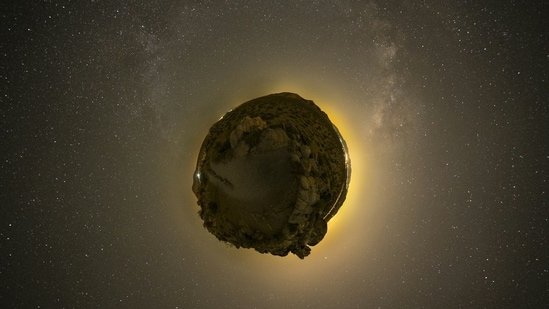
What does the quasi-moon look like? China’s Tianwen-2 spacecraft captures Earth’s elusive companion for the first time

China has released the first image of Kamo’Aleva, the mysterious asteroid often referred to as Earth’s ‘almost moon“This image gives the public the first up-close look at one of Earth’s most unusual celestial companions.

The image was taken by China’s Tianwen-2 spacecraft, which is currently on a landmark sample return mission to the asteroid that is expected to reshape scientists’ understanding of near-Earth objects and the early solar system.
Tianwen-2 will be launched in May 2026 and is expected to rendezvous with Kamoalewa in mid-2027. The spacecraft will collect samples from the asteroid and bring them back to Earth in 2029. It will then continue on an extended mission to comet 311P/PANSTARRS.
What does Earth’s quasi-moon look like?
Although Kamo’Aleva is nicknamed a “quasi-moon,” it is not an actual moon orbiting the Earth. Instead, it follows the sun while moving in a stable orbital pattern that brings it relatively close to the Earth over an extended period of time
The new photo was taken on July 2, according to China’s Xinhua News Agency.
The image shows Kamo’Aleva as a small, dim object in the darkness of space. Images show the asteroid is a tiny, uneven rock about 50-65 feet (16-20 meters) in diameter. Scientists say the asteroid is still millions of kilometers away from Tianwen-2, so it appears to be just a faint point of light.
Although the origin of this quasi-satellite is unknown, some scientists speculate that it may have formed between 1 and 10 million years ago when a massive impact propelled part of our moon into space.
Astronomers first discovered Kamaoalewa in 2016 using the Pan-STARRS telescope in Hawaii. The asteroid orbits the Sun in almost the same amount of time as Earth, giving the illusion that it is orbiting the Earth, but in reality it is still gravitationally bound by the Sun.
Also read: Astronomers discover giant ring system causing star’s rare nine-month dimming
Scientists hope samples will solve mystery
The goal of the Tianwen-2 mission is to collect material without significantly disturbing the asteroid. Because Kamo’Aleva’s weak gravity makes landing and sample collection particularly challenging, mission planners developed a variety of sampling techniques.
Engineers will decide the safest approach after carefully mapping the asteroid’s surface.
Researchers are particularly interested in whether Kamaualeva originated on the moon. These samples have yielded unexpected scientific discoveries, such as the presence of amino acids thought to be critical to life on Earth.
If successful, Tianwen-2 will be China’s first asteroid sample return mission and the latest in a growing international effort to study primitive solar system objects.