
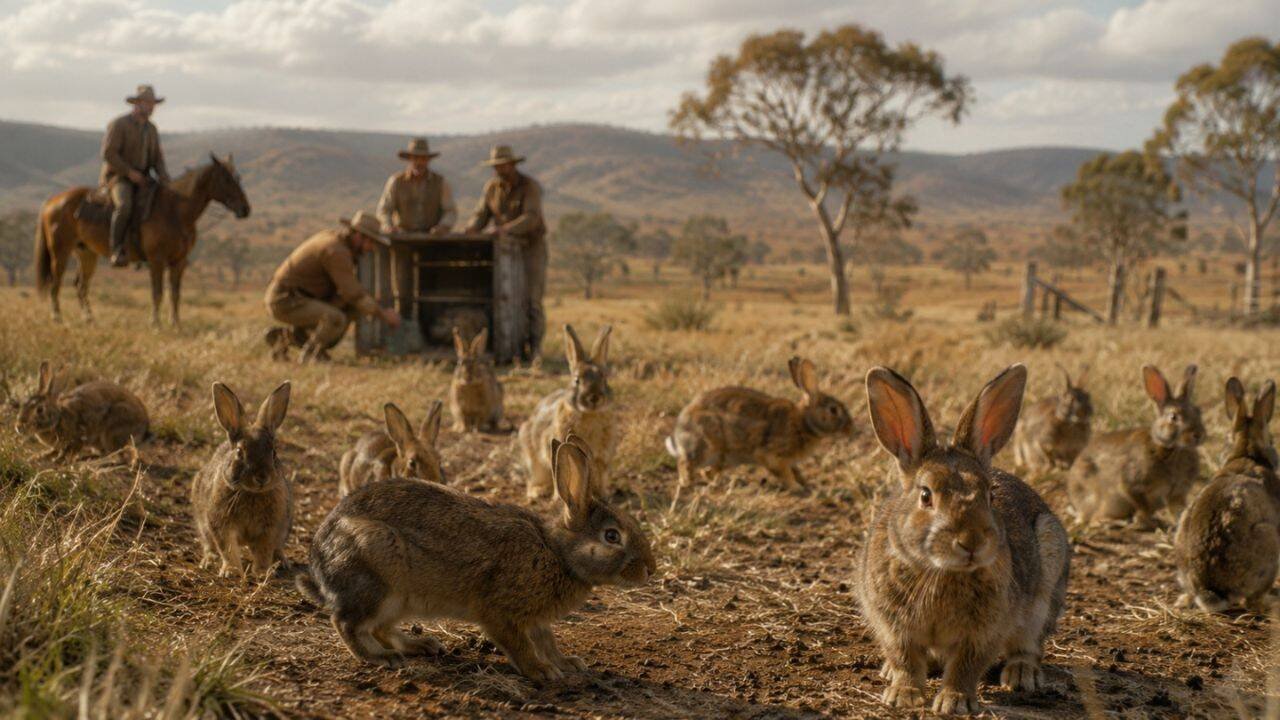
When European rabbits arrived in Australia in the 19th century, they were introduced as common hunting animals, not as a threat to the environment. Within decades, however, their populations exploded across the continent. With few natural enemies and a wide range of adaptations, rabbits’ habitats extend from farmland to forests, grasslands and arid interior areas. Their increasing numbers are beginning to put pressure on native plants, agricultural lands and fragile ecosystems. What started as a small release of imported animals became one of Australia’s most challenging invasive species problems, forcing scientists and governments to find ways to limit their impact.
How 13 rabbits released for hunting became Australia’s biggest invasive species problem
According to National Geographic, the story begins in 1859 when Thomas Austin, a wealthy landowner in Victoria, imported European hares for hunting. He kept 13 rabbits on his property in the hope that they would provide a source of exercise for himself and his guests.Rabbits are reproducing far faster than expected. Australia’s climate and open landscapes provided favorable conditions, while the absence of many predators in Europe allowed their populations to grow rapidly. Within about five years, rabbits had spread across much of the continent.By the early 20th century, large rabbit colonies were common in many areas. Their burrows cover farmland, and their continued grazing reduces the amount of vegetation available to native animals and livestock.
Why Rabbits Become So Uncontrollable
The European rabbit is one of the most versatile mammals. The animal can live in different environments from grasslands to semi-arid areas, as long as there are enough resources and enough soil to build burrows.Management of this problem is further complicated by rabbits’ ability to reproduce. Females of this species have the ability to reproduce year-round, producing many litters each year. Additionally, each litter consists of several individuals, allowing for rapid recovery even after killing a large number of animals.As a result of these factors, Australia has a large population of these mammals. The number of hares in Australia is estimated to be in the hundreds of millions.
From farmland to forests: Damage spreads across Australia
The rabbit invasion has caused permanent changes to Australia’s ecology. Their consumption of grasses, seedlings and native vegetation creates food competition between them and native wildlife, hampering vegetation recovery.Farmers suffered considerable losses. Overgrazing causes soil erosion by wind and water. Rabbit invasion in some places has destroyed newly planted vegetation, making it impossible for native vegetation to re-establish.Their effects are not limited to plants. The reduced food sources for rabbits also affect native species that depend on these food sources. It is on these grounds that hares are classified as environmental pests in Australian conservation legislation.
Australia’s first attempt to stop rabbit invasion
Australia has tried a variety of methods to control rabbit populations. Early efforts focused on physical barriers, including large fences designed to keep rabbits out of agricultural areas.One of the most ambitious projects is the construction of a national barrier fence in Western Australia, stretching for hundreds of kilometers. Despite significant efforts, fencing alone will not solve the problem as rabbits are already widespread in many areas.Farmers also began destroying rabbit hutches, systems of underground tunnels where rabbits live and breed. In areas where land managers can effectively reach and deal with bee colonies, removing these safe breeding spaces remains one of the more practical approaches.
Altered Virus Experiment Rabbit control strategies in Australia
In the mid-20th century, scientists turned to biological control. In the 1950s, Australia released myxoma virus, a disease that affects rabbits but not most other animals.The virus caused a sharp decline in rabbit populations when it was first introduced. Over time, however, surviving rabbits develop greater resistance and the disease becomes less effective as a control method.The second major attempt was with rabbit hemorrhagic disease virus (RHDV). The disease attacks European rabbits and can quickly kill infected animals. After colonization in the wild in the 1990s, RHDV caused significant declines in rabbit populations, particularly in arid areas of Australia.The virus also faces limitations. Some rabbit populations have developed resistance, and environmental conditions affect how efficiently the disease spreads. Cooler, wetter areas are generally less affected because the insects involved in spreading the virus are less active.
From poison to prevention: evolving rabbit control efforts in Australia
In addition to biotechnology, poisons are also used to reduce rabbit populations. Because this technique is so effective at controlling rabbit populations, chemicals such as sodium fluoroacetate have been used in some cases.There are other methods of fumigating burrows with gas to kill rabbits living in the burrows. These types of control measures are mostly used in specific areas but not nationwide.Scientists continue to explore other ways to control rabbit populations. This is due to the rapid reproduction rate of rabbits and their adaptability to control measures.
Problems that still exist decades later
More than 160 years after the first rabbits were released, Australia is still dealing with the consequences of introduced rabbits. These animals, which once came here as hunting companions, have become one of the most persistent invasive species in the country.Controlling them completely has proven impossible, but continued research and management can help reduce their impact in some areas. The challenge now is to maintain a balance between protecting Australia’s unique ecosystems and managing species that are already entrenched in the land.