
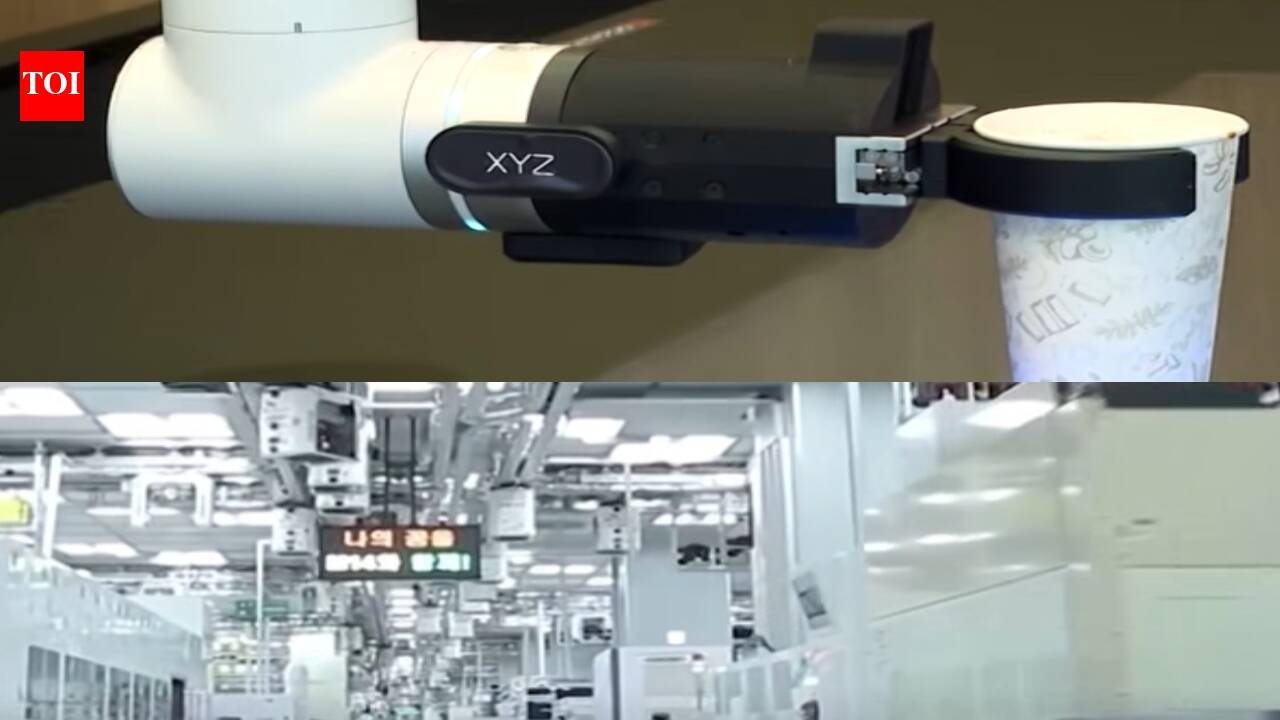
Artificial intelligence and robots are becoming part of daily life in South Korea. Families are using AI to recreate deceased loved ones, robot baristas serve coffee without human service, semiconductor engineers have become among the most in-demand professionals in the country, and students are reshaping their career options around AI. Seoul, meanwhile, is pouring trillions of won into chip, robotics and artificial intelligence infrastructure in a bid to become a global leader.
How artificial intelligence is reshaping society
Helping families hear the voices of their lost loved ones againOne of the most emotionally significant uses of artificial intelligence in South Korea is helping families reconnect with loved ones who have passed away. Startups such as Seoul-based Vaice can create realistic videos of deceased parents and grandparents using only a handful of photos and brief audio recordings, the Associated Press reported. Clients often write personalized scripts for AI avatars to convey messages of love, apology or encouragement at family gatherings and memorial ceremonies.The service is reaching a growing audience, especially those in their 40s and 50s who want to preserve the memory of their parents or surprise family members with a message from a loved one they miss deeply. A basic three- to five-minute video costs about 600,000 won (about $390).One customer, Lee Geon Hui, commissioned an AI video of his grandfather (who died before Lee was born) as a gift for his father. The digital game left Lee’s father in tears as he apologized for past regrets and told his son he was proud of him.While many users describe the experience as comforting, experts say the technology sits at the intersection of memory, grief and morality. “It’s a double-edged sword because it involves human emotions,” said Yong Man Ro of the Korea Advanced Institute of Science and Technology, warning that AI is creating experiences that society has never encountered before.Artificial Intelligence boom is redefining careers and even the marriage marketA global race for artificial intelligence has transformed semiconductor workers into South Korea’s most sought-after professionals. Samsung Electronics Co. and SK Hynix, whose advanced memory chips power artificial intelligence systems around the world, are increasingly viewed as equals to doctors and lawyers thanks to soaring salaries, generous bonuses and strong job security.Matchmaking agencies say the industry’s social status has changed dramatically in just a few years. According to Reuters, Son Dong-gyu, CEO of matchmaking agency Bien Aller, said: “If employees of SK Hynix and Samsung Electronics were classified as B+ or A-level candidates in the past, now they are closer to A+.”This shift is also affecting education. Universities report that demand for semiconductor engineering courses is at an all-time high, while vocational high schools that send graduates directly to chip factories are growing in popularity. Career counselors say competition for AI-related jobs is now similar to South Korea’s notoriously competitive competition for college admissions.Students believe stability is a key attraction amid rising youth unemployment. “Compared to my friends, I feel relatively secure about my job prospects,” said Koo Bon-ho, a semiconductor major at Korea University.Robot baristas and unmanned stores become part of daily lifeThere are several cafes in South Korea without baristas, ramen shops without chefs, flower shops without cashiers, and convenience stores with no employees at all.According to Reuters, thousands of autonomous businesses have emerged as owners turn to robots, artificial intelligence-driven ordering systems and self-service technology to cope with labor shortages and rising wage costs. For example, LoungeBusiness owners say the model works because South Korea has relatively low petty crime rates and customers generally follow the rules.Economics is also compelling. According to Lounge“The number of baristas in their early twenties is declining sharply,” said Lounge X CEO Kim Dongjin, noting that demographic pressure makes automation increasingly necessary.Coping with population aging?Behind many AI-driven changes lie deeper demographic challenges. South Korea has one of the lowest birth rates in the world and one of the fastest aging populations, causing severe labor shortages in various industries.Government forecasts suggest the country’s population could shrink from the current 51.8 million to around 36.2 million by 2072, making automation increasingly important to sustaining economic growth.For many business owners, artificial intelligence and robotics are no longer optional upgrades but practical solutions. Operators of cashless restaurants say automation allows them to balance childcare or other responsibilities while running their businesses without having to recruit increasingly scarce workers.Customers are adapting quickly, too. Some say they even prefer the quieter atmosphere of unmanned stores, arguing that occasional technical glitches are a reasonable trade-off for convenience and 24-hour operation.national economic strategyArtificial intelligence is now at the heart of South Korea’s long-term economic planning. The government recently unveiled three major AI plans, covering semiconductors, physical AI, and AI data centers, and they are backed by some of the country’s largest companies.Samsung Electronics announced hundreds of trillions of won in semiconductor investment plans, while SK Group outlined massive long-term spending on chip production and artificial intelligence infrastructure. At the same time, SK, Naver and GS Group plan to jointly develop an artificial intelligence data center that can support the country’s next-generation computing needs.In addition to infrastructure, Seoul also hopes to cultivate talent, announcing plans to train 10,000 AI robotics experts within five years, while supporting the development of South Korea’s basic AI models and expanding robot manufacturing.The goal is not just to adopt AI technology, but to position South Korea as one of the world’s leading AI powers.The humanoid revolutionSouth Korea’s AI ambitions extend far beyond software. The government aims to become one of the world’s top three artificial intelligence robot powers by 2030, with plans to commercialize humanoid robots customized for major industries. Goldman Sachs research shows the country already has several structural advantages. Its globally competitive automotive supply chain produces electric motors, sensors and precision components very similar to the actuators needed for humanoid robots. Korean companies have also become major suppliers of robotic hardware outside of China.It is estimated that by 2035, Korean companies will account for about 30% of global humanoid robot production, either by manufacturing robots or supplying key components.The report also highlights South Korea’s status as the world’s most robot-intensive manufacturing economy and its strong culture of early technology adoption, both of which can accelerate deployment.Biggest challenge: dataDespite rapid progress, experts say humanoid robots still struggle with basic real-world reasoning because they lack enough physical training data.Goldman Sachs sees a lack of real-world experience as the industry’s biggest bottleneck, noting that robots can only improve by interacting with their environment. China currently has an advantage because it has deployed 10,000-15,000 humanoid robots, while the United States and South Korea only have a few hundred.“The bottleneck remains the scarcity of physical AI training data,” analyst Do Hyoung Kim wrote. He believes wider deployment will create a self-reinforcing cycle in which more robots generate more data, leading to robots becoming smarter.From temples to fashion shows, humanoid robots find new roleHumanoid robots are starting to appear in spaces once thought to be exclusively human, from places of worship to cultural events. Ahead of the Buddha’s birthday last month, a 130-centimeter-tall humanoid robot named Gabi participated in a Buddhist ordination ceremony at Jogyesa Temple in Seoul, the first of its kind in South Korea. When asked if it would abide by the teachings of the Buddha, the robot, wearing traditional robes, bowed before monks and nuns and replied: “Yes, I will dedicate myself.” The ceremony marked the first time a non-human has officially participated in the ceremony in the country.Then, at a Seoul fashion show in late May, humanoid robots took to the catwalk alongside real models, wearing custom clothes ranging from cowboy-style suits to futuristic designs. Organizers said the event explored how humans and robots can coexist and argued that robots, like humans, should have their own identity. The appearances reflect a broader shift in South Korea, where humanoid robots are increasingly being shown not just as industrial machines but as participants in religion, culture and entertainment.