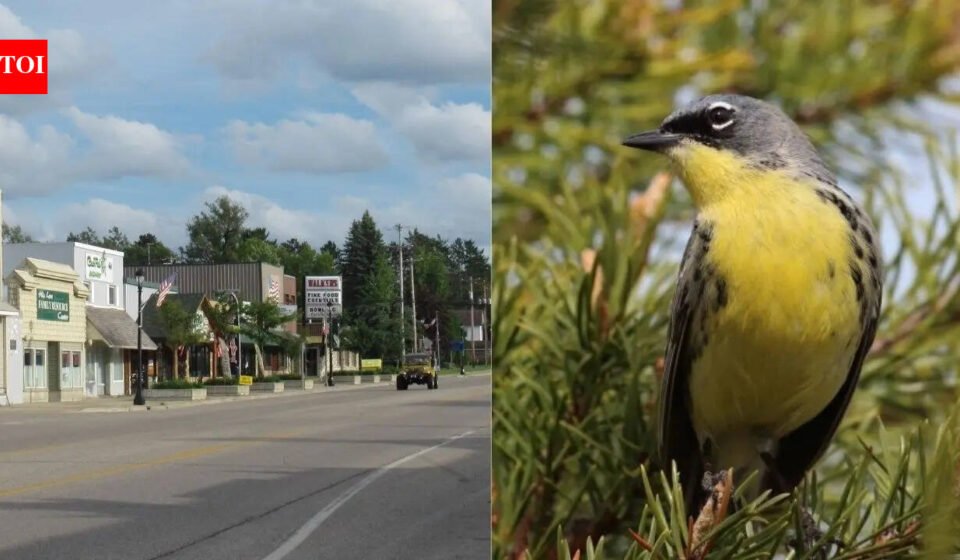

At first glance, Mio looks like any of the countless other small towns scattered across rural America. Less than 2,000 people live here, surrounded by forests and quiet roads. Yet this humble community in northern Michigan became the center of one of the greatest conservation successes in modern history. Fifty years ago, the Kirtland’s warbler was on the verge of extinction, with only 167 male warblers left in the wild. Today, the bird is recovering in numbers that experts say are almost impossible. The transformation began in and around Mio, where decades of determined habitat restoration helped save the entire species.
The crisis behind Michigan’s wildlife miracles
The Kirtland’s warbler is different from most birds. While many species can adapt to different environments, this small, grayish-yellow songbird is very picky about where it breeds. It nests almost exclusively in forests of young jack pine trees, 5 to 20 years old.Wildfires have naturally created these habitats over centuries. The fires burned older trees, allowing new stands of shortleaf pine to grow. This cycle ensures a steady supply of nesting sites for birds. When fire suppression became common in Michigan’s forests, that balance began to change.As fires decline, so do young jack pine forests. Existing trees continue to age and suitable habitat is lost.By the early 1970s, the situation had become alarming.A 1974 survey showed that only 167 male Kirtland’s warblers could sing. The numbers are so low that many conservationists fear the species could disappear within a generation.The bird already received federal protection under the earlier Endangered Species Act. However, protecting the bird is not enough. The real problem is the loss of the habitat on which it depends.Without significant intervention, the outlook is bleak.The forests surrounding Mio contain most of the remaining habitat used by the warbler. This makes the town a base for nature conservation efforts.Wildlife agencies and forestry experts have developed a long-term plan to recreate the conditions that once produced natural fires. Rather than waiting for wildfires to happen, they actively manage the landscape.Forest areas were cleared and replanted. New stands of jack pine are created in a continuous cycle so that there is always suitable habitat somewhere in the area.This strategy requires patience. The trees take several years to mature and the work must continue year after year.
rebuild habitat
Over time, the program expanded into one of the largest habitat restoration projects in the country.Today, approximately 76,000 hectares of land are managed specifically for the Kirtland’s warbler. Forest managers imitate the natural processes that once shaped ecosystems through cutting, replanting and controlled burning.Conservationists also address another threat. Brown-headed cowbirds often lay their eggs in warbler nests, which reduces reproductive success. Controlling cowbird populations helps more warbler chicks survive.Together, these measures provide the species with an opportunity to recover.
A comeback few expected
The results are outstanding.In 1974, there were only 167 singing men, and the population grew steadily over the following decades. Eventually, the total number of birds exceeded 4,500.This restoration serves as one of the most powerful examples of how habitat restoration can reverse seemingly hopeless decline.In 2019, the Kirtland’s warbler was officially removed from the U.S. endangered species list. This is a milestone that once seemed unattainable.
The work is not over yet
This success story comes with an important caveat.Kirtland’s warbler remains dependent on active habitat management. Young jack pine forests don’t stay young forever. Without ongoing intervention, trees will mature past the stage suitable for nesting.Experts estimate that much of the habitat could be lost within decades if management ceases.That means the bird’s future remains closely tied to the effort to bring it back.
Lessons on what conservation can achieve
The recovery of the Kirtland’s warbler shows what can happen when conservation focuses on solving the underlying problem rather than treating the symptoms.Scientists and land managers no longer focus solely on the bird, but on restoring the ecosystem it needs to survive. This approach took decades of hard work, but it got results.Today, Mio’s role in the story reminds us that even a small town can have a huge impact. Despite the odds, it saved a species that many thought was doomed to extinction.