
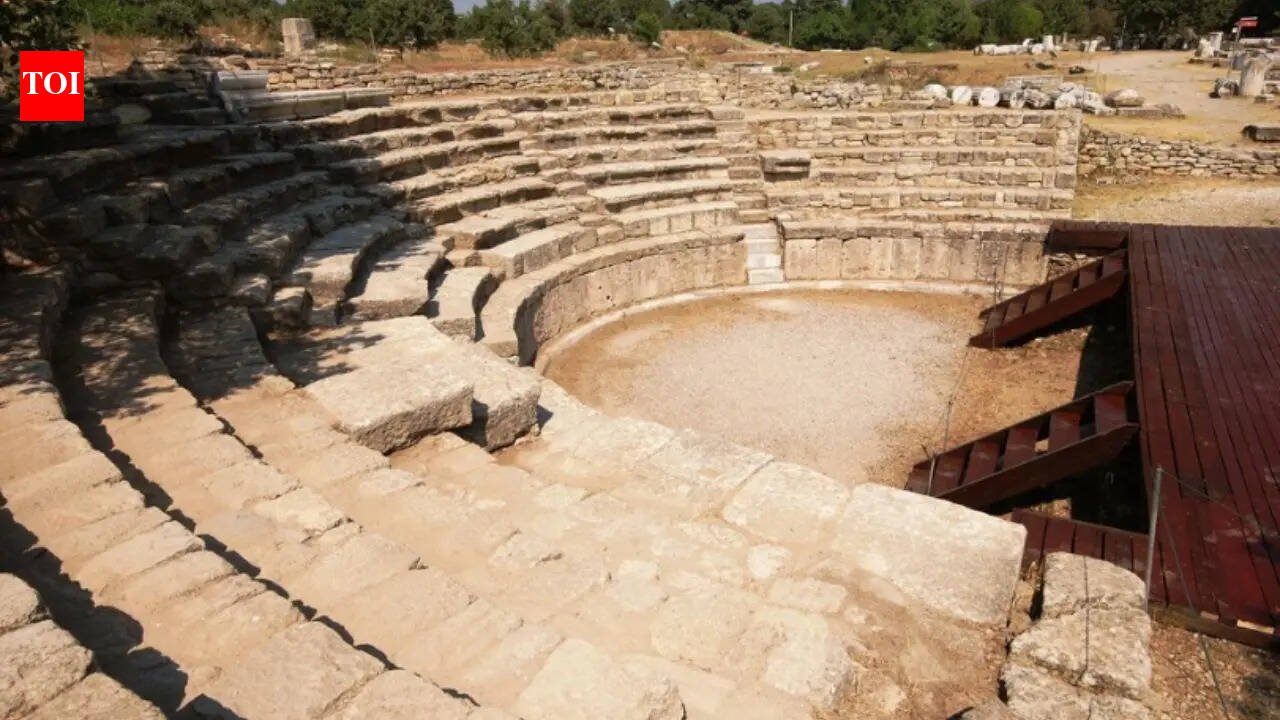
The landscape surrounding Troy does not immediately suggest an ancient city preserved in isolation. The ground rises gradually at Hisarlik, a mound formed more by repeated human occupation than by natural formation. Stone walls appear next to crumbling foundations from an entirely different era. Some parts of the earth contain traces of settlements separated by centuries. What survives today is the result of continual reconstruction over a long history, not the remains of a civilization frozen in time.The archaeological site represents over 4,000 years of human habitation. The mound preserves evidence of several major settlement phases that overlapped one another, creating an unusually dense historical record in northwestern Türkiye near the Dardanelles Strait.
how Troy ancient city Become a layered archaeological site
Troy expands through accumulation. The early settlements did not completely disappear when later communities arrived. Buildings collapsed, walls were buried, fires left ruins, and new buildings gradually rose above the ruins. Over generations, the ground level continued to rise, turning the settlement into layered mounds.It is reported UNESCO World Heritage Sitethe site contains “several layers of settlement,” each reflecting a different historical stage. Over time, the houses, walls and public spaces changed, with earlier structures being buried under later construction. Some layers reveal defensive sections with defensive walls, while others preserve traces of domestic life and the changing urban layout. The site leaves a mixed impression. One area may belong to a Bronze Age settlement, while nearby remains point to a later period. Time is compressed in the same landscape.
Strategic location to keep the ancient city of Troy alive
Troy’s location partly explains its longevity. The settlement is close to the routes connecting the Aegean Sea to the interior and the waterways around the Dardanelles. Movement through this region has been of commercial and military importance for centuries.According to the UNESCO report, the site occupies a position that “controls the Dardanelles” and helps explain why settlements from different civilizations and historical periods persist. Even after decline or destruction, geography itself remains useful enough for later population returns. This continuity is visible archaeologically. Troy was not an isolated historical moment but developed through cycles of reconstruction shaped by changing social and regional influences.
The ancient city of Troy reveals a changing civilization over the centuries
Public attention often focuses on the connection between Troy and the ancient epic tradition, particularly the story associated with Homer. However, the archaeological significance of the site goes far beyond literary interpretation.Troy is reported to be of “considerable scientific importance” because of the long cultural sequence preserved within the mound. These remains provide evidence of changes in settlement patterns, architectural styles and urban organization over thousands of years. Some levels suggest times of prosperity and expansion. Others indicate destruction followed by reconstruction. Transitions aren’t always clean or easy to separate. This complexity is part of what makes this site unique.
Troy’s ancient walls reveal city rebuilt over generations
The visible ruins of Troy represent only a part of the settlement’s history. Much of its importance lies beneath the surface, built up over time through successive careers. Each generation slightly altered the site, leaving behind fragments that were later buried under new construction.According to the UNESCO report, the Troy ruins record multiple periods of “continuous habitation.” Walls from different centuries are now closely connected, as later settlements reused and built on the earlier foundations rather than clearing them entirely. Today’s website reflects this long-term continuity. Walls from different centuries are closely connected, sometimes overlapping and sometimes separated only by thin layers of earth. The result feels less like a single ruined city and more like a stacked history of human habitation that gradually blends into the landscape itself.