
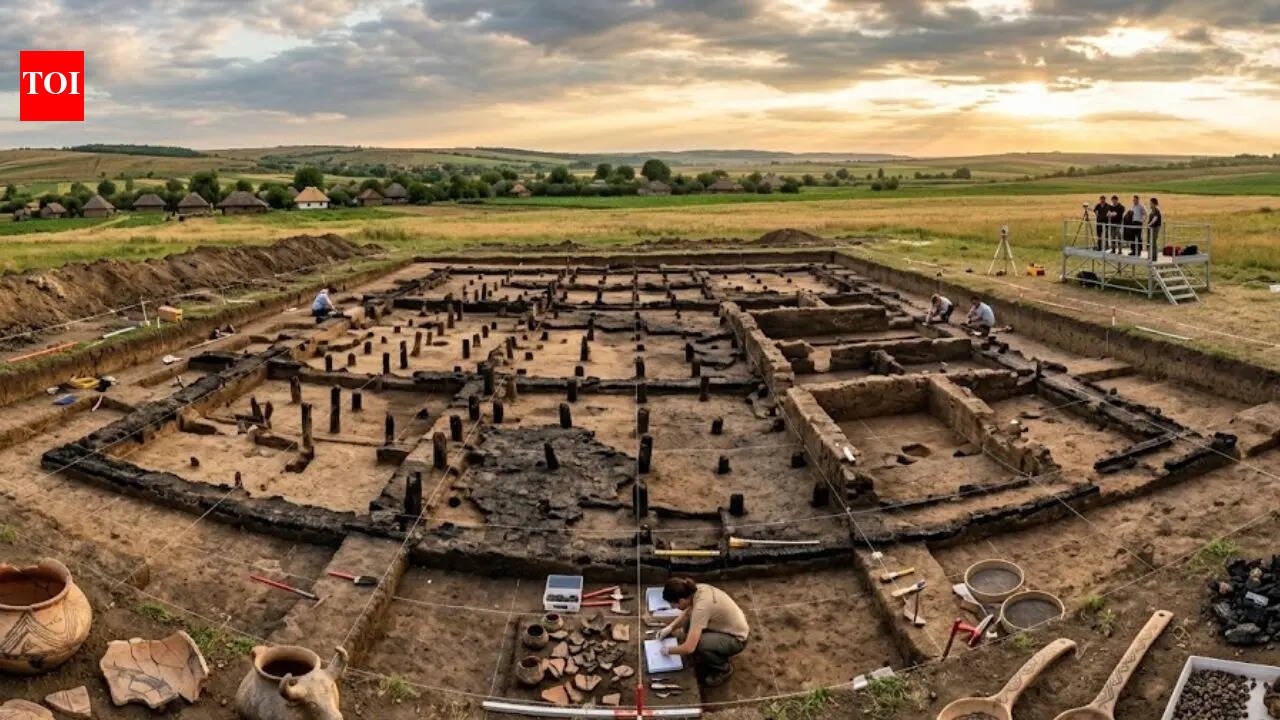
In Botosani County, Romania, a team of archaeologists discovered a massive megastructure dating back 6,000 years. The discovery challenges our fundamental ideas about how human societies develop. According to a study published in PLOS One, the structure is related to the Cucuteni-Trypillia culture from around 4000 to 3900 BC and covers an area of approximately 350 square meters. This was nearly four times the size of a standard residence of the period. Unlike later grand monuments, this site shows no signs of elite wealth or central leadership. It shows that prehistoric Europeans implemented large engineering projects through community efforts rather than orders from rulers. The discovery at Stăuceni-‘Holm’ is changing our view of prehistoric Europe. It proves that complex architecture can exist without complex stratified social classes.
Scientists stunned by Romania’s hidden 6,000-year-old megastructure
The building known as “Building 43” is an unusual architectural feature of the Late Bronze Age (specifically the Cucuteni B1 phase). As noted in a study published in the journal Science, its dimensions are approximately 13 x 27 meters, with a total area of nearly 350 square meters. PLOS One. Research shows that people used complex wood construction techniques and large amounts of clay (daub) to build it. Building materials required hundreds of tons of clay and wood, indicating a massive collective effort by the community that far exceeded the needs of a typical house in the settlement.
Why the Cucuteni-Tripilia culture burned their houses
The research team carried out geomagnetic surveys and micromorphological analysis. They discovered that the megastructure was divided into internal compartments. An important discovery was evidence of “intentional firing.” Building 43, like many other buildings of the Cucuteni-Tripilia culture, was deliberately burned down at the end of its use. Scientists have found that temperatures in some areas have reached over 800 degrees Celsius. This suggests that the burning was likely a planned ritual rather than an accident or act of war.
Researchers discover henbane and poppy seeds
Excavations of the footprints and foundation layers revealed some rare pottery. These include an animal-shaped container and intricately designed ladles. What’s more, researchers discovered the charred seeds of black henbane and poppy through detailed analysis. The discovery of these psychoactive plant remains in a large public area suggests that the structure functioned as a “social center” or “ceremonial center.”Here, people may come together to share experiences that may involve altered states of consciousness.
No luxury goods found
The study, published in PLOS One, highlights an interesting point about the site’s equality. Although the building was large, it did not contain any of the luxuries typically found in the homes of kings or chiefs, such as gold, copper, or rare imported items. This information shows that the people of Stousini were a complex society without a single leader in charge. This massive structure served as a “community center,” demonstrating that ancient Europeans were able to achieve impressive feats of engineering through social cooperation rather than coercive authority.