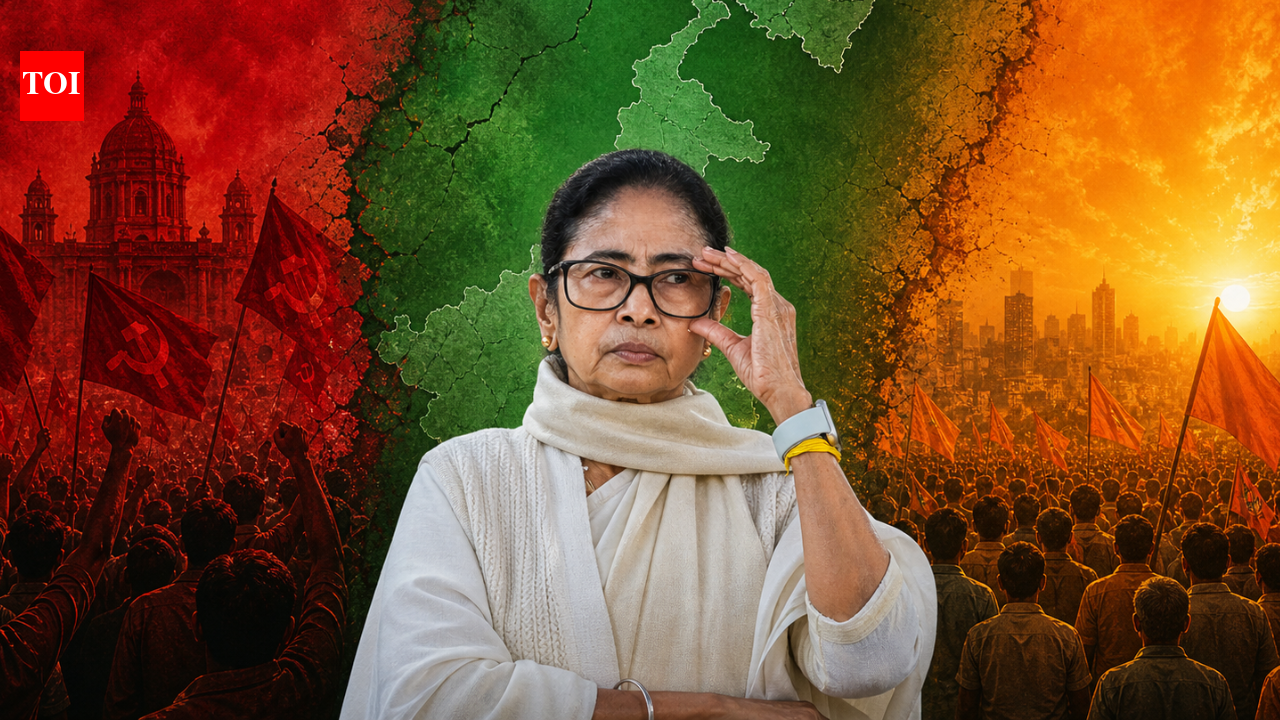

New Delhi: The Bengali ‘manush’ has historically shown deep-rooted political loyalty, often uniting decisively behind a single political force and allowing it to stay in power for long periods of time. In the nearly eight years since Independence, West Bengal’s political journey has been not just a series of governments changing hands, but a story shaped by clear dominant eras, each marked by ideological convictions and long-standing mandates.However, the 2026 parliamentary elections have breathed new life into this legacy. What is unfolding is not just another electoral contest but a high-stakes, high-voltage battle between long-serving chief ministers Mamata Banerjee and a determined, aggressively expanding Bharatiya Janata Party brigade.
Didi’s 15-year reign now faces its toughest challenge yet. this bjp launched a ruthless, bottom-up campaign, deployed top leadership and intensified Trinamool Congress. The saffron party high command even asserted that “the sun has set on the TMC in Bengal”.But to understand the weight of the BJP’s claims, the story of how Bengal’s political course evolved must be told.
congress The Times: Power Bases and Post-Partition Reconstruction
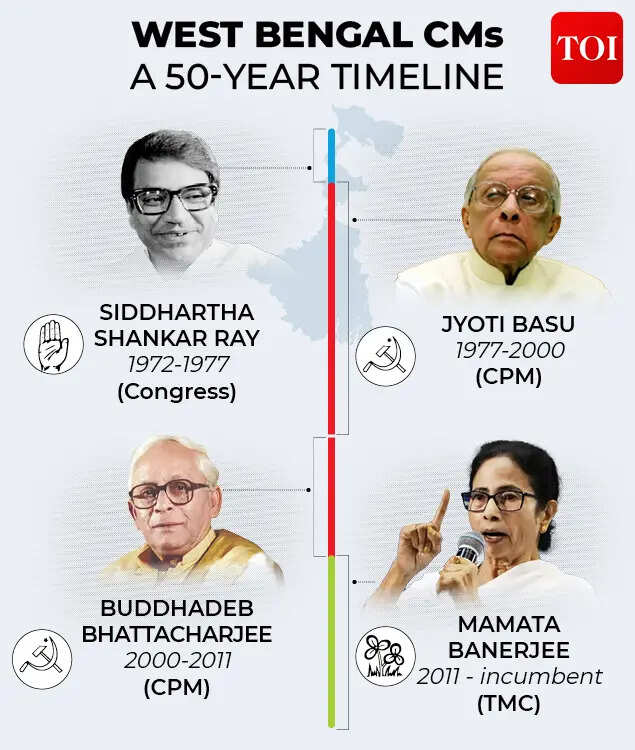
Like most states in newly independent India, Bengal’s early political leadership was shaped by the Congress Party. Bidhan Chandra Roy is one of the most important icons in the history of the state, becoming its first chief minister in 1947 at a time when Bengal was suffering the devastating effects of the partition of India and Pakistan.Bidhan Chandra’s leadership extends beyond day-to-day governance. He played a vital role in stabilizing the divided society and laid the foundation for the administrative and infrastructural framework of modern Bengal. One of his lasting contributions was the development of Salt Lake City, a planned town that symbolized forward-thinking urbanism.Calcutta (later Calcutta) was not only the state capital but also the political nerve center of the Congress party. Over the decades, the city hosted several landmark party conferences and became the stage for decisive moments in India’s freedom struggle and political evolution. From the first singing of ‘Vande Mataram’ to the pronunciation of ‘Swaraj’, Bengal has always been at the heart of the Congress.However, the dominance of the Congress party gradually began to weaken. Internal divisions, shifting political demands and instability at the national level have weakened its grip. The emergence of the major party in Bangladesh marked the first serious break in its monopoly, introducing coalition politics and opening the door to alternative ideologies.The deaths of prominent national leaders such as Jawaharlal Nehru and Lal Bahadur Shastri further shook the party’s structure and its influence. The 1967 elections, often called a “political earthquake”, dealt a decisive blow to the Congress hegemony in Bengal.
Red Era: Rise and Consolidation left dominance
Although Indira Gandhi strengthened her political authority at the national level, especially after the 1971 electoral victory and the Indo-Pak war, Bengal was moving in a different direction.The Congress party continues to lose ground in the state, with its last chief minister so far, Siddhartha Shankar Ray, representing the end of an era. This political vacuum was quickly filled by the Left Front, which came to power in 1977 with strong grassroots mobilization capabilities and a clear ideology.The central figure in this transformation was Jyoti Basu, a prominent Marxist leader who went on to become one of India’s longest-serving chief ministers. Under his leadership, Bengal witnessed a profound reorganization of rural and administrative systems.Key initiatives such as Operation Barga redefined land relations by strengthening the rights of tenant farmers, while the institutionalization of the Panchayati Raj system in 1978 decentralized governance and empowered local bodies. These reforms gave the left a lasting political foundation.The Left Front ruled Bangladesh uninterruptedly from 1977 to 2011, one of the longest consecutive terms of an elected communist government in the world. In 2000, Basu resigned due to health reasons and handed over the baton to Comrade Buddhadeb Bhattacharjee. Despite Bhattacharjee’s attempts to recalibrate the left’s image with a focus on industrialization, reality has begun to change. Discontent is brewing and new political forces under Mamata Banerjee are gathering momentum.
Mamata Moment: Subversion and Dominance
Mamata emerged as the new strong leader of the country.Mamata emerged as a fierce and ruthless challenger, dismantling the left’s decades-long dominance in the 2011 parliamentary elections. She led the Trinamool Congress to an overwhelming mandate of 184 seats and became Bengal’s first female chief minister.
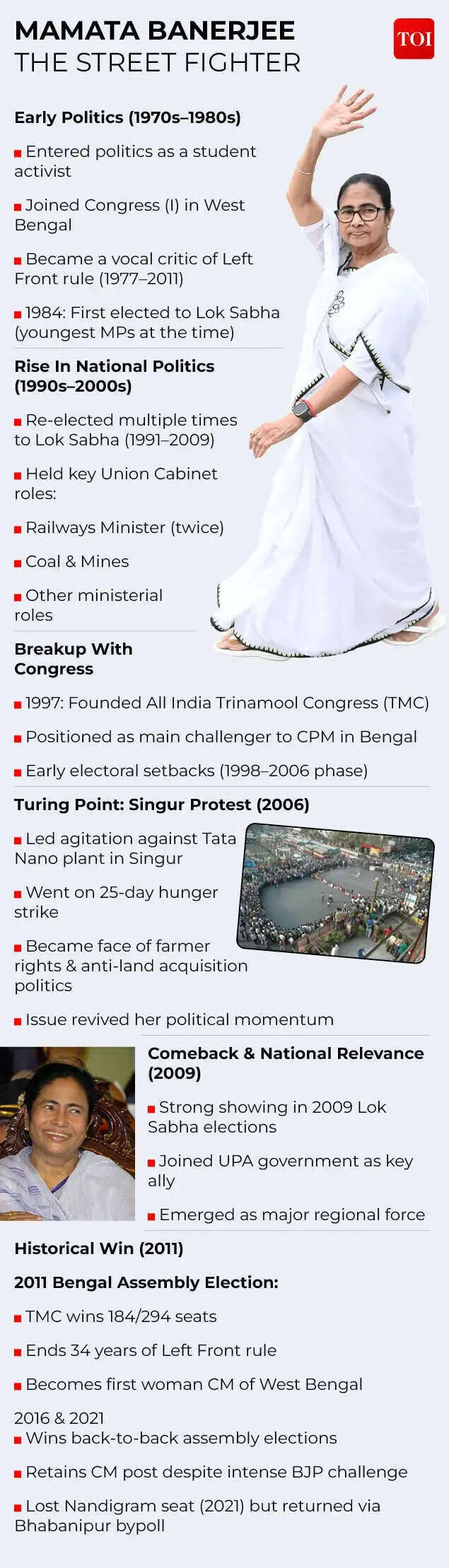
Her victory marked not just a change of government but a complete political reset. The Congress and the Left, once the major forces in the state, have now been pushed to the margins.
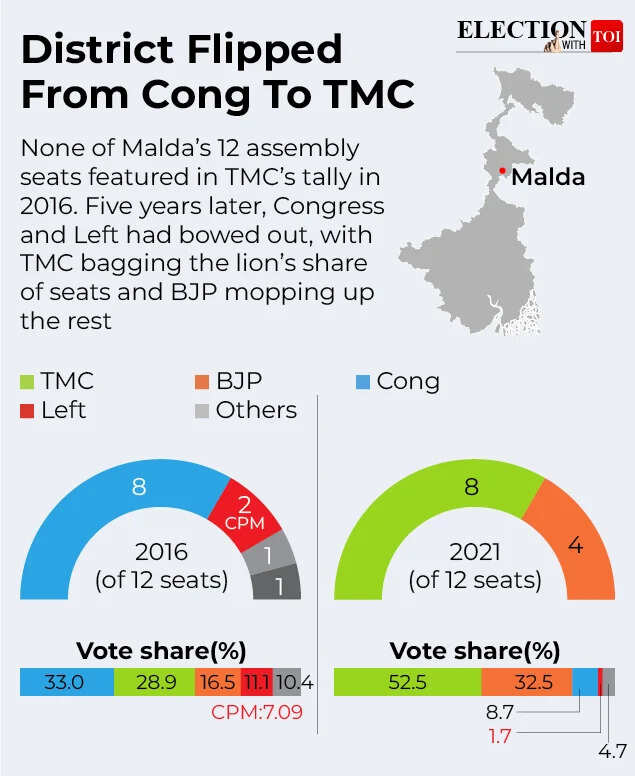
The BJP, despite having earlier been in power at the Center for nearly six years under the leadership of Atal Bihari Vajpayee, was then still an insignificant player in Bengali politics.In 2016, Mamata further strengthened her hold and returned to power with greater powers, crossing the 200-seat mark. At this stage, her dominance appears unchallenged and the opposition is fragmented and struggling to regain influence.Her style of governance, welfare outreach and close personal connect with the electorate ensured that the Trinamool Congress remained the central pole of Bengali politics.
The rise of the Bharatiya Janata Party: from fringe to power
In 2021, the political balance began to shift dramatically.The Bharatiya Janata Party has launched an unprecedented campaign in Bengal, led by its star Prime Minister Narendra Modi and Union Home Minister Amit Shah, who is also seen as the “Chanakya” of the saffron party. Its scale, intensity and resources deployed signaled a new phase in the state’s electoral politics.While Didi remains in power, the BJP’s performance marks a major breakthrough. The party won 77 seats in the 294-member parliament, surpassing the Congress and the Left to become the main opposition party.
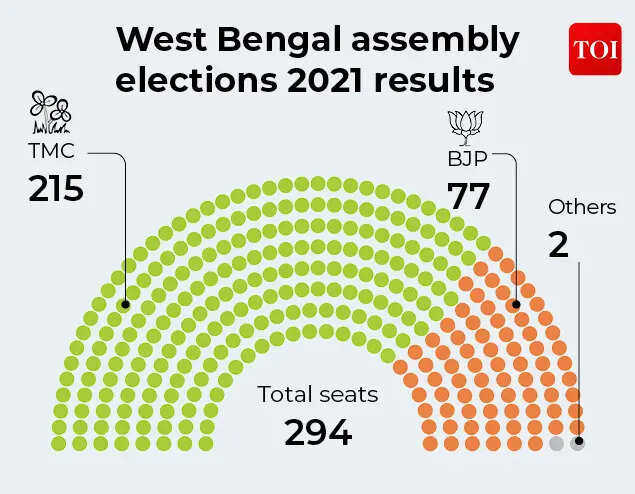
In fact, the strong rise of the BJP has pushed the Congress and the Left to the brink of irrelevance.This rise is not only quantitatively significant but also symbolically significant. The party that once struggled in Bengal elections is now positioning itself as the main challenger to the ruling dispensation led by TMC supremo Mamata.
Showdown in 2026: Continuity or Change?
Now, with Bengal recording one of its highest ever voter turnouts and witnessing an intense, high-decibel campaign, the stakes have never been higher.Is the country signaling a shift? Has the “sun set on TMC in Bengal”, as the BJP leadership claims?Conventional wisdom about high turnout has also been interpreted as an undercurrent against the incumbent.The contest has taken on an increasingly bipolar nature, squeezing out other political players and turning the election into a direct showdown between the Trinamool Congress and the Bharatiya Janata Party.Buoyed by its victory in the 2021 general elections, the BJP has upped the ante and even fielded heavyweight candidates in traditional TMC bastions like Bhowanipur and other constituencies in south Bengal. As a clear message – no seat is ceded without a fight.Several pollsters also gave the BJP an advantage over Mamata’s TMC in their exit poll predictions. This may be the first sign that Didi is feeling uneasy. Opinion polls predict that with the BJP taking over the TMC, the TMC will no longer be a single strong leadership force. In 2021, Mamata faced her former aide and BJP leader Suvendu Adhikari in Nandigram, suffering a rare personal defeat even as she retained power across the state.

This time, the situation seemed more complicated, and both sides launched a fierce contest in Boignepore.The election also involved extensive administrative activity, including a particularly intensive revision process, which Mamata criticized but the electoral commission defended, adding another layer of political tension.Will it continue its long tradition of supporting a dominant force, or will it write a new chapter by embracing change?The answer lies in the Bengali word “manush”.