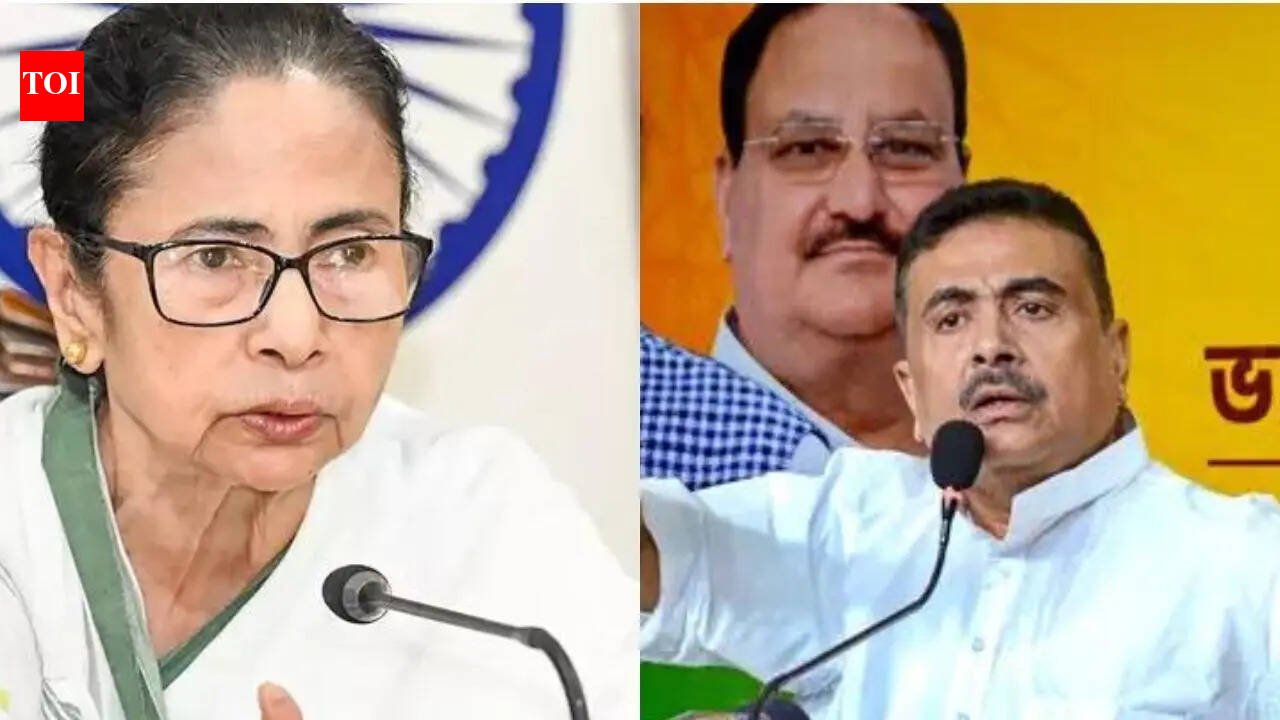

KOLKATA: The decisive match of the Bengal battlefield is being played out at Bhowanipore in south Kolkata, where CM Mamata Banerjee She will face former BJP aide Suvendu Adhikari in an election rematch that will have far greater consequences than when she narrowly lost to him in Nandigram in 2021. For the Trinamool Congress, holding Bhowanipore was not just about defending Mamata’s fort and maintaining the aura of invincibility around her. In many ways, the constituency represents the party’s clash with the BJP over larger issues of identity, ideology and governance. Even if the saffron party fails to win Bengal, the BJP’s breach of Mamata’s bastion will deal a psychological blow to Trinamool. The social fabric of the constituency makes it an exceptionally sensitive polling area. These include the so-called Bengali Badralok families, Marwari and Gujarati business families, Sikh and Jain residents, settlers from Bihar and Orissa and a sizeable Muslim electorate. “This diversity has turned this seat into a laboratory of competing political approaches,” said Ashim Bose, the Trinamool’s ward 70 MP who faces the challenge of turning last year’s Lok Sabha deficit in the constituency into a lead for Mamata. The numbers explain why both sides are confident in Boignepore. CM Mamata won the 2021 by-election with a record margin of 59,000 votes. But in the 2024 Lok Sabha elections, the Trinamool’s lead in the assembly segment has shrunk to just over 8,000. The BJP leads in five of the eight constituencies, a sign that while the Trinamool has retained emotional capital, the saffron party has gained territorial depth.
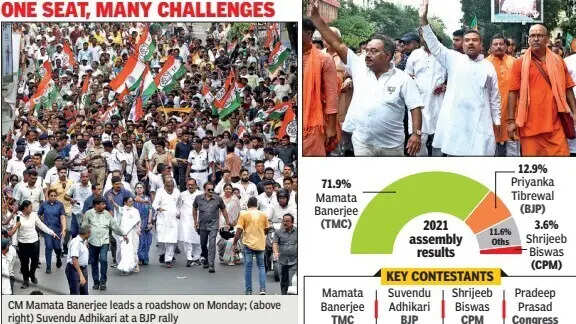
One seat, many challenges
Mamata’s aim is to prevent Bhovanipor from turning into a fragmented social contest. Her party’s strategy relies on familiarity and emotional belonging. Its “ghorer meye” (daughter of the family) slogan aims to transform elections from a verdict on governance to a show of loyalty to one’s neighbours. Trinamool worker Subhankar Roychowdhury said: “It will be extremely challenging for us if there are other contestants in the seats.” This approach suits a constituency where coexistence is often as important as ideological mobilization. In an area populated by a mix of Bengali Hindus, non-Bengali traders and Muslims, the Trinamool’s emphasis on continuity and emotional belonging was meant to placate rather than provoke. Mamata’s appeal in these areas has long relied on welfare provision, symbolic accessibility, and her perception of protecting a pluralistic urban social order. The BJP’s strategy is the opposite. Adhikari’s poll managers sought to divide constituencies into constituent communities and transform each community into manageable electoral blocs. During the campaign, this was particularly evident in constituencies 63, 70, 71, 72 and 74, where the BJP’s recent gains demonstrated growing acceptance among non-Bengali businessmen and sections of the Hindu middle class. Muslim voters also remain central to the arithmetic. They make up a quarter of the electorate, and a cohesive minority vote in neighboring city seats could offset divisions among Hindu groups. This is why the deletion and censorship of reports in electoral rolls is important. More than 11,000 Muslim voters cast their votes in ward 77 during the SIR, which could loosen the Trinamool’s grip, said BJP worker Jayanta Ghosh. Rajan Majumdar, an octogenarian Left Front supporter, said: “Bowanipore transcends the battle of prestige by encapsulating the X factor in Bengal’s electoral calculus. Our constituencies, the mix of populations in each constituency, force both sides to test the limits of emotion, arithmetic and polarization.”