
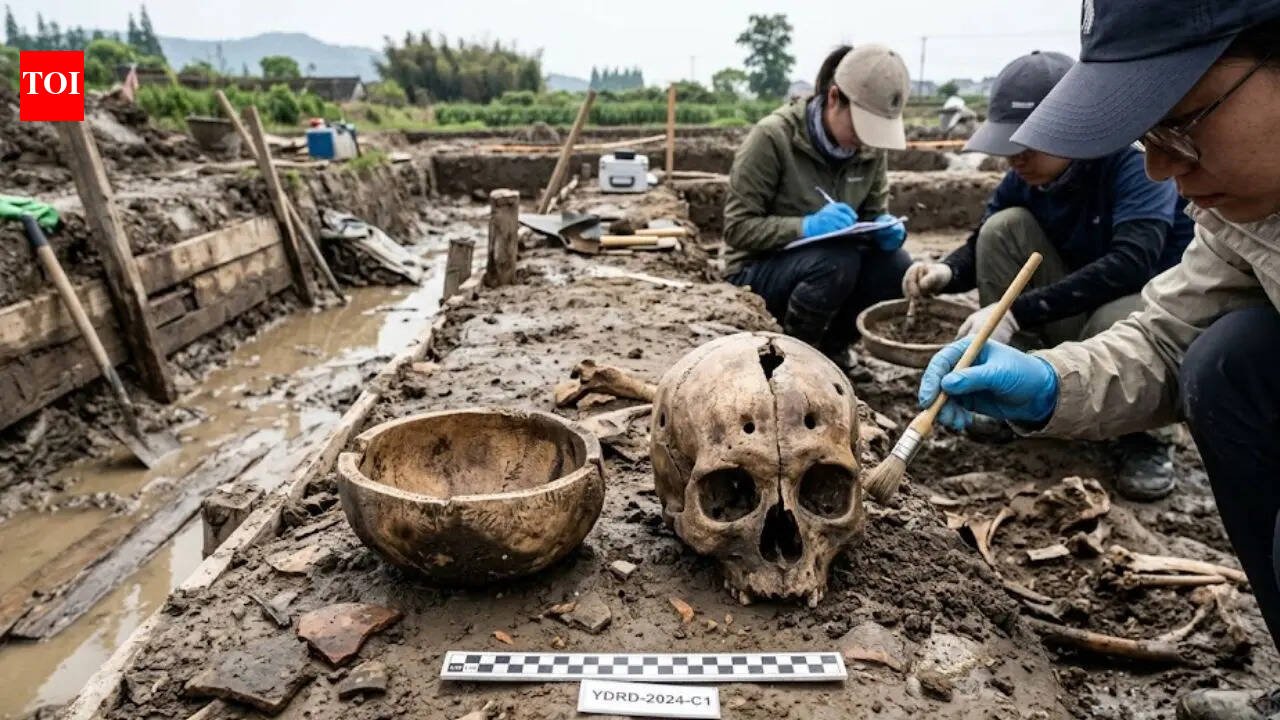
Recent archaeological excavations in China’s Yangtze River Delta have revealed the complex social and cultural practices of the Neolithic Liangzhu civilization, which dates back approximately 5,000 years. Using remains from the Zhongjiagang site, researchers found that human bones were often used as a source of functional and ritual items such as “skull cups” and “skull masks.” Unlike typical burials where the dead were respected, the bones were found in a city canal, suggesting a significant change in how early city dwellers viewed human remains.The findings, published in Scientific Reports, suggest that as Liangzhu urbanized, the remains became “raw materials” for functional purposes and symbolic artefacts, rather than being regarded as the remains of sacred ancestors.
Discoveries 5,000 years ago human bone cup and Chinese masks
The study in Scientific Reports examined 183 human bone fragments for evidence of their use as raw materials for practical or symbolic crafts. Of the total skeleton, 52 showed specific characteristics that suggested they had been intentionally modified. The cranial cup is a horizontal cut through the skull (top part of the head) and the cranial cup is a vertical cut through the skull. Both artifacts were visibly modified by scraping, drilling, and polishing, and they represent the first evidence of systematic processing of human bones in East Asian prehistory.
Why early cities recycled their dead
Researchers from Niigata University and the Zhejiang Institute of Cultural Relics and Archaeology say “anonymity” may have prompted early city dwellers to materialize human remains. In densely populated Liangzhu, urban residents only care about those they knew in life, and the social distance from the deceased has also widened due to urbanization, causing many remains to be regarded as “material” rather than sacred.
Technical analysis of bone reuse
Technical analysis also shows that the Liangzhu people used many technical methods to shape bones. Examination of the bones using high-power magnification revealed striations and indentations consistent with the stone tools used to create the bones. According to Phys.org, the bones are not only broken, but also harvested. Specifically, long bones such as femurs were shaped into handles or fasteners for tools, while skulls were shaped and processed with precision comparable to the world-famous jade carvings of Liangzhu.
Why are bone products dumped in canals?
Zhongjiagang area is a professional workshop area in Liangzhu City. These altered human bones were found along with animal bones and pottery shards in waste-filled ditches, suggesting that these particular human remains did not serve a sacred purpose, unlike the Fanshan site (an elite burial ground). The spatial distribution of human remains shows evidence of a complex social hierarchy that preserved elite remains in jade tombs while repurposing non-elite remains as part of urban industrial processes.