


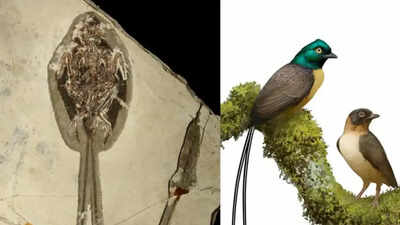
A bird that had been kept in a museum drawer for many years began to attract attention after closer inspection revealed an unusual tail structure. The fossil belongs to Plumadracobankoorum, a small bird that lived about 121 million years ago in what is now northern China. It was deposited among other bird remains before its proportions were reexamined. Its body appears to be modest in size, and its tail feathers are far beyond what is normally expected for a bird of this size, Discover magazine reports.
Ancient bird fossil reveals unexpected feather structure
The fossil belongs to a large collection of ancient bird fossils collected by Chinese museums. The fossil had not been examined for some time before the researchers decided to examine it again. This examination resulted in a closer look at the tail, where unusually long feathers were observed despite its age and deteriorating condition.Individual parts of the bird’s skeleton are not complete and may be fragments, but its feathers still preserve more information about the bird, allowing researchers to observe the details of the bird’s feather structure. Plumadracobankoorum is a pair of birds, one of the earliest birds that coexisted with non-avian dinosaurs during the Cretaceous period. This bird exhibits many different morphological characteristics and adaptations. Notably, many species of this bird had teeth, which are not seen in modern birds.The entire group of enantiornithes became extinct at the end of the Cretaceous. Their fossils are found throughout the world; in addition, fossils of this group are often well preserved in sedimentary layers containing the remains of bird feathers.
Tail Feather Proportion and Structure
The most striking feature of Plumadracobankoorum is the relative length of the tail feathers to the body. Its body size is estimated to be similar to that of a modern robin, while its tail feathers were nearly twice as long.One of the specimen’s feathers is almost completely preserved, which is rare for fossils of this age. The feather structure exhibits a narrow, elongated shape with a tapered end. Some parts appear stiffer, indicating limited flexibility in the tail section.
Fossil’s tail region unlocks key clue to emergence of early birds
Microscopic chemical traces in the feathers indicate darker pigmentation. Preserved material suggests the hue may have been consistent with brown or black. The skeletal remains are less complete than the feather impressions, with some areas of the body only partially preserved.The tail provides the clearest anatomical information, including feather arrangement and structural alignment along the axis. These features allow observing shape without relying entirely on bone reconstruction. This species lived during the early Cretaceous period, inhabiting an area with wetlands, seasonal water systems, and mixed vegetation. Fossil evidence from the same formation includes turtles, small reptiles, gastropods and early theropod dinosaurs.


