Home Blog Page 901

‘Congress opens borders’: Amit Shah ramps up infiltration into Assam India News

0

'Congress opens borders': Amit Shah ramps up infiltration into Assam
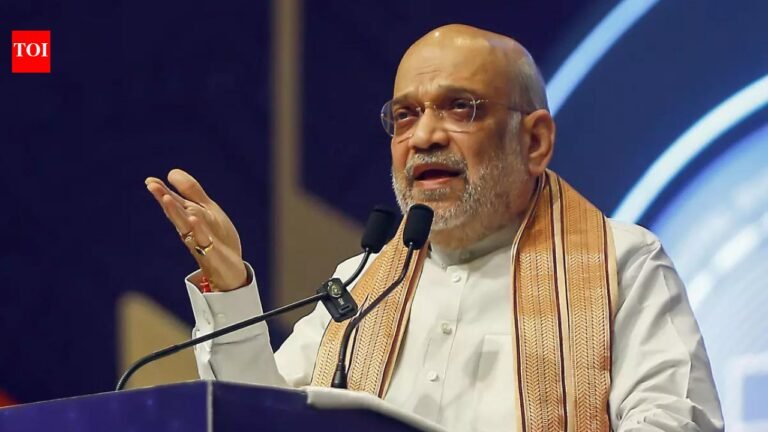
Federal Home Minister Amit Shah (file photo)

New Delhi: Union Home Minister Amit Shah on Friday took aim at the Congress’ rule in Assam for many years, accusing the party of infiltration and claiming that it “opened our borders to infiltrators” in what he termed “an attempt to change the demography of the state”. He also drew comparisons with the current BJP government under the Chief Minister Himanta Biswa Sarmapraising his “work clearing hundreds of thousands of acres of land occupied by infiltrators.”Addressing a rally in Assam, Shah strongly criticized the Congress party’s record, saying: “Assam is plagued by two problems: infiltrators are usurping the rights of Assamese people…These Congress governments are opening our borders to infiltrators. Infiltrators continue to enter Assam.” There are attempts to change the demography of Assam by taking away jobs from Assam’s youth, food from the poor and land from villages.Shah further praised the Sarma-led government and said, “In the second five years, our Chief Minister Himanta Biswa Sarma worked hard to clear and clear hundreds of thousands of acres of land occupied by infiltrators. Now, the third election is coming. Once again, a BJP government is being formed here. I assure you that we will repatriate every infiltrator who entered during the Congress regime.”He also highlighted the infrastructure development under the BJP, saying, “The Congress ruled for many years but it did not help the development of Assam. What the Congress could not do in fifty years, we have done in ten years. In the last five years, Assam has built 14 kilometers of roads every day… Almost hundreds of bridges have been built, including four new major bridges.”Notably, CM Himanta Sarma was a member of the Congress government in Assam. He joined the Bharatiya Janata Party in 2015 after a tense relationship with the party and later succeeded his BJP colleague as chief minister Sarbananda Sonowal.At the same time, Shah also launched the second phase of Assam’s Vibrant Villages Scheme, which will cover 1,954 border villages in 15 states and two Union Territories. The press conference was held in Cachar district.Earlier in the day, the Union Home Minister arrived in the state on a two-day visit to launch border infrastructure projects and address a public rally.

Realme P4 Lite 5G debuts in India with 6,300mAh battery, price starts at Rs 9,999 | Tech News

0

Realme has expanded its affordable P4 series lineup with the launch of Realme P4 Lite in India. This latest smartphone is targeted at buyers who need a basic smartphone for daily communication, internet usage and media consumption. The company has confirmed that sales will begin later this month, while pre-orders have started on Flipkart and the brand’s online store.

Realme P4 Lite 5G phone launched in India with 6,300mAh battery and octa-core Unisoc T7250 chipset. (real self)

Realme P4 Lite 5G: Price, color options and promotional offers

Realme P4 Lite is priced at Rs. 9,999 for the 4GB RAM and 64GB storage variant. The higher variant with 4GB RAM and 128GB internal storage is priced at Rs. 11,999. As part of the issue offer, the company is offering Rs. 1,000 Instant Bank Discount or Rs. 1,000 coupons. The device is available in Beach Gold, Obsidian Black, and Ocean Blue color options. The phone will go on sale from February 24th.

Also read: Summer 2026 Travel Guide: 5 Popular Tech Gear You Should Pack Before You Go

Realme P4 Lite 5G: Specs and features

Realme P4 Lite features a 6.74-inch HD+ display with a resolution of 720×1,600 pixels. The screen supports refresh rates up to 90Hz and touch sampling rates up to 180Hz. For photography, the device includes a 13MP rear camera. The phone has a 5MP camera on the front for taking selfies and video calls. The phone supports video recording at up to 1080p resolution and 30 frames per second.

Realme P4 Lite 5G is powered by an octa-core Unisoc T7250 chipset based on 12nm process, paired with 4GB of RAM and up to 128GB of onboard storage. It runs on Android 15 with Realme UI on top. Additionally, the device has an IP54 rating, which means it is dust and splash-proof.

Also read: Google Pixel 10a vs. Pixel 9a: What exactly sets them apart?

Realme P4 Lite 5G is equipped with a 6,300mAh battery and supports 15W wired charging. In terms of connectivity, it offers 4G LTE, Bluetooth 5.2, Wi-Fi, and satellite navigation systems including Beidou, GPS, GLONASS, and Galileo. The smartphone also includes proximity sensor, ambient light sensor, gyroscope, accelerometer, and side-mounted fingerprint scanner for security.

Japan’s legendary samurai: Uncovering the knight’s mysterious legacy, from fearsome swordsman to masterful artist | World News

0

Japan's legendary samurai: Uncover the knight's mysterious legacy, from fearsome swordsman to consummate artist

What do you think of when you hear the word “samurai”? For most people, the imagination unfolds like soldiers on the battlefield, clad in armor, wielding swords and with unwavering loyalty. The story begins in the medieval period, which is more than 1,000 years old and is of great significance for understanding its evolution. From its medieval cultural history years ago to the present day, the legacy of the samurai has been continually celebrated as part of contemporary video games, TV shows, movies, and more. Samurai are considered ancient knights. From the 18th century Ukiyo-e to the present day, they are fearless, loyal and disciplined Japanese warriors. But the story isn’t that simple; it’s more complex and surprising than Hollywood has revealed.

Japanese Samurai: History and Origins

Samurai are considered part of the fantasy world and they are not just part of Star Wars or the games, but are mystical warriors with a fascinating history, according to the British Museum’s new Samurai exhibition. Here’s how the true story of the samurai unfolded.According to exhibition curator Rosina Buckland, samurai were warriors and this was reflected in how they rose to the position. “But that’s not all,” Buckland said.Their origins reportedly date back to the 10th century, when they were first recruited as palace mercenaries. Japan in the 12th century faced a series of open street fighting and rebellions, and samurai took advantage of the unrest to gain major political power, establishing a military government (shogunate) in 1185.

Samurai are more than just warriors: Skills transcend the sword

Samurai were also open to new ideas and technologies from other cultures. For example, the samurai armor on display at the exhibition was based on a Portuguese design, with a sharply angled front and sloping sides to deflect rifle bullets. These features became necessary after European firearms arrived in Japan in 1543.In addition to military skills, samurai also studied high arts such as painting, poetry, music, drama, and tea ceremonies. Military leaders known as shoguns realized that brute force alone was not enough to rule effectively. They combined military power with subtle influence within court society.Their style of governance was influenced by Chinese philosophy, especially Confucianism. “In Neo-Confucianism, you need to balance military power with cultural skills,” Buckland explains. This has led to an emphasis on soft power, such as diplomacy and court culture. The exhibition also features a 19th-century fan painted by a samurai artist, illustrating the unexpected artistic talents of these samurai.

Are samurai just men?

From the 12th to the 16th century, high-ranking women also wielded great power. For example, Hojo Masako, who was married to the first shogun Minamoto Yoritomo, served as regent many times. During the Tokugawa period, half of the samurai class was made up of women, who performed important household chores and raised children. Objects, accessories, robes and various other items in the British Museum exhibition reportedly tell the story of warrior women.

What did a samurai wear when leaving the battlefield?

According to rank, samurai wore clothing according to rank. Their clothing may vary from luxurious textiles of high-ranking warriors to imported textiles. This is very different from the situation where low-level samurai use long katana, short wakazaki, and different mounts to express their clothing. Eels are believed to come in various shapes and sizes and are primarily made of iron, but can also be made of copper, brass, or enamel.

What does the word “Samurai” mean?

The term is derived from the Japanese verb “saburau” which means to serve. This hints at the pedigree of the person who served as governor. Historically, these terms have been used to describe members of the ruling class.

Do samurai still exist today?

Not really. It ceased to exist as a distinct socio-military class. Their official status reportedly ended in the late 19th century when Japan modernized its military and government. However, their legacy lives on. Samurai values ​​such as loyalty, discipline and honor influence Japanese culture. Martial arts such as Kendo and Judo, traditional rituals and cultural stories still retain their spirit. Samurai armor, swords and artwork are preserved in museums, exhibitions and collections around the world.

Why rights exist but justice remains out of reach for the poor | India News

0

Why rights exist but justice remains out of reach for the poor

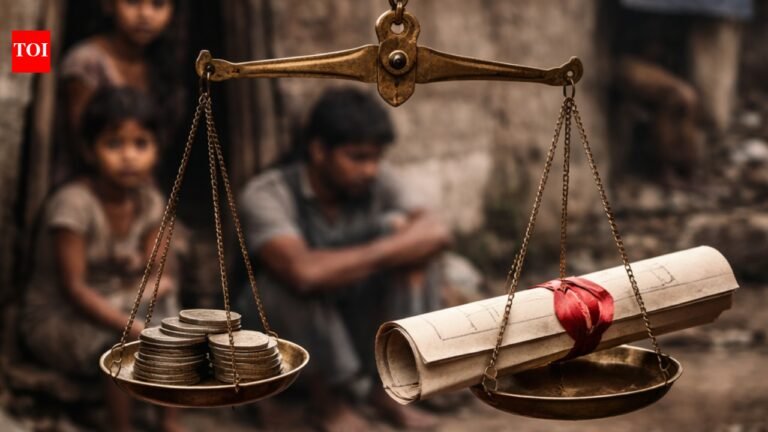
Justice comes with hidden costs that those already burdened by the perpetual cycle of poverty, a cycle that shackles every step each day, feel too acutely to ignore. Rights exist. Legal aid is free for them. However, they do not have the privilege of affording the costs, both literal and opportunity-related, associated with recurring court dates. Injustice in any form hits them harder. Some remain under the dark cloud of lack of awareness about their existing rights, while others fear the consequences that may follow if they assert them.Poverty not only strips away social standing, hinders growth, and erodes health, but also robs dignity, striking most brutally at the vulnerable.When poverty forces people from disadvantaged backgrounds to toil relentless hours under harsh conditions just to ensure their child sees a meal on his plate, even if not the future he dreams of but enough to keep hope alive, survival becomes the only priority.Poverty cements their feet and, at the same time, pushes them into legal vulnerability.And when such individuals are confronted with injustice of any sort, whether a wrongful accusation, workplace exploitation, eviction, domestic abuse, discrimination, or even a sudden legal summons, it takes far more than courage to access their own legal rights.

The constitutional promise vs ground reality

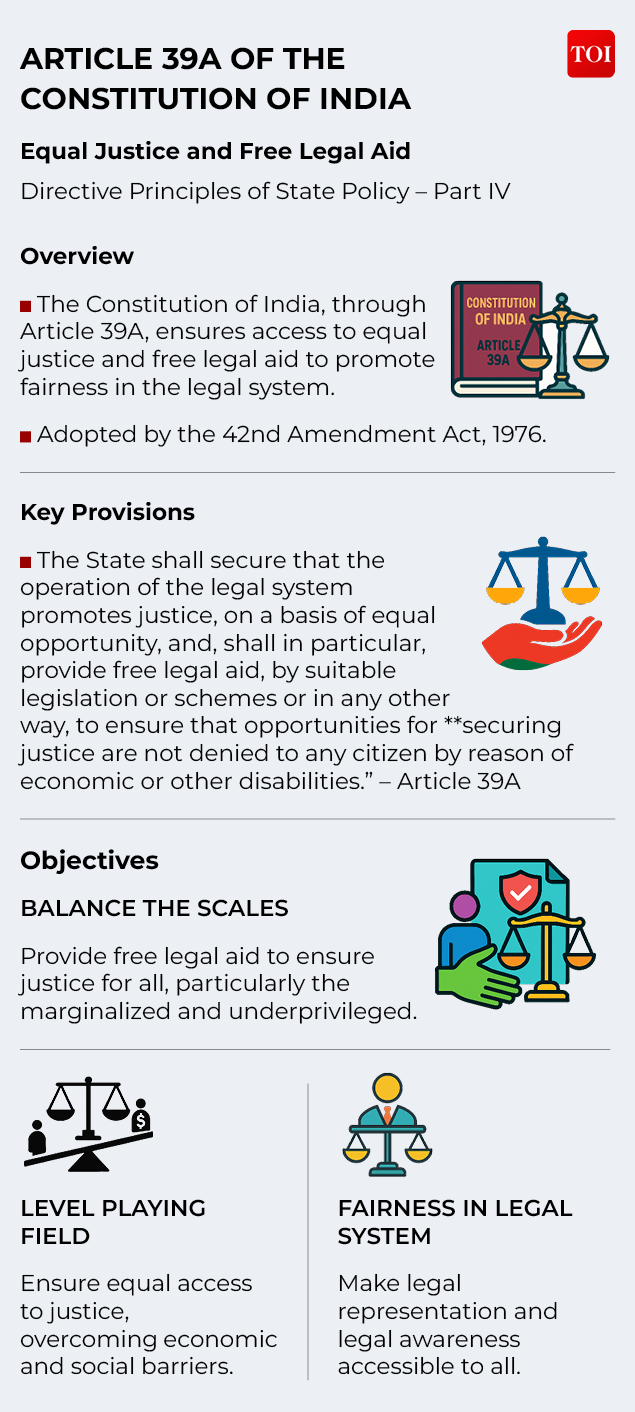
To ensure that no person is denied justice merely because they cannot afford legal representation, Article 39A of the Constitution of India, introduced through the 42nd Amendment in 1976, mandates the State to provide free legal aid and ensure equal justice for all.
12 (1)

.

This constitutional vision was institutionalised through the Legal Services Authorities Act, 1987, under which the National Legal Services Authority (NALSA) was established in 1995 as the central body to implement legal aid programs across the country.The legal aid system in India is structured as a nationwide network, from the National Legal Services Authority (NALSA) at the Centre, chaired by a Supreme Court judge with the Chief Justice of India as Patron-in-Chief, to State and District Legal Services Authorities, and local Taluka bodies. At the grassroots, paralegal volunteers, drawn from communities, including teachers, social workers, Anganwadi workers, law students, and marginalized groups serve as bridges between citizens and the justice system.
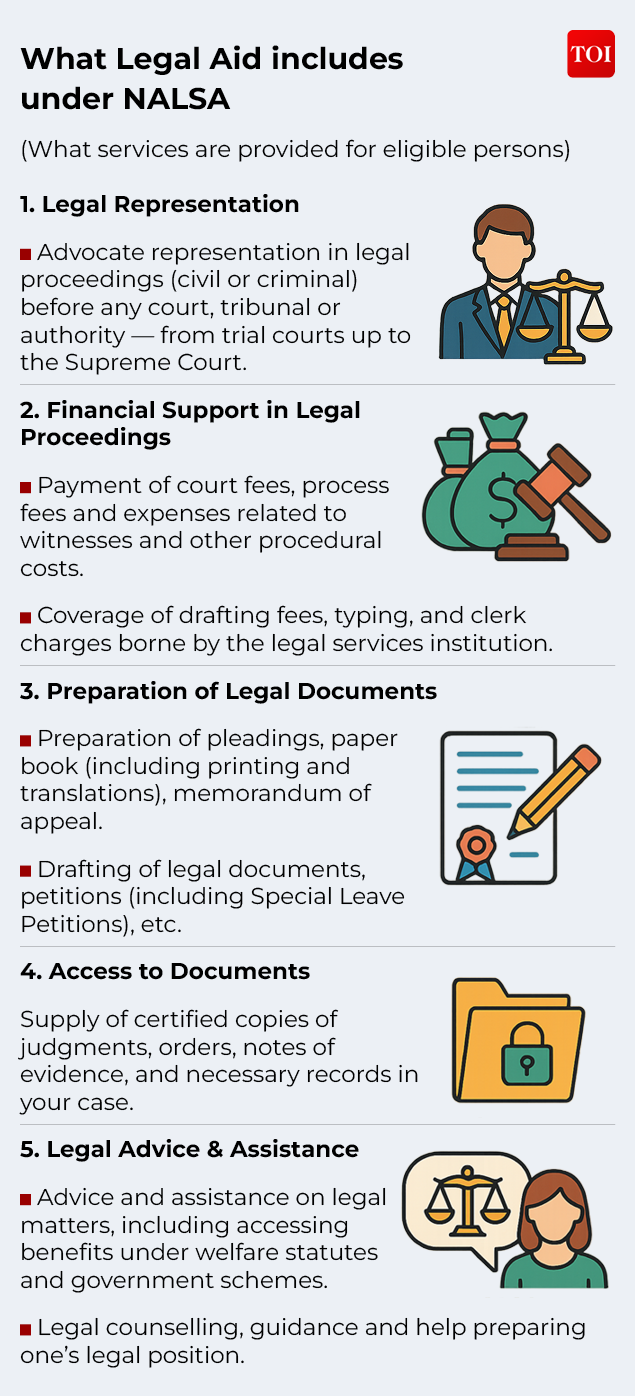
14 (1)

.

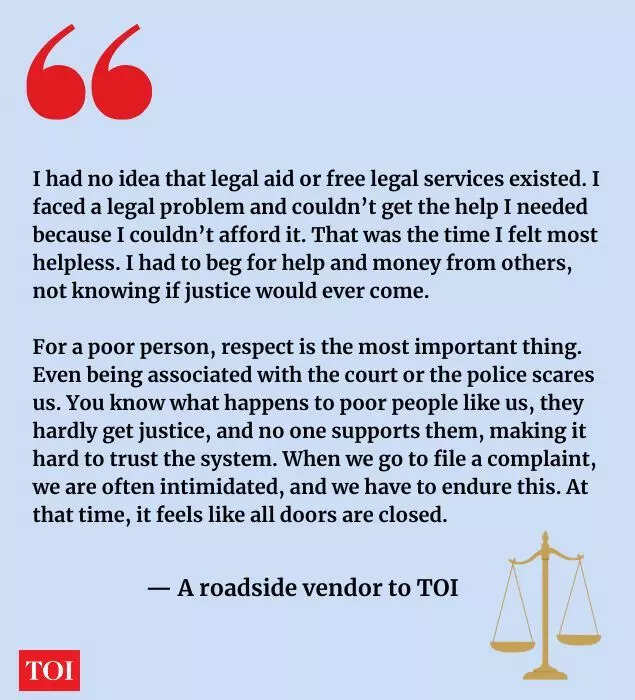
The idea being simple yet ambitious, justice should reach the doorstep of the poor.Yet access remains low. Former Chief Justice of India, former Judge of the Supreme Court of India, and former Executive Chairman of the National Legal Services Authority (NALSA), Justice Uday Umesh Lalit, in an interview to Sansad TV, noted after reviewing nationwide data:“Statistics showed that people get legal aid in less than 1% of the cases where justice is required. If we look at how many people are below the poverty line, it is inconsistent that only 1% would need legal aid. Either they do not know it is their right, or they do not have confidence in the system.”That single statistic exposes a deep structural contradiction, a country with millions eligible for free legal assistance sees only a tiny fraction accessing it.Amid the daily struggles of poverty, many people remain unaware of their right to legal aid or free legal services. A roadside vendor narrated how police use court cases to intimidate them. When asked if he knew that legal aid is free, he expressed shock.“I had no idea that legal aid or free legal services existed. I faced a legal problem and couldn’t get the help I needed because I couldn’t afford it. That was the time I felt most helpless. I had to beg for help and money from others, not knowing if justice would ever come. For a poor person, respect is the most important thing. Even being associated with the court or the police scares us. You know what happens to poor people like us, they hardly get justice, and no one supports them, making it hard to trust the system. When we go to file a complaint, we are often intimidated, and we have to endure this. At that time, it feels like all doors are closed,” he told TOI.
SC (3)

.

Poverty and legal vulnerability: A reinforcing cycle

According to the latest World Bank data, between 2011‑12 and 2022‑23, India lifted roughly 269 million people out of extreme poverty, reducing the poverty rate from 27.1% to 5.3%. Yet around 75 million people still live in extreme poverty, leaving them vulnerable not only to deprivation in food, healthcare, and education, but also to challenges in accessing legal protections and exercising their rights effectively.
1 (2)

.

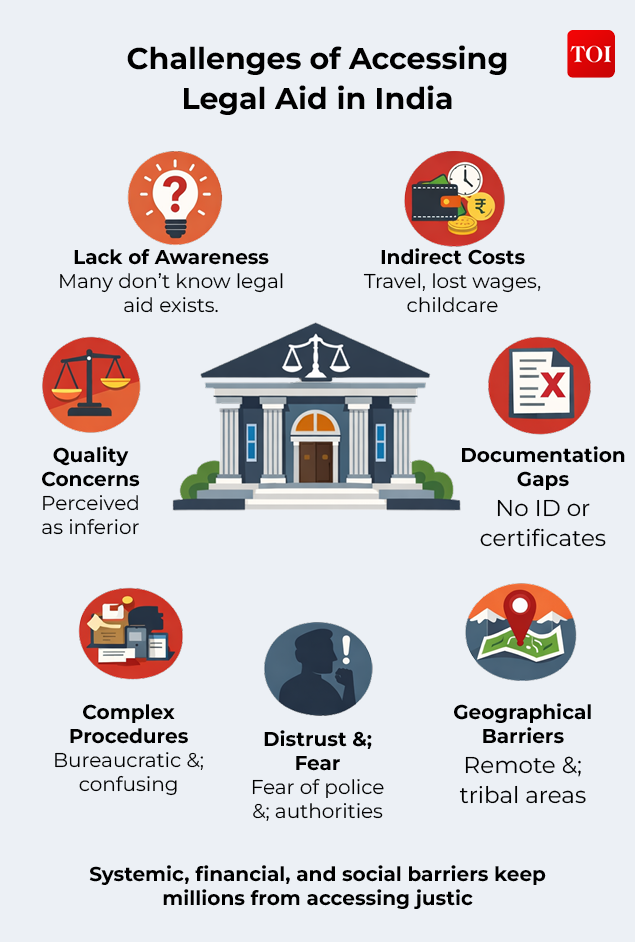
People living in deprivation often face:

  • inability to miss daily wages to attend hearings,
  • lack of transport to courts,
  • absence of identity or property documents,
  • fear of police or authority figures,
  • dependence on informal or exploitative intermediaries,

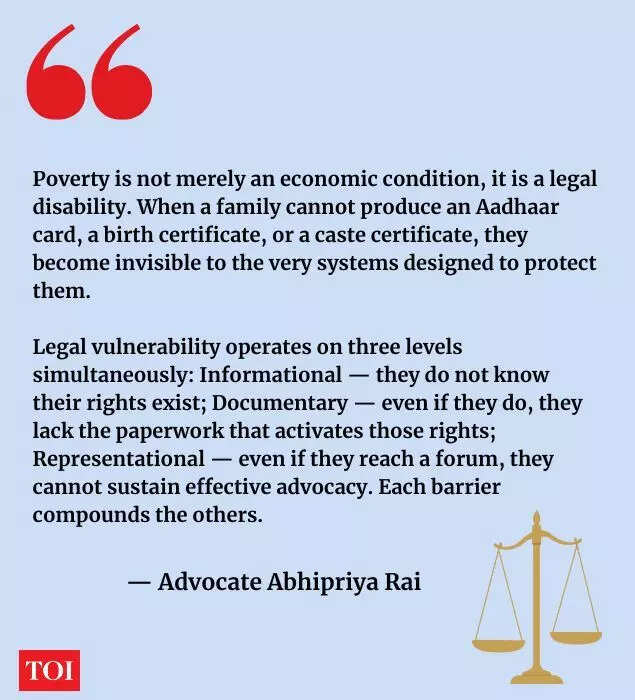
For many, even receiving a legal notice or court summons can trigger panic rather than protection. Without awareness or guidance, such notices may be ignored, not out of defiance but confusion or fear, sometimes worsening legal consequences.Advocate Abhipriya Rai explained, “Poverty is not merely an economic condition, it is a legal disability. When a family cannot produce an Aadhaar card, a birth certificate, or a caste certificate, they become invisible to the very systems designed to protect them.”
SC (4)

.

She added that legal vulnerability operates on three levels simultaneously. “Informational: they do not know their rights exist. Documentary: even if they do, they lack the paperwork that activates those rights. Representational: even if they reach a forum, they cannot sustain effective advocacy. Each barrier compounds the others.”Legal vulnerability therefore becomes not a separate condition, but a direct extension of economic vulnerability.

What grassroots organisations witness

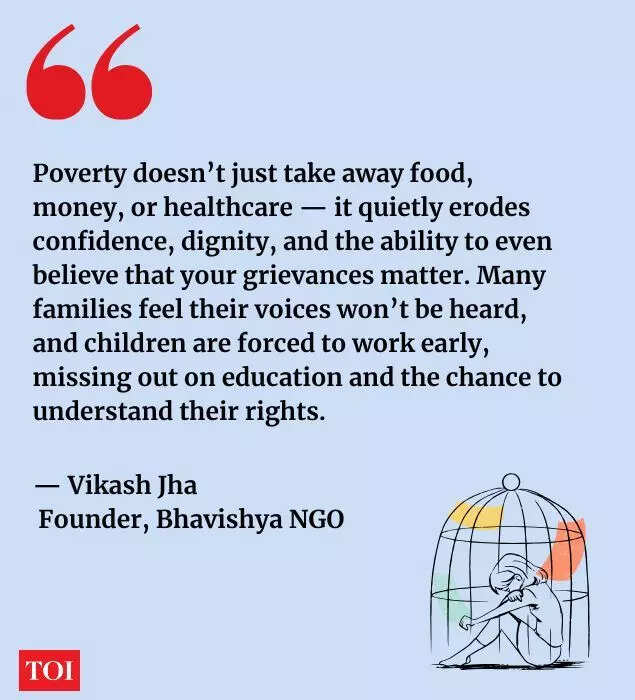
NGO workers who interact daily with marginalised families consistently observe how poverty quietly erodes agency and confidence.According to Vikash Jha, founder of Bhavishya NGO, poverty often prevents families from even believing their grievances will be heard. Lack of access to nutritious food, clean water, healthcare, and quality education weakens both physical and psychological resilience. He noted that many children from such backgrounds begin working early to support their households, further reducing their chances of awareness about rights or legal remedies.
SC (5)

.

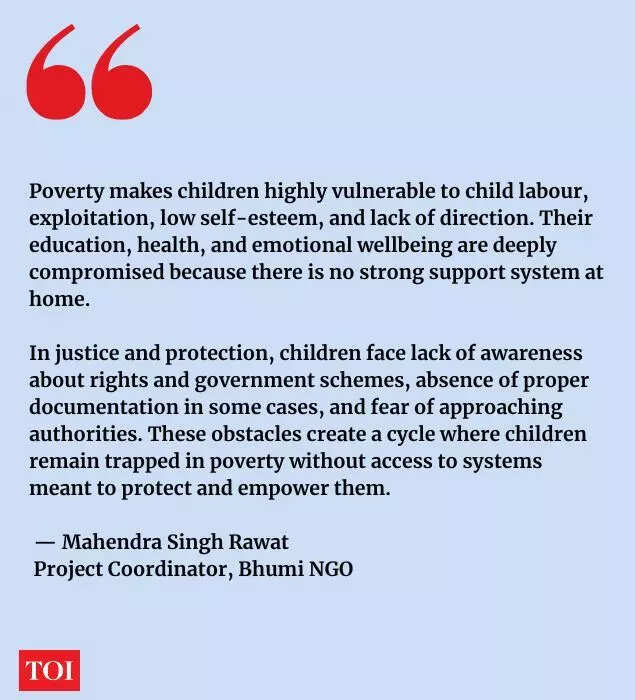
TOI also spoke to Mahendra Singh Rawat, project coordinator at Bhumi NGO, Delhi, who has worked with underprivileged children in shelter homes and slum communities for over three years. He highlighted how poverty affects every aspect of a child’s life:“It is not only financial deprivation, but also limits awareness, opportunities, confidence, and aspirations. Many parents are daily wage workers with unstable incomes. Many children drop out early, and some are pushed into begging or work to support their families”. He further noted that there is lack of awareness about rights and government schemes, absence of proper documentation in some cases, and fear of approaching authorities that further perpetuates lack of access to justice among the poor even when the legal aid framework exists.
quote 1

.

A Delhi-based cleanliness worker who wished to remain anonymous added: “Demanding better conditions is a privilege daily wage workers like me cannot afford. Even if it badly affects our health, we cannot quit. Nobody cares. I may be useful to the system, but I am not treated as a dignified part of it and I don’t feel that my voice would be heard even if raised.”

Why free legal aid alone is not enough

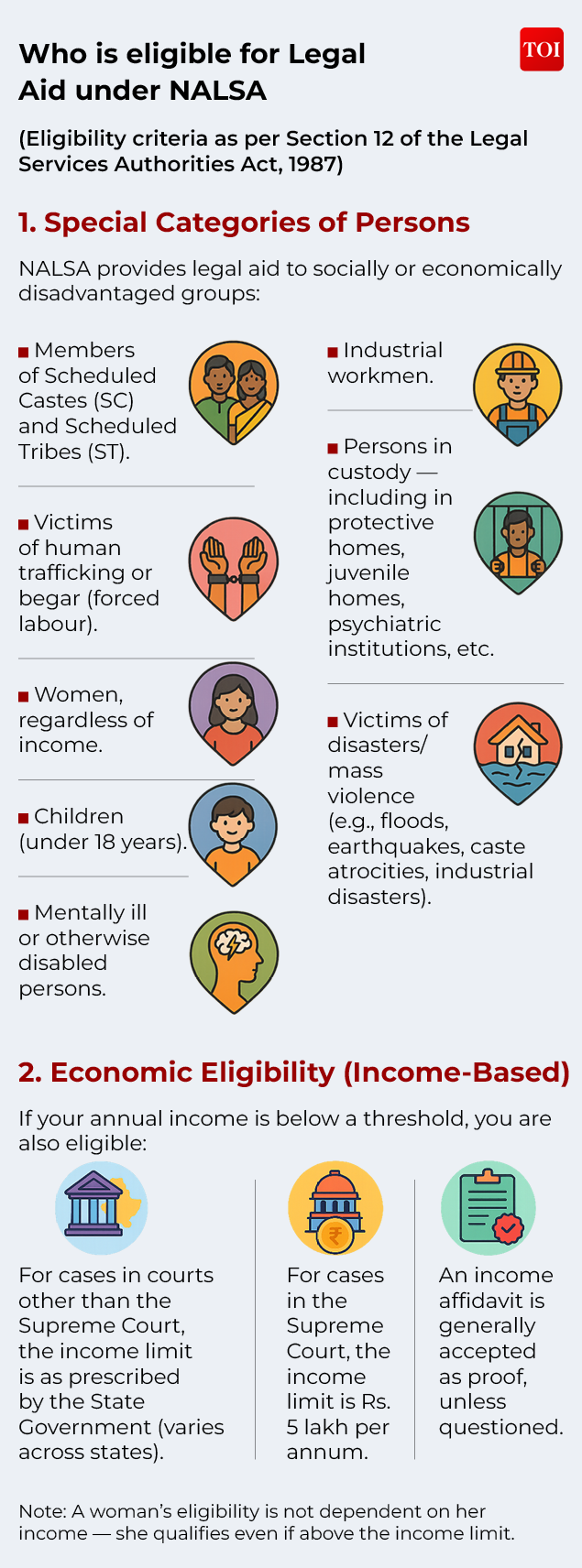
India’s legal aid framework is widely regarded as one of the most comprehensive in the world. Eligibility typically includes:

  • persons below income thresholds,
  • women and children,
  • Scheduled Castes and Scheduled Tribes,
  • persons with disabilities,
  • victims of trafficking or disaster,
  • industrial workmen,
  • those in custody,
13

.

Services may include legal advice, representation, drafting documents, and mediation, all free of cost.Yet access gaps persist because formal entitlement does not automatically translate into practical accessibility.

Common barriers include:

  • lack of awareness about the rights, legal aid framework, and eligibility,
  • distrust of state institutions,
  • language barriers,
  • social stigma,
  • procedural complexity,
  • perception that free services are inferior,

The Hidden Costs of Justice

Although legal representation may be free, justice still carries indirect expenses:

  • travel costs to courts,
  • lost wages from attending hearings,
  • childcare arrangements,
  • repeated procedural delays,

Reflecting on these hidden costs, Adv. Abhipriya observes:“A worker who cannot read the summons served to her, who has been told by police to ‘go home and settle,’ does not see the law as a resource. She sees it as a threat. That fear is rational.” On the broader framework, she notes, “India has one of the most elaborate statutory frameworks for protecting the poor in the developing world. But a right that cannot be exercised is not a right. It is a promise that was never kept.”For daily wage earners, a single missed workday can mean a missed meal. Multiple court dates can therefore translate into financial distress, discouraging people from pursuing even legitimate claims.

Can legal aid help alleviate poverty?

Adv. Abhipriya noted that legal aid, when delivered effectively, has immediate, tangible impacts. The mechanism is more direct than people assume:When a woman who has been illegally terminated recovers her wages through a legal aid lawyer, she has protected her family’s food security for months. Similarly, when a family obtains a stay against illegal demolition, children stay in school.She added that legal aid, when delivered well, is poverty alleviation, without a welfare scheme label attached.Between 2015 and 2025, over 1.61 crore citizens received legal aid, while over 40 crore cases were settled through National Lok Adalats, and the Legal Aid Defence Counsel System disposed of nearly 8 lakh criminal cases in three years.Government funding for NALSA for 2022‑23 was Rs. 190 crore, which was increased to Rs. 400 crore for 2023‑24, dropped to Rs. 200 crore in 2024‑25, and rose again by 25 percent to Rs. 250 crore in the Union Budget 2026‑27.However, structural challenges still persist:Awareness: Judges and legal experts have emphasised that many eligible people are unaware of free legal aid, with most assuming they cannot access assistance because it is unaffordable.Quality: Justice Nagarathna emphasized that “legal aid to the poor does not mean poor legal aid.” Panel lawyers are often junior, overloaded, and inadequately compensated. Wide disparities persist between legal aid representation and private representation. This is not a criticism of individual lawyers but a systemic design failure.Geography: Tribal families in remote areas often cannot reach District Legal Services Authorities, and the digital divide creates additional barriers for accessing online portals.Fund utilisation: Hon’ble Chief Justice Surya Kant disclosed at the Conference that by September 2025, only 16.93% of the Legal Aid and Advice budget had been utilised, while outreach expenditure had exceeded its allocation. Money meant for representation and aid delivery remained unspent, while funds for awareness were overspent, an inversion of priorities.

Why this conversation matters

On World Social Justice Day, observed annually on February 20 by the United Nations, the global spotlight turns to poverty, inequality, exclusion, and human rights. For India, it underscores the urgent challenge of bridging the gap between legal rights and actual access to justice.As harsh as it may sound, society often reserves dignity for those who are affluent and demands subservience from those who struggle simply to survive, educate, and aspire. Poverty does not only deprive, it silences. Understanding how poverty intersects with legal vulnerability is essential not merely for policy reform, but for safeguarding democracy itself. Because access to justice is not just another welfare benefit, it is the foundation that determines whether rights exist only on paper or in reality.

Everest wasn’t always a mountain! These 200-million-year-old marine fossils prove the Himalayas were once underwater World News

0

Everest wasn’t always a mountain! These 200-million-year-old marine fossils prove the Himalayas were once underwater

Imagine standing on the ocean floor 8,000 meters above sea level Everestyou will find a marine fossil. You shouldn’t be surprised as fossils of marine animals have been found near the top of the mountain Everestthe findings continue to interest the scientific community and the public. Climbers and geologists report the remains of trilobites, crinoids and brachiopods buried high in the Himalayas. These fossils are not a recent invasion. They are part of sedimentary rocks formed millions of years before the mountains existed. Their presence reflects deep geological changes related to plate tectonics and the long-term closure of ancient oceans. Evidence collected over decades links these marine sediments to the pre-Tethys Ocean, which once separated the Indian continent from Asia. The rocks now exposed at extreme elevations were once deposited under sea water and later lifted up as the continents converged.

Fossilized shells on Mount Everest prove the Himalayas were once under the sea

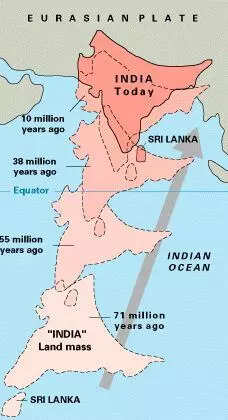
according to geological societythe summit of Mount Everest was formed at the bottom of the Tethys Ocean. About 225 million years ago, the Indian Plate lay far south in Asia, separated by vast ocean basins. Sediments accumulate along its edges. Fragments of shells and bones were deposited in layers, slowly hardening into rock.These layers remain in place when tectonic forces reshape the area. The fossils seen today are ordinary sea creatures from that distant period. Their altitude seems unusual.

The drift of the Indian plate has reshaped the region (Image source - Geological Society)

The drift of the Indian plate has reshaped the region (Image source – Geological Society)

Indian plate drift reshapes region

About 200 million years ago, when the supercontinent Pangea began to break apart, the Indian plate began moving northward. Eighty million years ago, it was thousands of kilometers south of Asia, but still advancing steadily. The oceanic crust of the Tethys Ocean was pushed beneath the subduction zone at the edge of Eurasia, in an environment similar to that of the Andes today.Not all matter disappears underground. Thick oceanic sediments were scraped away and pressed against the edge of Eurasia. Over time, these accumulated sediments became part of the rising mountain range.

The Himalayas continue to rise by 1 centimeter per year

Between 50 and 40 million years ago, the Indian and Eurasian continental plates collided. Neither plate sinks easily because they are both buoyant continental crust. Instead, the crust shrank, thickened, and rose. This collision marked the beginning of the Himalayan uplift.The Himalayas stretch about 2,900 kilometers from east to west. At 8,848 meters above sea level, Mount Everest is the highest point on Earth. Geological surveys show that the range is still rising at a rate of more than a centimeter per year as India continues to advance north. Meanwhile, erosion has the opposite effect. Rocks are worn away by ice, wind and water. The balance slowly shifts. Fossils remain in place, quiet traces of an ocean that once covered the roof of what is now the world.

‘Now is the perfect time to smash’: Oman captain leads team against struggling Australian Cricket News

0

'Now is the best time to smash': Oman captain inspires team against struggling Australia

Captain Oman Jatinder Singh He showed confidence in the final group match of the ICC Men’s T20 World Cup 2026 against Australia at the Palleke International Cricket Stadium on Friday. Speaking to the ICC, Singh said “now is the best time to crush” the struggling Australian team. Australia, the 2021 T20 World Cup champions, were considered favorites before the tournament but have struggled to find form. After narrowly defeating Ireland in their first game, Mitchell Marsh’s side suffered two consecutive defeats, losing to Zimbabwe by 23 points and losing to Sri Lanka by 8 points. These results have excluded them from the Super 8 stage.

How Suryakumar Yadav and Tilak Varma hurt India? T20 World Cup

Oman has also been eliminated from the tournament and is yet to register a victory. But Singh stressed that the most important thing in T20 cricket is momentum and making the most of key moments, something his side will hope to capitalize on against a shaky Australian side. “It’s an opportunity. Our kids are looking forward to it. Because T20, it’s a game of momentum and moments. I think if you utilize those moments correctly, you can do anything on that day. So Australia are not doing well at the moment,” Singh said. Despite the early exit, Singh stressed that the Oman team remained optimistic and determined to make a mark in the final game. “Even they were out of the tournament. So the mood in the camp was that the boys were very positive as we tried to play better cricket but unfortunately things went against us. But I am sure the boys are looking forward to the next game against Australia and do well,” he added. Australia have so far won just one of their three group matches and are out of contention for the Super Eights.

Was Nancy Guthrie reported missing before she was officially missing? fact check

0

X post from February 20 claimed that a report of a missing endangered adult Nancy Guthrie She was submitted at 7:00 pm local time on January 31, 2026, and was subsequently publicly reported missing on February 1, 2026. The post questioned how authorities could file such a report “before anyone had officially reported her missing,” sparking debate and speculation online.

Jennifer Bond signs a banner that reads "take her home" and showed a photo of American television journalist Savannah Guthrie's abducted elderly mother, Nancy Guthrie, in the KVOA newsroom in Tucson, Arizona, where Savannah worked early in her career. (Reuters)
Jennifer Bond signs a banner at the KVOA newsroom in Tucson, Arizona, that reads “Bring Her Home” and displays a photo of US television journalist Savannah Guthrie’s abducted elderly mother Nancy Guthrie. (Reuters)

Some commenters wondered whether time zone differences or administrative backdating could explain the discrepancy, while others stated that they could not find the case number in public records.

What the official schedule shows

According to reliable reports and official timelines, 84-year-old Nancy Guthrie was last seen on the night of January 31, 2026, when she was transported to Tucson, Arizona Home after dinner with family.

She was reported missing around noon on February 1, 2026, with family and friends concerned after she failed to attend a planned party and could not be contacted.

Law enforcement responded when they were unable to find her at her residence, but personal items and essential medications remained at her residence.

There is no credible evidence from official sources or law enforcement statements to support the claim that the Missing Endangered Adult Report was officially filed on January 31st.

Also read: Big twist in Nancy Guthrie case; investigators find new clues in chilling video of suspect

Publicly available information, including from Pima County Sheriff’s Departmentunanimously indicate that Guthrie’s disappearance was reported to authorities on February 1, triggering a missing persons alert and investigation.

While emergency systems may require internal documents or preliminary records as the case unfolds, public missing persons notifications and official confirmations are consistent with the February 1 timeline.

Also read: Is the Nancy Guthrie case connected to Walmart? Former FBI agent says Savannah’s books mentioning “kidnapping game” are also being sold there

Authorities have not released any documents indicating the existence of the Jan. 31 filing.

Law enforcement agencies, including the Pima County Sheriff’s Department and the FBI, are continuing to investigate the disappearance of Guthrie, who was allegedly abducted from his home in the early morning hours of February 1. As the case unfolds, surveillance footage, DNA evidence from items found near her residence and an ever-increasing search are ongoing.

10 price-cut deals worth considering for home brewers, with up to 60% off | Tech News

0

If you like to start your day with a strong cup of café-style espresso, investing in a good espresso machine can be a game-changer, but price can often be a deterrent. Things are changing now. Several espresso machines at various price points have dropped in price recently, making home brewing easier than ever.

The best espresso machines are now heavily discounted! (pixels)

Whether you’re a beginner looking for a compact machine or someone upgrading to a more advanced model with better pressure control and milk frothing capabilities, these price drops can make your decision easier. Now, instead of settling for instant coffee or going to a coffee shop every day, you can brew consistent, flavor-rich espresso at home without stretching your budget.

10 Espresso Machine Deals You Can’t Miss on Amazon

For those who want to drink coffee at home without thinking too much, this espresso machine feels like a solid win. The 20 bar Italian Ulka pump performs surprisingly well at extraction, and the 1350W heat block heats up quickly, eliminating the need to wait long between brewing and steaming. The touchscreen makes things easy with preset options, including a rare cold espresso mode. At 68% off, this price cut makes it even more attractive than before, especially for everyday home use.

Specification

handle:

51mm stainless steel

If you like your espresso strong and clean, the Dedica style makes sense. It’s slim enough to fit on compact kitchen counters, yet still delivers a decent 15 bar of pressure for classic espresso. The steam wand handles milk very well once you get the hang of it, and it handles iced coffee surprisingly well. With prices down 67%, this feels like one of those rare moments when premium brands are truly affordable for home baristas.

Specification

Milk frother:

manual steam wand

Body material:

Stainless steel

design:

Slim, compact countertop size

The VANTRO espresso machine is designed for those who want more control without getting bogged down in cafe-level complexity. 20 bar pressure helps extract rich flavors and oils, while 1500 watts of heating makes brewing times fast and consistent. The touch panel lets you adjust the temperature and extraction, which is great once you start experimenting. Its stainless steel body feels sturdy and premium. With a price reduction of 53%, this is a strong mid-range option for serious home coffee drinkers.

Specification

Body material:

Stainless steel

control:

touch control panel

If you like convenience but don’t want to be limited to capsules, this COSTAR espresso machine is perfect for you. It works with both capsules and ground coffee, which really makes everyday coffee so much easier. The 20 bar pressure creates a nice grease and the quick heat is perfect for rushed mornings. It’s compact, lightweight and easy to use – no learning curve required. At 43% off, the price feels pretty reasonable for a flexible, hassle-free home coffee setup.

Specification

Brewing type:

capsules and coffee powder

Operation:

One touch control

The AGARO Imperial is a simple espresso machine that focuses on getting the basics right. 15 bar pressure delivers balanced crema and good crema, while dual temperature controls help manage coffee and milk foam separately. If you prefer manual controls, analog dials are a good choice. It’s not fancy, but it’s reliable and easy to use. The price has dropped by 41%, making it a smart choice for everyday espresso and milk coffee at home.

Specification

Milk frother:

Adjustable steam wand

Body material:

Stainless steel

Wonderchef Regalia is designed for coffee lovers who want a complete bean-to-cup experience at home. The built-in grinder with 20 grind settings can really change the freshness of your espresso. 20 bar of pressure extracts rich flavour, and hot and cold brew options add flexibility for different moods and seasons. It does take a little getting used to, but that’s part of the fun. With a 43% discount, this feels like a solid value for an all-in-one setup.

Specification

Grinder type:

Taper burr grinder

Grind settings:

20 levels

Brewing options:

Hot and cold brewing

This COSTAR espresso machine is the perfect balance of convenience and control. The dual handle setup allows you to switch between capsule coffee and ground coffee, which is convenient depending on your time. The 20 bar pressure, coupled with the pressure indicator, helps you dial in better shots once you get used to it. The stainless steel body feels sturdy and the steam wand is perfect for everyday cappuccinos. It’s 39% off and is a practical upgrade to a basic capsule machine.

Specification

Brewing type:

capsules and coffee powder

Features:

Pressure gauge, cup warmer

This DOMESTICA Brewcraft is clearly designed for beginners or anyone who wants a simple, quick coffee without spending a lot. The 3.5 bar pressure can’t compete with coffee machines, but it’s more than enough for everyday espresso and milk drinks.

Quick brew heating reduces waiting time, and the steam wand works great for brewing frothy cappuccinos. It’s compact, lightweight and easy to use. The price has dropped by 46%, making it an affordable choice for home espresso.

Specification

capacity:

240 ml (up to 4 cups)

Brewing time:

Within 2 minutes

This COSTAR fully automatic espresso machine is for those who just want to drink good coffee without doing any work. Put in the coffee beans, press the button, and it does everything from grinding to brewing in about 30 seconds. The 19-bar Italian pump delivers consistent brewing results, while the built-in milk frother makes it easy to cover lattes and cappuccinos. Automatic cleaning is a real advantage for everyday use, especially in the office. If convenience is more important than manual controls, then at 35% off, it’s a good choice.

Specification

grinder:

Integrated automatic grinder

Operation:

Fully automatic, one-click

Inalsa Bonjour is for those who want simple, relaxing coffee at home. It handles espresso, cappuccino, and latte with one control knob, making it easy to operate even if you’re new to coffee machines. 4 bar steam pressure is basic but works great for frothing milk for everyday drinks. It heats up quickly and the carafe is very useful when making coffee for a small group of people. With a 35% discount, this is a great entry-level option.

Specification

Milk frother:

Steam bubble function

Glass carafe:

borosilicate glass

Top 3 Features of the Best Espresso Machine

Espresso machine pressure strength capacity
Rothman espresso machine 20 bar 1350W 1.5 liters
De’Longhi Dedica style EC685 15 bar 1300W 1.1 liter
VANTRO espresso machine 20 bar 1500W 1.8 liters
COSTAR 2-in-1 espresso machine (capsules and powder) 20 bar 1450W 600ml
AGARO Imperial Espresso Machine 15 bar 1100W 1.5 liters
Wonderchef Regalia Espresso Machine with Grinder 20 bar 1500 watts* Dou Dou~100 g
COSTAR espresso machine (ground and capsule coffee machine, double handle) 20 bar 1450W 1 liter
DOMESTICA Brewcraft Espresso Machine 3.5 bar 800W 240 ml (4 cups)
COSTAR fully automatic coffee machine 19 bar 1500 watts* 1.1 liter
Inalsa Bonjour 4-Cup Coffee Maker 4 bar 800W 4 cups

Disclaimer: At Hindustan Times, we help you stay updated with the latest trends and products. Hindustan Times has affiliate partnerships, so we may get a share of the revenue when you make a purchase. We are not responsible for any claims relating to the products under applicable law (including but not limited to the Consumer Protection Act 2019). The products listed in this article are in no particular order of preference.

CCPA cracks down on unauthorized sale of counter-drone and signal jammers, six e-commerce companies face lawsuits India News

0

CCPA cracks down on unauthorized sales of counter-drone and signal jammers, six e-commerce companies face lawsuits

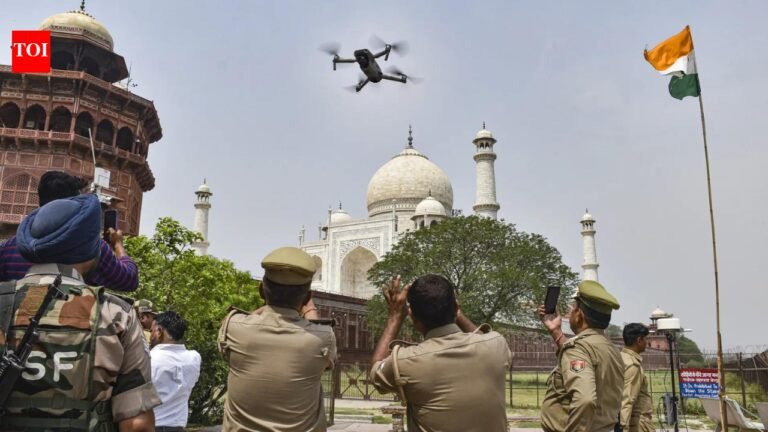
NEW DELHI: In a bid to crack down on online sales of “anti-drone” and “GPS jammer” devices, the Central Consumer Protection Authority (CCPA) has issued notices to six e-commerce platforms and entities. Officials said the entities risk penalties for misleading listings and non-compliance with regulations.The CCPA has sought details regarding import licenses, regulatory clearances and buyer details from Everse, Indiamart, Xboom, Javiat Aerospace, AirONE Robotics and Maveric Drones & Technologies Pvt Ltd.The authority observed that the devices were listed online without disclosing compulsory licensing requirements, without valid Equipment Type Approval (ETA) or Wireless Planning and Coordination (WPC) certification details, and without a clear prohibition on civilian possession and use without statutory authorization. It said that selling such products on e-commerce platforms is likely to mislead consumers into believing that these devices can be purchased freely.The CCPA has directed entities to provide detailed information, including sources of procurement and imports, as well as copies of import licenses, invoices and relevant documents. They have also been asked to submit copies of regulatory approvals and authorizations obtained from the WPC, Department of Telecommunications (DoT), Directorate General of Foreign Trade (DGFT), Cabinet Secretariat and Ministry of Home Affairs (MHA).The authority further seeks the legal basis for restricting the commercial sale of the device; the number of units sold in the past two years with complete details of purchasers; details of third-party sellers who have listed similar devices; steps taken to stop such listings and prevent recurrence; and a complete list of similar radio frequency or wireless transmission devices available on its platform.Drone jammers and signal jamming devices are regulated under the Indian Telegraph Act and the Wireless Telegraph Act and are subject to strict licensing and regulatory controls by the Department of Telecommunications (DoT) and the Wireless Planning and Coordination (WPC) department. The import of such restricted equipment is governed by the Foreign Trade (Development and Regulation) Act, 1992 and applicable DGFT notifications. Such devices are generally permitted only for use by authorized government agencies and law enforcement agencies, subject to statutory approval.

Jeffrey Epstein’s estate agrees to provide $35 million in compensation to victims

0

Jeffrey Epstein's estate agrees to provide $35 million in compensation to victims

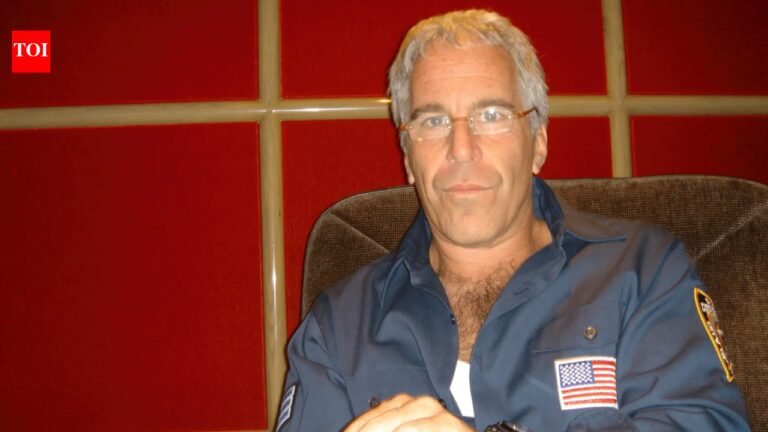
Convicted sex offender dies in jail years after death Jeffrey EpsteinThe victims’ estates have agreed to pay up to $35 million in damages to resolve claims from victims who accused him of abuse or trafficking for more than two decades.The proposed court ruling, filed Thursday, covers alleged attacks from Jan. 1, 1995, to Epstein’s death in prison on Aug. 10, 2019.

Trump sends shocking Epstein message to British royals after former Prince Andrew is arrested for misconduct

Epstein’s estate will pay $35 million if 40 or more people qualify, and $25 million if fewer than 40 people qualify. Bloomberg News reported Thursday that law firms representing victims are confident that at least 40 people have yet to reach settlements with Epstein’s estate.The settlement is co-executive of Epstein’s former lawyer Darren Indyke and the financier’s former accountant Richard Kahn. Both men have denied any wrongdoing with Epstein and have not been charged with any crime.The judgment noted that the agreement did not mean that the co-executors admitted wrongdoing or were liable for further legal proceedings against the victims.The settlement still must be approved by a New York federal judge before it can become final.The settlement comes after the U.S. Department of Justice released millions of documents, photos and videos related to the Epstein investigation.Epstein built a global network of powerful politicians, business executives, academics and celebrities – many of whom were tainted by their association with him.