The man behind Sunday’s bloody massacre at a crowded Austin bar was a former New York City resident who wore an “Allah’s Property” hoodie and may have been seeking retaliation for U.S. attacks on Iran, law enforcement sources told The Washington Post.Ndiaga Diagne, the 53-year-old Texas gunman who opened fire at a Buford backyard beer garden near the University of Texas at Austin, had a Quran in his car and may have been wearing an undershirt emblazoned with an Iranian flag or other Iranian symbols, according to people familiar with the matter.A chilling newly released photo shows Austin mass shooter Ndiaga Diagne holding a rifle and wearing a hooded sweatshirt emblazoned with “Properties of Allah.”Diagne, 53, a former New York City resident and immigrant from Senegal, opened fire early Sunday in a backyard beer garden in Buford, Texas, killing two people and injuring 14 others.The bizarre photo shows Diagne with his mouth open, wearing camouflage pants and holding a black long gun in his right hand.Diagne is a U.S. citizen from Senegal who was naturalized in 2013 and applied for asylum in 2016, sources said.He also has a history of arrests in New York City and Texas. He is believed to have lived in New York for many years, arriving in 2000 before being arrested multiple times between 2001 and 2016, sources said.In 2001, he was arrested for illegal trafficking. Three other city busts of his have been sealed, sources said.“Obviously it’s too early to determine the exact motive, but there are signs in this incident and in the vehicle that point to potential ties to terrorism,” Alex Doran, acting special agent in charge of the FBI’s San Antonio field office, told reporters.The attack took place at around 2 a.m., closing time at the popular nightclub as hundreds of people were preparing to go home.Austin Police Chief Lisa Davis said Diagne’s large SUV was spotted driving around the block several times, then parked in front of the bar and began firing a handgun out of the front window, hitting patrons in the front yard.He then parked his car, got out and began shooting at people walking by on the street, the chief said.Less than a minute after the first shots were fired, officers confronted the gunman at a Sixth Street intersection and shot him, police said.The two victims and the gunman died on the spot. Emergency crews transported 14 other patients to nearby hospitals, three of whom were in critical condition.“Our hearts go out to the victims and I want to once again thank the public safety officers and officers who responded quickly to the scene; they literally saved lives,” said Austin Mayor Kirk Watson.“This act of violence will not define us and will not shake the resolve of Texans. For anyone who would think of exploiting the current conflict in the Middle East to threaten Texans or our critical infrastructure, please understand this clearly: Texas will respond with decisive and overwhelming force to protect our country,” Texas Gov. Greg Abbott said in a statement.
U.S.-Israeli strikes on Iran continued for a second day on Sunday after the killing of Iranian Supreme Leader Ayatollah Ali Khamenei threw the future of the Islamic Republic into uncertainty and raised the risk of regional instability.
The Latest: Israel hits Tehran as Trump signals willingness to talk with Iran’s new leaders
There were explosions in Tehran on Sunday night as Israel said it was taking its attacks to the “heart” of Iran’s capital.
Iran retaliated by firing missiles and drones at Israel and at U.S. military installations around the Gulf, and also at the Saudi capital and the global business hub of Dubai. Earlier Sunday, Iran selected a 66-year-old cleric to join the three-member leadership council that will govern the country until a new supreme leader is selected.
A senior White House official says that “new potential leadership” in Iran has suggested they are open for talks with the United States. The official, speaking on condition of anonymity to discuss internal administration deliberations, said President Donald Trump says he is “eventually” willing to talk, but for now the military operation “continues unabated.”
Trump told The Atlantic in an interview on Sunday that he planned to speak with Iran’s new leadership. “They want to talk, and I have agreed to talk, so I will be talking to them,” he said, declining to comment on the timing.
Here is the latest:
The United Arab Emirates has closed its embassy in Iran and announced the withdrawal of its diplomatic mission after strikes from the Islamic Republic hit the country.
The announcement from the Gulf country’s Foreign Ministry comes as Iranian retaliatory attacks targeting U.S. bases in the Mideast have hit Dubai airport and other civilian buildings, forced the closure of its airspace, and disrupted daily life.
“The Foreign Ministry as confirmed that this decision reflects its firm and unwavering position against any aggression that threatens its security and sovereignty,” the statement said.
Turkish President Recep Tayyip Erdogan has issued a message of condolence over the death of Iran’s Supreme Leader Ali Khamenei in U.S.–Israeli air strikes.
In a post on X, Erdogan emphasized Turkey’s commitment to peace and stability in the region, adding that Ankara would continue working toward a “return to diplomacy” to help end the conflict.
Cuban President Miguel Díaz-Canel said his administration extended its “deepest condolences” to Iran’s people and its government for what he called the assassination of Supreme Leader Ayatollah Ali Khamenei.
“This heinous act constitutes an unscrupulous violation of all norms of international law and human dignity,” he wrote in a post on X. “In Cuba, he will be remembered as an outstanding statesman and leader of his people who contributed to the development of friendly relations between Cuba and Iran.”
Iraqi security forces have fired teargas at dozens of pro-Iran protesters trying to enter the heavily-fortified Green Zone in Baghdad where the U.S. Embassy is located.
Protesters in Iraq earlier marched to mourn Iran’s Supreme Leader Ali Khamenei who was killed Saturday in a series of U.S. and Israeli airstrikes.
Iran-backed Iraqi militias have claimed responsibility for attacks on U.S. bases in the country in solidarity with Tehran. The U.S. Embassy in Iraq is one of the largest globally.
Blasts rocked northern Tehran and rattled windows on Sunday night, according to a resident of the Tajrish district, who spoke on condition of anonymity out of fear of retaliation.
The reports of explosions came as the Israeli Defense Forces announced that its Air Force was continuing strikes on targets in Tehran.
Mehdi Taj, the president of Iran’s soccer federation, cast doubt on the national team’s ability to play World Cup matches in the U.S. later this year.
Iran is scheduled to play two World Cup games in Inglewood, California, and one in Seattle.
Taj told an Iranian sports television show he wasn’t sure how it would be possible following Saturday’s strikes.
“What is certain is that after this attack, we cannot be expected to look forward to the World Cup with hope,” Taj told sports portal Varzesh3.
A senior White House official says that “new potential leadership” in Iran has suggested they are open for talks with the United States.
The official, speaking on condition of anonymity to discuss internal administration deliberations, said President Donald Trump says he is “eventually” willing to talk, but for now the military operation “continues unabated.”
The official did not say who the potential new Iranian leaders are or how they made their alleged willingness to talk known.
Trump told The Atlantic in an interview on Sunday that he planned to speak with Iran’s new leadership.
“They want to talk, and I have agreed to talk, so I will be talking to them,” he said, declining to comment on the timing.
U.S. President Donald Trump said on social media that nine ships in the Iranian navy had been “destroyed” and sunk, “some of them relatively large and important.”
Trump said the rest of Iran’s fleet of military vessels “will soon be floating at the bottom of the sea, also!”
The death toll in strike at an all girls school in southern Iran has risen to 165, according to the state-run IRNA news agency.
The local prosecutor of Minab in Iran’s Hormozgan province was quoted Sunday as saying 96 other people were injured in the strike.
A local official said the casualties from the Saturday strike included students, parents and school staff.
The Israeli military said it was not aware of strikes in the area. The U.S. military said it was looking into the reports.
The CIA tracked the movements of senior Iranian leaders, including Ayatollah Ali Khamenei, for months before Saturday’s airstrikes, according to a person familiar with the operation who was not authorized to comment publicly and spoke on condition of anonymity.
The intelligence was shared with Israeli officials, and the timing of the strikes was adjusted in part because of that information about the Iranian leaders’ location, the person said.
The New York Times earlier reported about the CIA’s efforts ahead of the Israeli-U.S. strikes.
Sen. Chris Murphy is predicting that the air campaign against Iran will backfire and result in an even more hardline government in Tehran.
“We’re not going to get a democracy. We’re going to get an even worse leadership,” Murphy told CBS’ “Face the Nation”. “It’s no secret that our allies in the region, with the exception of the right-wing government in Israel, they begged us not to take this action.”
The Connecticut Democrat and member of the Senate Foreign Relations Committee said regime change in Iran would never succeed without troops on the ground — something that President Donald Trump has ruled out.
Barring that, Murphy said he expects the Iranian regime to hold on to power and reconstitute itself in a more hardline form.
B-2 stealth bombers struck Iran’s ballistic missile facilities with 2,000-pound bombs, the U.S. military said Sunday in a post on X.
Ballistic missiles have been one of the concerns President Donald Trump has raised in the lead up to the attacks on Iran. Trump has claimed that Iran has been building ballistic missiles that could reach the U.S. homeland.
Iran hasn’t acknowledged it is building or seeking to build intercontinental ballistic missiles.
The U.S. Defense Intelligence Agency said in an unclassified report last year that Iran could develop a militarily viable intercontinental ballistic missile by 2035 “should Tehran decide to pursue the capability.”
U.S. Sen. Tom Cotton, the chairman of the Senate Intelligence Committee, says he expects the massive airstrike campaign against Iran will continue for “probably a few weeks.”
The Arkansas Republican told CBS’ “Face the Nation” that President Donald Trump “has no plan for any kind of large-scale ground force in Iran.”
Cotton would not say how the U.S. and Israeli knew the location of slain Iranian Supreme Leader Ayatollah Ali Khamenei
“We have exquisite intelligence collection methods,” he said. “Israel and the United States once again proved that our nation have capabilities that no other nation on Earth has.”
Thousands of jubilant demonstrators marched through Paris on Sunday to celebrate the U.S. and Israeli strikes and express hope for regime change in Iran.
Waving Iranian, Israeli, American and French flags, the crowd chanted ″Freedom for Iran!″
Members of the large Iranian diaspora in France and their French supporters marched from Bastille Plaza, birthplace of the French Revolution, toward a statue of Joan of Arc. One group opened a bottle of Champagne, and the atmosphere was festive.
The night before, a crowd of Iranian demonstrators danced across from the Eiffel Tower.
Paris also saw a small counter-protest Sunday by left-wing groups denouncing ″American imperialism″ and warning of broader war.
Meanwhile, France is postponing an international conference meant to bolster Lebanon’s security because of the widening conflict in the Middle East.
″Conditions are not met″ to hold the conference as scheduled in Paris on March 5, French President Emmanuel Macron’s office said Sunday. It said Macron spoke Sunday with Lebanese President Joseph Aoun and they jointly decided to delay it until April.
The streets were almost empty in Iran’s capital Sunday. Merchants said shoppers were buying in bulk while supplies were arriving in Tehran at a trickle.
Ali, a 42-year-old produce vendor, said trucks of potatoes and tomatoes were arriving in fewer numbers because drivers were wary of driving into the capital while strikes were ongoing.
“People are buying as much as they can out of fear of the current mess,” said Ali, who only agreed to give his first name out of fear for his own security.
Some residents expressed fear of the strikes, but also of the future.
Reza Mehrabi, 67, said celebrations of the deaths of Iranian senior leaders seem premature. He recalled similar celebrations after the 1979 revolution when the Shah was deposed, and the Islamic Republic reign began.
“I saw some people were happy about the losses, but when I remember 1979 revolution and its aftermath, I need more consideration to understand if the nation and the country is on the right path.”
Reza Pahlavi, the exiled son of Iran’s last shah overthrown during the 1979 Islamic Revolution, claims he is taking charge of the transition to a new government.
Speaking to Fox News Channel’s “Sunday Morning Futures,” he said: “This is time now for a very strong, stable transition. I am leading this transition. I have the support of millions of Iranian people. I have the people inside the country that are joining … the military will side with us. We have a plan of action and a transition plan.”
He says that process would lead ultimately “to a democratic outcome so the Iranian people get to choose their future government and system.”
Asked how long his transitional leadership would be, he said that “to be realistic from the time that we start until the day we can have the final referendum, I anticipate a period that should be longer than a couple of years at the most. But what’s critical is the first 100 days.”
Iran’s Foreign Minister Abbas Araghchi says that despite the attacks on his country, “nothing has changed in our … military capability.”
He tells ABC’s “This Week” that in only a few hours after Iran was struck, Tehran retaliated against Israeli targets and American bases “and we have continued to do so. So, our military is in place. They are capable enough to defend our country.”
Asked whether a diplomatic deal with the Trump administration was still possible, he said, “We negotiated with the United States twice in the past 12 months. And in both cases, they attacked us in the middle of negotiation. And that has become a very bitter experience for us.”
He said “a deal was at our reach, and we left Geneva happily with the understanding that we can reach a deal next time we meet.”
First responders dug through rubble in a search for survivors hours after a missile struck a synagogue in a central Israeli town.
At least nine people were killed in the Beit Shemesh region, according to Israeli police. It’s the deadliest attack on Israel since it launched attacks on Iran jointly with the U.S. on Saturday.
The victims were sheltering in a safe room in the synagogue when a missile struck it, according to emergency responders, who said the number of dead could rise.
Crowds of people from the community gathered Sunday overlooking the gaping hole in the ground where the missile struck. The area was surrounded by bombed-out cars, slabs of concrete and houses with their roofs blown off.
“It’s really sad that people came to hide and actually died in a synagogue,” said Chaim Stenge, 13.
Residents said they want the war to continue. “Bibi and Trump well done,” said Hagit Ben Ezra, referring to the Israeli and American leaders. “Bibi Netanyahu has to kill Hamas and Iran so there’s quiet in the Middle East.”
Hundreds of protesters gathered at multiple locations in Istanbul to denounce the Israeli-U.S. attacks on Iran. A demonstration in front of Israel’s Consulate ended with protesters burning the U.S. and Israeli flags as well as posters of President Donald Trump and Israeli Prime Minister Benjamin Netanyahu.
A protest was also held near city hall, where people chanted and held up signs against Israel and the United States.
“We reject and denounce American oppression and America’s actions,” one of the protesters, Ahmet Agirakca, told The Associated Press. “We have gathered here not only to condemn but also to show that we will fight against them for the rest of our lives.”
Another protester, Ali Emre, said he was there to show solidarity with Muslims “and to protest Trump, the USA, and global imperialism.”
A doctor in northern Iran said he and colleagues spent the early hours of Sunday celebrating indoors news of the death of Supreme Leader Ayatollah Ali Khamenei, because armed security forces were heavily deployed in his city.
Security forces were stopping and interrogating people celebrating in their cars, he said, but there was no gunfire.
“It was one of the best nights, if not the best night of our lives,” the doctor said in a voice message from the city of Rasht in northern Iran. He spoke on condition of anonymity for fear of reprisal. “It was actually my first time ever smoking a cigarette. … We didn’t sleep at all. And we don’t even feel tired.”
The U.S. military is pushing back against claims by Iran’s leadership that the USS Abraham Lincoln aircraft carrier was struck in an attack, stating that the “missiles launched didn’t even come close.”
U.S. Central Command said in a post on X that the American warship continues to launch aircraft. The Lincoln is one of two aircraft carriers that the U.S. military has deployed to the region.
Central Command posted its statement shortly after releasing another statement that three U.S. service members have been killed in the U.S. military operation against Iran.
Iranians in Berlin and Vienna took to the streets to celebrate the death of Supreme Leader Ali Khamenei.
Hundreds gathered in front of the U.S. Embassy in Berlin. They held pre-1979 Iranian flags as well as Israeli and American flags, as they danced and sang near the Brandenburg Gate.
Demonstrators included supporters of Reza Pahlavi, the exiled son of Iran’s last shah overthrown during the 1979 Islamic Revolution.
More than 1,000 people also celebrated in Vienna, according to the city police quoted by the Austrian press agency.
Hundreds of supporters of the Iranian-backed Hezbollah militant group gathered south of Beirut to mourn the death of Iranian Supreme Leader Ali Khamenei
They chanted anthems and slogans paying tribute to Khamenei and Iran. They waved the flags of Iran and Hezbollah, some beating their chests.
Hezbollah is Iran’s most powerful proxy in the region, but it suffered heavy losses in a monthslong war with Israel in 2024. It has not taken military action in solidarity with Tehran, as Lebanon’s political leadership tries to keep the nation out of the conflict for fears of a spillover.
The U.S. military says three service members have been killed and five seriously wounded in the Iran operation.
Central Command made the announcement on social media Sunday without providing additional information.
Italy blamed Iran for provoking the U.S. and Israeli attack, saying its hardening position about its nuclear and long-range missile aspirations had “posed a threat to everyone.”
“The obvious issue was the atomic bomb and the increase in the production of long-range missiles that posed a threat to everyone,” Foreign Minister Antonio Tajani said Sunday.
Tajani also strongly condemned Iran’s retaliatory strikes as “senseless” and said they had only served to further isolate Tehran. He said countries hit by Iran had the right to respond.
“I hope the situation doesn’t worsen but I sensed a strong irritation of all the ministers and leaders of countries hit by Iran about the Tehran regime,” Tajani said.
Sirens ring out periodically in Jerusalem to signal incoming missiles from Iran, but the warnings are received differently in different parts of the city.
In the west of the city, where most Israelis live, the streets are relatively empty, though some kids could be seen running around in neighborhood playgrounds. It seemed Israelis are mainly staying close to home so they can get to shelters quickly if necessary.
In the east of the city, however, Palestinian residents go about their normal lives, shopping for meals during the holy month of Ramadan. There are some public shelters in east Jerusalem but they are far less common than in the west.
Sen. Mark Warner, D-Va., said that the death of Iran’s Supreme Leader Ali Khamenei is creating uncertainty about the trajectory of the conflict.
“We have had very little visibility into what happens next after the supreme leader is eliminated,” Warner told CNN on Sunday. “I think we still don’t know what is happening next.”
Warner said he hoped the Iranian people would rise up, but he didn’t believe that would be the outcome. He said the fear is that the U.S. is seeing the “opening salvos” of “what could be a sustained war in the region.”
Maersk, the world’s biggest shipping company, said it has paused vessels’ traffic through the Ban el-Mandab Strait and the Suez Canal.
The company said in a statement Sunday it has decided to reroute the ships from the Suez Canal to the Cape of Good Hope.
Iranian-backed Houthi rebels in Yemen had targeted vessels in the Bab el-Mandeb and the Red Sea in 2024 and 2025.
Turkish President Recep Tayyip Erdogan emphasized that diplomacy remains “the most rational path forward” during a telephone call with Saudi Crown Prince Mohammed bin Salman.
According to a statement from the Turkish presidency, Erdogan also extended his well‑wishes to Saudi Arabia following recent attacks on the country and warned that, without decisive action, the conflict could escalate with “serious consequences for both regional and global security.”
Hundreds of Iraqis have decried the killing of Iran Supreme Leader Ali Khamenei and expressed solidarity with the Islamic Republic.
The mourners wore black and waved flags belonging to Iran-backed Iraqi militias and red flags that symbolize vengeance in the Shiite Muslim faith as they marched across Sadr City. Some held Iran flags and portraits of Khamenei, who was killed in U.S. and Israeli strikes across the Islamic Republic.
Iraq has for years tried to balance a delicate relationship with both the U.S. and Iran, and has called for an end to the conflict and a return to dialogue.
Iran’s retaliatory strikes on U.S. bases have struck a handful of cities across the Mideast, several in the northern Iraqi city of Irbil.
A leading U.S. senator says he fears that President Donald Trump will cause “a more repressive, more aggressive Iranian regime” by “choosing the path of war when diplomacy was still within reach.”
Sen. Chris Coons, a Delaware Democrat and a member of the Senate Foreign Relations Committee, also says he hopes “our national security apparatus is as prepared as it can be for attacks anywhere in the world against the United States and our interests.”
Coons says he understands Trump “taking a bold gamble” given how “weak” the Iranian leadership was, “but I disagree with this gamble at this point.”
OPEC Plus, a group of eight oil-producing countries, says it will increase oil production by 206,000 barrels a day in April in an effort to mitigate the impact on oil prices during the latest conflict in the Middle East.
The group, which includes Arab Gulf countries and Russia, has said in a statement that its members will “closely monitor and assess market conditions, and in their continuous efforts to support market stability.”
Iran’s President Masoud Pezeshkian said Sunday that a new leadership council “has begun its work” after the death of Supreme Leader Ayatollah Ali Khamenei.
Pezeshkian made the comment in a prerecorded message aired on Iranian state television.
Pezeshkian is one of three officials on the council. The other two are head of judiciary cleric Gholam Hossein Mohseni Ejehei and Ayatollah Ali Reza Arafi.
A second vessel has come under attack in the Strait of Hormuz, according to an agency of the British military.
The U.K. Maritime Trade Operations center said that the attack happened off Mina Saqr, United Arab Emirates.
It said that the vessel had been hit by a projectile that caused a fire. The blaze was extinguished and the vessel will continue on its way.
Another vessel earlier in the Strait of Hormuz off Iran also came under attack. The attacks come as Iranian officials reportedly have been threatening vessels transiting the strait over the radio.
The Strait of Hormuz sees a fifth of the world’s traded oil pass through it.
Kuwait’s Ministry of Health says one person has been killed and 20 people have been wounded in new retaliatory attacks by Iran.
The country’s news agency reported the latest toll. None of the casualties are Kuwaiti citizens, the ministry said.
A dozen people were injured in Kuwait in previous attacks on Saturday.
The Kuwaiti army said Sunday that it has destroyed a number of ballistic missiles and drones launched against the Gulf country “since the start of the Iranian aggression.”
The spokesperson for the Kuwaiti defense ministry, Saud Abdulaziz al-Otwan, said in a statement 97 Iranian ballistic missiles launched toward the State of Kuwait were detected, along with 283. He said debris falling on facilities led to “minor material damage.”
North Korea has condemned the joint U.S.-Israel strikes on Iran as an “illegal act of aggression” and “the most despicable form of violation of sovereignty.”
The North’s foreign ministry in a statement on Sunday said the attack shows how they continue to destabilize the region by pursuing hegemonic interests under the pretext of “fake peace.”
North Korea has suspended meaningful dialogue with Washington since 2019, when a summit between leader Kim Jong Un and President Donald Trump during his first term collapsed over disagreements on exchanging the release of U.S.-led sanctions and the North’s denuclearization steps.
Pyongyang and Tehran were among the few governments in the world that supported Russian President Vladimir Putin’s invasion of Ukraine, and both have been accused of providing Russia with military equipment.
The chairman of the U.S. Senate Intelligence Committee says a priority for its joint military campaign is Iran’s “vast missile arsenal.”
Republican Tom Cotton of Arkansas told CBS’ “Face the Nation” that those missiles threatened American troops “from bases as far flung as the Indian Ocean to Western Europe.”
“We’re stopping a lot of them from being fired before Iran can fire them. It’s much easier to kill the archer on the ground than it is to shoot his arrows out of the sky,” he said in the television interview.
The United Arab Emirates’ Defense Ministry said Sunday that three people have been killed so far in Iranian attacks on the country.
The ministry said Iran had launched 165 ballistic missiles targeting the country, of which 152 were destroyed. Thirteen fell into the sea, it added.
Iran launched 541 bomb-carrying drones at the UAE, of which 506 were destroyed. Another 35 struck the country, killing three people from Pakistan, Nepal and Bangladesh, while 58 others were wounded.
Iran fired 97 ballistic missiles and 283 drones at Kuwait since the start of the war between the U.S., Israel and Iran, the Gulf nation’s military said.
The military said in a statement interception operations led to shrapnel falling in parts of the county, causing “limited damage.”
On Saturday, the military said three Kuwaiti troops were wounded when shrapnel landed in the Ali Al Salem air base.
Israel’s police said at least five people were killed and 23 others wounded in a strike that hit central Israel on Sunday.
A spokesperson for the rescue services said searches were ongoing for additional victims.
Iran has so far launched dozens of rockets at Israel.
This follows repeated Iranian attacks on the kingdom.
The state-run Saudi Press Agency said the country expressed “dismay, condemnation and denunciation of the Iranian attacks on the kingdom and the Gulf states.”
It added that the kingdom “will take all necessary measures to defend its security and protect its territory.”
South Korea says it’s preparing emergency evacuation plans and considering the deployment of response teams to the Middle East to guarantee the safety of South Korean nationals.
The Foreign Ministry said Second Vice Foreign Minister Kim Jina chaired back-to-back meetings over the weekend with officials from the country’s embassies in Iran and Israel, as well as other Middle East missions, to assess the conflict’s impact on the safety of Korean nationals.
There are about 60 South Koreans in Iran and about 600 in Israel, including about 100 short-term visitors, according to the ministry. No casualties among South Koreans had been reported as of Sunday, but Kim warned that uncertainty in the region could intensify.
This article was generated from an automated news agency feed without modifications to text.
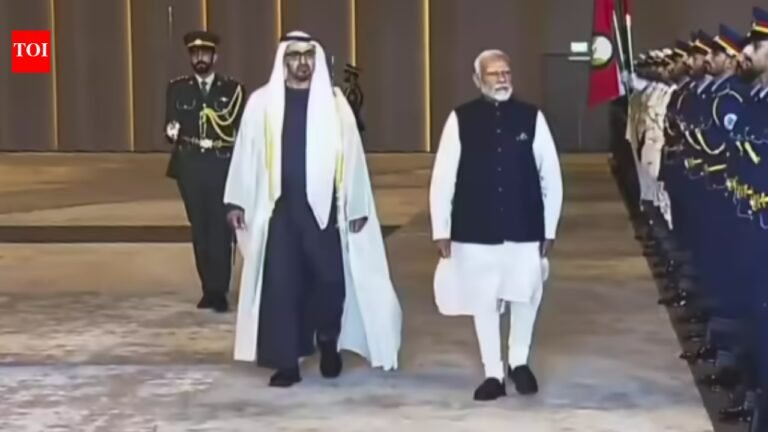
New Delhi: Prime Minister Narendra Modi Iranian retaliatory missiles and drones struck parts of the Gulf on Sunday, killing civilians and hitting critical infrastructure in the region.In a message posted on X, Prime Minister Modi Said: “Speaked to the President of the UAE, my brother Sheikh Mohammed bin Zayed Al Nahyan. Strongly condemned the attacks on the UAE and expressed condolences for the loss of life in these attacks. India stands with the UAE during these difficult times. Thank him for taking care of the Indian community living in the UAE. We support de-escalation, regional peace, security and stability.”The prime minister’s comments came as authorities in the United Arab Emirates confirmed that four people have been killed and dozens injured since Iran began counterattacking in the wake of a U.S. and Israeli campaign to eliminate Tehran’s top leader and other senior officials. Explosions were heard in cities including Dubai and Abu Dhabi for a second day in a row as Gulf states scrambled to intercept missiles and drones.The UAE Defense Ministry said it had detected 165 ballistic missiles since Saturday and destroyed 152 of them, while intercepting two cruise missiles. Iran launched 541 drones, of which 506 were shot down. Despite the high interception rate, fragments of falling projectiles still cause casualties and property damage. Three foreigners from Pakistan, Nepal and Bangladesh were reportedly among those killed in the UAE. Two people were injured when debris hit a complex housing foreign missions in Abu Dhabi.Civilian infrastructure in the Gulf has been affected, including airports, seaports and residential buildings. Fires were reported in prominent locations in Dubai, and airports in the United Arab Emirates and Kuwait were also attacked. In Bahrain, a drone caused minor damage to the capital’s airport.
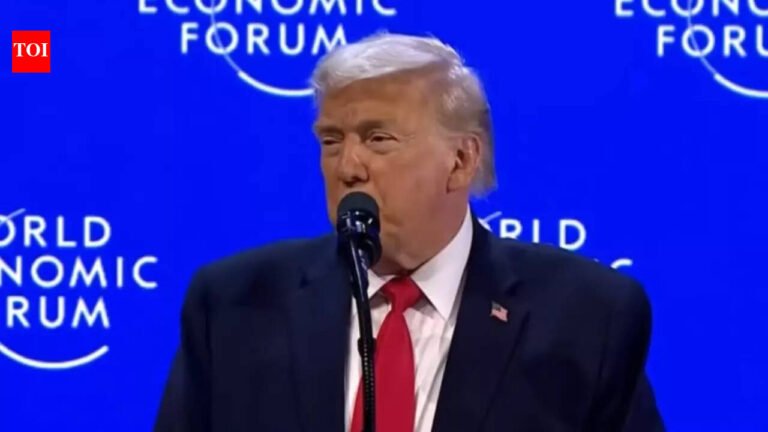
President of the United States Donald Trump According to an interview with The Atlantic, he said on Sunday that Iran’s new leadership wanted to talk to him and he agreed.“They want to talk and I agree to talk, so I will talk to them. They should have done it sooner. They should provide something very practical and easy to do as soon as possible. They’ve waited too long,” Trump said in an interview at his residence in Florida.Trump did not specify who he would talk to or whether the talks would take place on Sunday or Monday, but he noted that some Iranians involved in the negotiations have died in recent weeks.
Iran War: Trump’s first video message to Khamenei and Iranians; confirms combat action | ‘Surrender now’
“Most of them are gone. Some of the people we dealt with are gone, too, because it was a big blow,” he said. “They should have done it sooner, Michael. They could have made a deal. They should have done it sooner. They were being so cute.”iranian president Massoud Pezeshkian After Khamenei’s death, a leadership council composed of himself, the justice minister and members of the powerful Council of Guardians temporarily assumed the responsibilities of the supreme leader.Asked whether he would be willing to extend the U.S. bombing campaign in Iran to support a popular uprising if a popular uprising broke out, “If it takes some time to overthrow the regime, will they continue to have support?” Trump was noncommittal. “I have to see the circumstances when it happened, Michael. You can’t answer that question,” he said. But the president also expressed confidence that the uprising is about to succeed, noting signs of celebration in the streets of Iran and support rallies among the Iranian diaspora in New York and Los Angeles. “It’s going to happen. You’re seeing this and I think it’s going to happen. A lot of people there, in Los Angeles and a lot of other places are very happy,” he said. Trump told the magazine he was pleased with the response of the Iranian people so far. “Knowing that this is very dangerous, knowing that I’m telling everyone to stay where they are — I think this is a very dangerous place to be right now,” he told me. “People were cheering in the streets over there, but at the same time, there were a lot of bombs falling.”
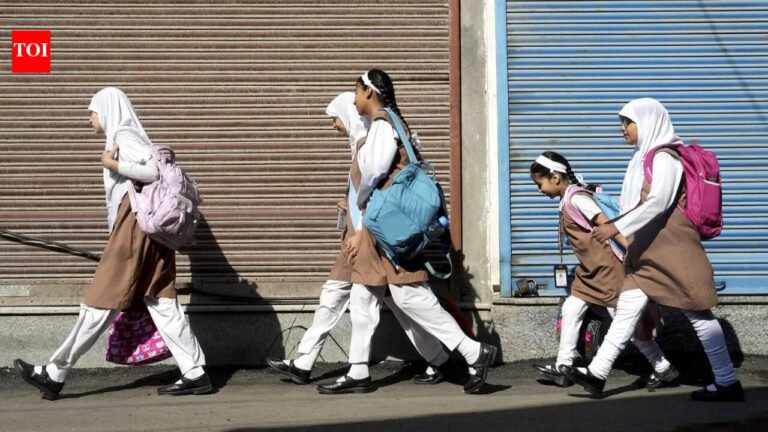
New Delhi: Schools in Jammu and Kashmir will remain closed from March 2 to 3 due to repeated Pakistani drone incursions along the Line of Control (LoC) and escalating tensions in West Asia, the Directorate of School Education, Kashmir announced today.Authorities have postponed the scheduled reopening of schools tomorrow after winter break to Grade 8 in order to prioritize student safety amid a rapidly evolving security situation. The order covers all government and private recognized schools in the district.
Suspected Pakistani drone spotted in LoC, IB areas near Samba, Rajouri and Poonch districts of J&K
In the latest incident, Indian Army troops foiled 2-3 small quadcopters that attempted to intrude into Indian airspace in the Poonch sector of the Line of Control between 5:45 and 6:00 am today. Vigilant personnel quickly deployed counter-drone measures, forcing the drone to retreat without causing any harm.This is the latest in a series of drone sightings along the Line of Actual Control and the international border in recent days, prompting the Army to step up surveillance and preparedness to prevent further violations.The blockades coincided with heightened regional instability triggered by joint Israeli and U.S. missile attacks on Iran (codenamed Operation Roaring Lion and Operation Epic Fury), which reportedly killed Iran’s Supreme Leader Ayatollah Ali Khamenei, his daughter, grandson, daughter-in-law, and son-in-law in bombings in Tehran and other cities. U.S. President Donald Trump confirmed the attack, while Iranian state media responded by describing the leader’s casualties.Iran has retaliated by targeting U.S. bases in Dubai, Doha, Qatar, Bahrain and Kuwait, further raising concerns about a wider conflict spilling into South Asia. Officials in Jammu and Kashmir said the combined threats prompted a two-day lockdown to protect children.
Far-right influencer Laura Loomer claims to have identified the suspect in the 2017 Buford backyard beer garden shooting. austinTexas, early Sunday morning. As of now, the FBI has not identified the suspect but is investigating it as a potential act of terrorism.
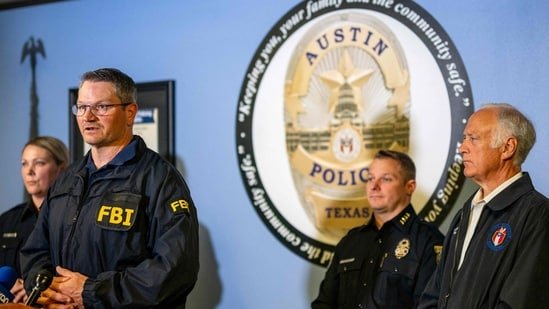
FBI Special Agent Alex Dolan speaks during a news conference on the mass shooting at the Buford Bar in the Austin Police Department on March 1. (Getty Images, AFP)
In one, Loomer claimed the shooter was Ndiaga Diagne, who she said was a naturalized citizen of Senegal. also. The New York Post also claimed that the shooter was Diagne, 53 years old.
As of now, no other sources have confirmed the identity of the shooter. The suspect was shot to death by law enforcement officers after killing two people and injuring at least 14 others.
Ht.com cannot independently make a statement about Laura Loomer Suspect. Loomer has a long history of spreading misinformation, and many of her theories have been debunked multiple times.
Here is Loomer’s post:
According to Austin Police Chief Lisa David, the suspect was driving a large SUV. He drove around the bars on West Sixth Street and finally stopped in front of Buford’s Bar. He turned on the SUV’s hazard lights, pulled out his gun and started shooting.
The shooting occurred around 2 a.m. local time on Sunday.
Terrorism and alleged Iran links
Alex Dolan, the special agent in charge of the FBI’s Austin office, said there were “indications” the shooting may have been an act of terrorism. However, Dolan added that “it is too early to make a decision.”
The New York Post reported, citing sources familiar with the FBI’s Joint Terrorism Task Force investigation, that the shooter may have been motivated by the death of Iran’s late supreme leader. Ayatollah Ali KhameneiOn Saturday, the United States and Israel launched a joint attack on the country.
The New York Times report again cited sources who said the suspect had a Quran in his car and other belongings in the car, suggesting it may have been motivated by terrorism. They said the suspect had a history of arrests and lived briefly in New York in the early 2000s.
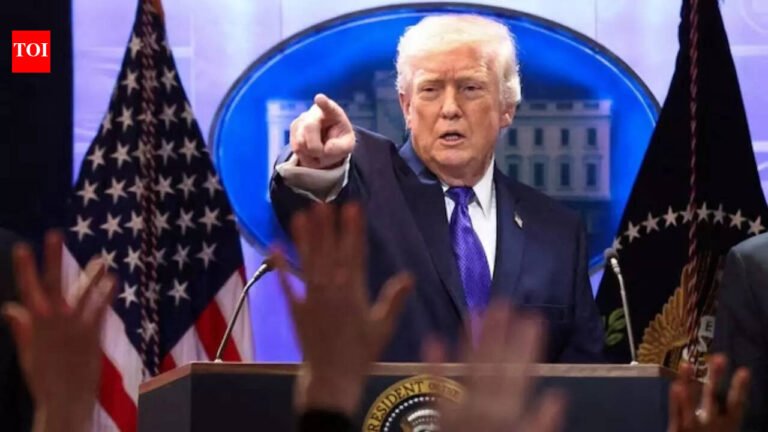
TOI reporter in Washington: In the past ten years, the President of the United States and the top leader of MAGA Donald Trump His political identity revolved around a simple but powerful promise: to end America’s “endless wars.” He derided the foreign policy establishment as reckless interventionists and insisted that only he could stand up to the military-industrial complex. “I am the most militaristic man in the world, but I don’t want to use it,” he often said, calling himself the “Peace President.”As 2026 approaches, however, Trump’s second term tells a very different story—one characterized by forceful intervention in Venezuela and now Iran, overt threats against Greenland, Mexico, and Canada, and a worldview that blends passionate nationalism with high-stakes brinksmanship.
Iran attacks U.S. troops; conflict escalates, at least 3 U.S. troops killed and 5 seriously injured
The most dramatic break with Trump’s early peace stance came in January, when U.S. forces launched a blitz of operations in Venezuela that resulted in the capture of Venezuelan President Nicolás Maduro and his wife, Celia Flores. The raid, dubbed a “counternarcotics mission” by the White House, effectively destroyed the Caracas government. But that was a “little thing” compared to his actions in Iran, where he lambasted the country’s top leader. Trump has called the actions in Venezuela a law enforcement action. “We are eliminating narco-terrorists who threaten American communities,” he said, adding that the United States would oversee a “stable transition.” Critics, including many Democrats on Capitol Hill, call it regime change by another name.Behind the rationale for drug prohibition lie broader geopolitical considerations. Maduro’s government has deepened ties with Moscow and Beijing, providing both countries with a strategic foothold in the Western Hemisphere. The operation, which critics call part of the “Donroe Doctrine” – a reinterpretation of the Monroe Doctrine – shows that Trump sees the Americas as a domain where the United States will reinforce its dominance through force if necessary.That confidence has extended north. Trump has rekindled his long-standing ambition to “seize” Greenland from Denmark, at one point hinting at military options if talks stalled. “Whether they like it or not, we are going to take some action in Greenland,” he said in January, before softening his rhetoric at the Davos forum amid strong opposition from Nato. The incident has rattled European allies and underscored a foreign policy that treats the territory no longer as sovereign territory but as strategic real estate.The contradiction between Trump’s words and deeds is most obvious in Iran. In June 2025, following “Operation Midnight Hammer,” Trump claimed that U.S. strikes had “totally destroyed” Tehran’s nuclear capabilities. “They will never have nuclear weapons,” he said triumphantly, describing the mission as a decisive end to the threat.But eight months later, he authorized Operation Epic Fury, a sweeping joint attack with Israel targeting nuclear facilities, missile facilities and senior regime figures. In a televised address, Trump offered a starkly different assessment. “The regime continues to develop its nuclear program and plans to develop missiles to reach U.S. soil,” he said. “We will ensure that Iran does not acquire a nuclear weapon… This regime will soon understand that no one should challenge the power of the United States’ armed forces.“The contrast is shocking: a president who claimed to have eliminated a threat is now citing an “imminent” resurgence of the threat as justification for further war. A U.S. intelligence assessment last year suggested Iran was not actively seeking weapons, raising questions about the urgency of the danger. Administration officials believe the renewed force is needed as Tehran attempts to rebuild capabilities after the 2025 attacks. For Trump, the difference may be less about technical intelligence judgment and more about projecting power. In his framework, peace is achieved not through negotiated equilibrium but through overwhelming domination.On top of these actions is Trump’s longstanding focus on the Nobel Peace Prize. He has repeatedly argued that diplomatic efforts such as the Abraham Accords deserve recognition, and has publicly lamented that “Norway foolishly chose not to give me this award.” His repeated claims that he has “ended eight wars” and saved “tens of millions of lives” suggest that his critics are ignoring the stabilizing effect of his self-confidence. In a message to Norwegian officials, he suggested that the perceived slight had undermined his drive to “think purely about peace.”The irony is obvious. Trump equates peace with surrender — ending a conflict through coercive or decisive force. By this logic, escalating a crisis to a breaking point and then imposing an outcome could be considered peacemaking. The result was a presidency that was both isolationist and interventionist. Trump remains skeptical of multilateral institutions, cutting foreign aid and asking allies to shoulder more of the burden. However, he has shown a readiness to unilaterally deploy U.S. power in pursuit of strategic influence. Supporters see decisive leadership restoring deterrence. Critics see the erosion of alliances and a pattern of regime-change operations once condemned as folly.The core paradox remains: A leader who rose to prominence by condemning foreign entanglements now presides over an era of expanding military engagement. In Trump’s evolving credo, “America first” does not mean withdrawing from the world. That means reinventing it – with force if necessary – while insisting that the ultimate goal is peace, and perhaps a medal, which he’ll likely wear on himself to prove it.
At 9, Aahana checks her mother’s phone before brushing her teeth. By the time she leaves for school in Gurugram, she has scrolled through multiple short-video feeds, probably texted in two group chats. Her mother says she worries about how much she is engaged now to what happens on a screen.Across India’s cities and small towns, this scene is no longer unusual. Smartphones are often handed to children before they enter their teens, at times when they are toddlers. Social media accounts, sometimes created despite platform age limits, follow soon after. What began as a tool for communication has become an ecosystem where friendships, validation and identity increasingly take shape.
Australia Enforces World’s First Under-16 Social Media Ban, Sparks Global Debate| Global Pulse
Now, as countries from Australia to the United Kingdom tighten digital safety norms for minors, India faces a policy crossroads: confronting a difficult question: should social media platforms be off-limits for those under 15? The debate is no longer theoretical, rather have shifted from anecdotal parental anxiety to a public health and regulatory conversation backed by research. Mental health professionals are reporting patterns. Concerns around screen addiction, online bullying, harmful content and declining mental health indicators among adolescents have pushed policymakers to study global precedents worldwide to consider stricter age-gating laws. In India, home to over 250 million adolescents and one of the world’s largest internet user bases, the stakes are significantly higher. For millions of Indian children, the smartphone is no longer a device of privilege but of routine. Classrooms moved online during the pandemic. Friendships migrated to messaging apps. Entertainment, identity formation and peer validation increasingly unfold through short videos and algorithm-driven feeds. Yet, alongside opportunity lies unease: how much exposure is too much, and at what age? The question is no longer whether social media affects children. It is whether prohibition is the answer, or whether regulation, design reform and digital literacy can achieve better outcomes.
Global regulatory shifts: A growing policy trend
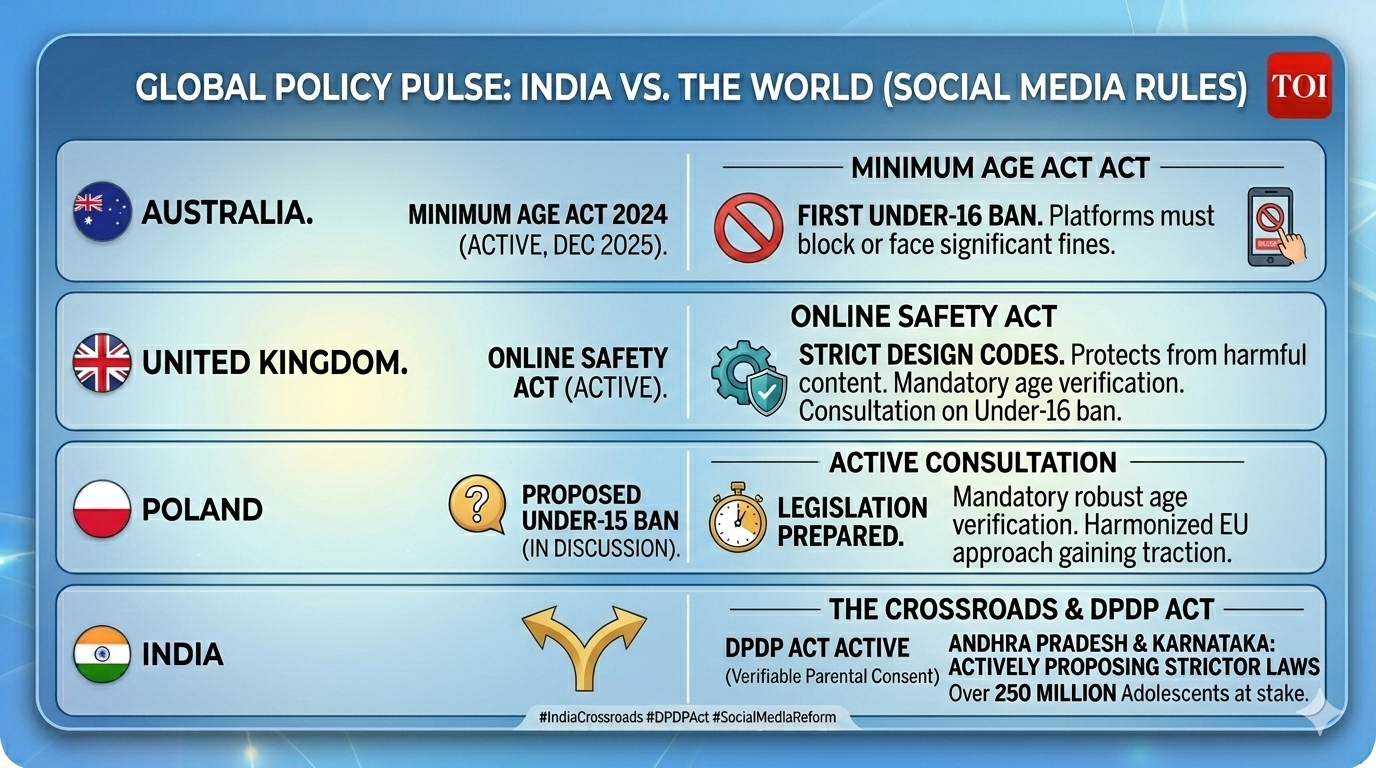
Governments have begun responding to mounting evidence linking heavy social media use to mental health challenges among adolescents. And in effect have moved toward stronger age restrictions on social media use.In Australia, the government has moved from debate to implementation. The Online Safety Amendment (Social Media Minimum Age) Act 2024 took effect on 10 December 2025, making Australia the first country to ban social media accounts for users under 16, with platforms required to take “reasonable steps” to block access or face significant fines. Early evaluation of the law’s impacts, on youth wellbeing, family dynamics and usage patterns, has begun, with findings to be published through 2026 and beyond. In the United Kingdom, the Online Safety Act continues to impose stricter obligations on platforms to protect children from harmful or explicit material and enforce age-appropriate design. Regulators have fined major services for failing to adequately verify users’ ages, and the government is now consulting on potentially raising age restrictions or even exploring a formal under-16 ban after Australia’s example. Elsewhere in Europe, several countries are actively pushing similar measures. Poland’s ruling party is preparing legislation to ban social media for children under 15 and mandate robust age verification, while France, Denmark and other EU states are debating or enacting age limits between 15–16 years. Efforts toward a harmonised EU approach are gaining political traction amid rising concern over youth mental health, as reported by Reuters.
In the United States, the picture remains complex and contested. Multiple state laws aimed at age verification, parental consent or outright limits on minors’ social media use have been introduced. Notably, a Virginia law that would have limited under-16 usage to one hour daily and required age checks was blocked by a federal court in February 2026 for infringing constitutional speech rights, illustrating the legal challenges such measures face. While outright bans are still uncommon and legally fraught in the US, the direction of travel is clear: policymakers are increasingly shifting accountability from families to technology companies through design rules, verification obligations, and platform-level safeguards.The global policy shift is emphasised by mounting research linking heavy social media use among adolescents to anxiety, depression, sleep disturbances and body image issues, concerns now cited widely on public health grounds rather than purely moral arguments.For India, observing these global experiments offers both cautionary and instructive lessons. Enforcement challenges, the privacy implications of stringent age verification, and constitutional protections around free speech and access to information complicate the feasibility of blanket prohibitions. Ongoing debate reflects these tensions, with commentators urging a balanced focus on digital literacy, safer defaults, and family-oriented safeguards rather than top-down bans alone.
The impact of social media on children: Evidence and counterpoints
Screen time, mental health and behavioural risks
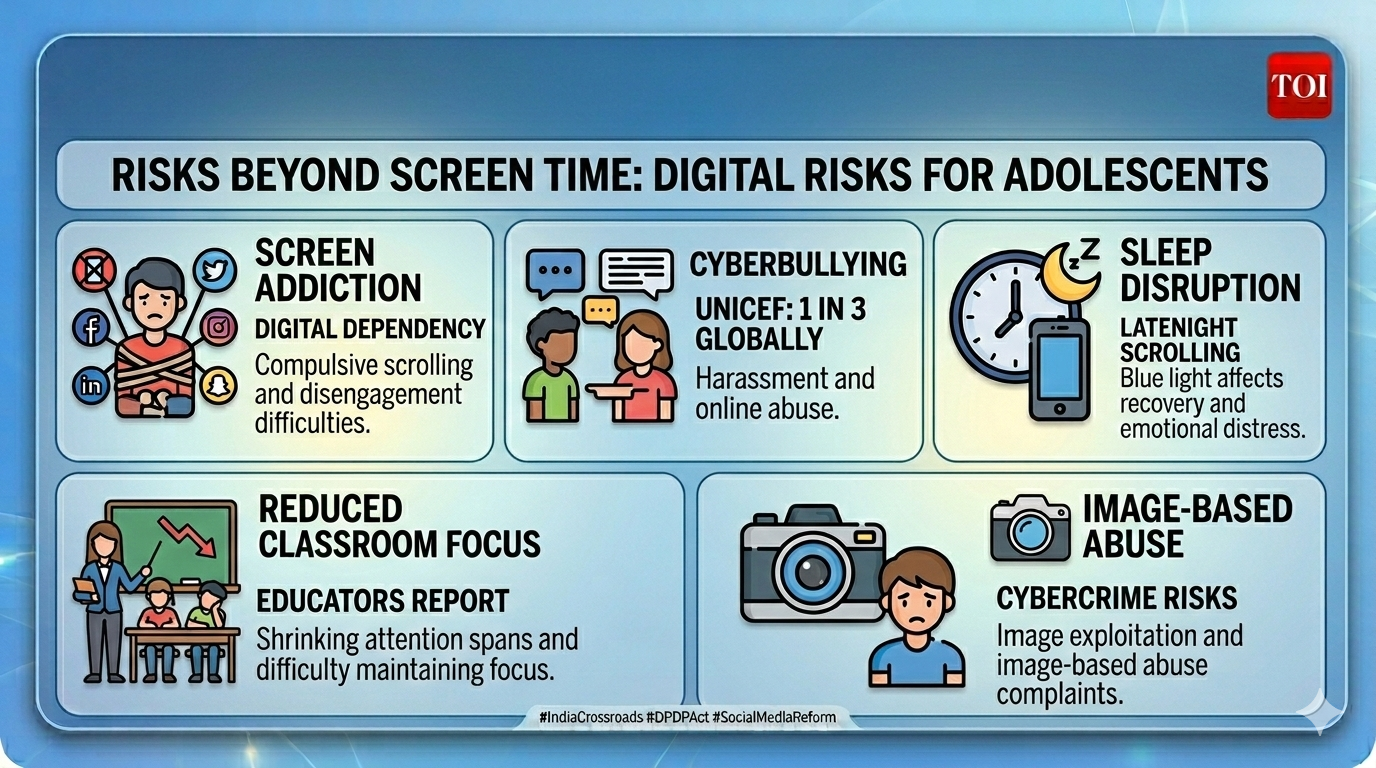
Research has consistently flagged correlations between excessive social media use and adverse psychological outcomes in adolescents.A 2019 study published in JAMA Pediatrics tracked nearly 6,600 adolescents and found that those spending more than three hours a day on social media faced a significantly higher risk of mental health problems, particularly internalising symptoms such as anxiety and depression.In 2023, another study in the same journal reported that habitual checking of social media was associated with changes in brain development patterns related to social reward sensitivity in early adolescence. While researchers cautioned that correlation does not prove causation, they noted measurable neural differences in frequent users.Similar research published in The Lancet Child & Adolescent Health has found that heavy social media use among teenage girls was associated with poorer sleep, lower self-esteem and higher rates of depressive symptoms. Sleep disruption emerged as a key pathway linking screen exposure to emotional distress.
The WHO has flagged problematic digital use as a growing behavioural concern, noting associations with sedentary lifestyles, cyberbullying and compulsive use patterns.Dr Rhea Mehra, a Delhi-based child psychiatrist, says she has observed a steady increase in digital dependency cases among children aged 11 to 15. “We are seeing children who struggle to disengage from their devices, whose mood fluctuates based on online interactions,” she says. “In some cases, sleep cycles are severely disrupted because screen time extends past midnight (when left unchecked).”She adds that early adolescence is a vulnerable developmental stage. “Impulse control and emotional regulation are still developing. Social media platforms are designed around instant feedback and comparison, which can amplify insecurities.”
Cyberbullying and exposure risks
The risks are not limited to screen duration.A UNICEF report has highlighted that one in three young people globally reports experiencing cyberbullying. In India, cybercrime data show increasing complaints involving minors, including harassment and image-based abuse.Parents recount similar concerns. “It’s not just about time,” says Mohit, a Delhi-based father of an 11-year-old. “It’s about what they are seeing. There are trends and challenges that can be dangerous. And sometimes we don’t even know what’s circulating in their groups.”Another parent, Prathamesh Singh from Pune, says monitoring has become a daily task. “You don’t want to invade privacy, but you can’t be completely hands-off either. It’s a constant balancing act.”
Academic and developmental concerns
Educators report shrinking attention spans and difficulty maintaining classroom focus. Studies have linked excessive device use to reduced academic performance, though causation remains debated.Dr Mehra notes, “Some children show signs of reduced face-to-face social skills. They are comfortable online but anxious in real-world interactions.”
The counterpoint: Not all use is harmful
Research also cautions against sweeping conclusions.Studies have shown that moderate, purposeful use, such as communicating with known peers, does not uniformly predict poor mental health. For some adolescents, online communities provide support, particularly for those who feel isolated offline.The American Psychological Association has stated that the impact of social media depends on content, duration and individual vulnerability factors.“Blanket demonisation of technology is not helpful,” Dr Mehra says. “The question is how it is used, at what age and with what safeguards.”
India’s regulatory landscape: What exists
India does not currently ban social media for minors under 15. Most platforms prohibit users under 13, consistent with global standards, but enforcement relies largely on self-declared age.The Digital Personal Data Protection Act, 2023, mandates verifiable parental consent for processing children’s data and places obligations on data fiduciaries to protect minors’ information.The IT Rules, require intermediaries to remove unlawful content and establish grievance mechanisms. However, age verification remains technically and administratively complex. India’s vast user base, with hundreds of millions of internet subscribers, makes enforcement challenging.Legal experts also note that any outright ban would have to withstand scrutiny under constitutional protections related to speech and access to information, as interpreted by the Supreme Court of India.Enforcement, however, is India’s perennial challenge. With millions of new internet users each year and widespread access to shared devices, age-based prohibitions could prove difficult to implement uniformly. Rural-urban divides, digital literacy levels and socio-economic disparities further complicate the regulatory equation.
Should India impose a ban?
Among parents of children under 15, opinion is divided.Those advocating a ban argue that children under 15 lack the cognitive maturity to navigate algorithm-driven ecosystems designed for engagement maximisation. Some favour stricter age barriers, citing distraction, exposure to inappropriate content and peer pressure. Others worry that an outright ban would push usage underground, making monitoring harder.
Parents describe a daily negotiation: balancing academic needs with leisure use, setting screen-time limits and modelling digital discipline themselves. Many acknowledge that devices have become integral to schooling and social belonging, making complete prohibition unrealistic.“Regulation has not kept pace with platform design,” says Dr Mehra. “Younger adolescents are particularly susceptible to peer comparison and online validation cycles.” On the regulation front, the argument in policy circles is also that, don’t wait for regulations, as current regulations are neither adequate, nor sufficient, nor can be termed as over -regulations.Parents like Mohit support stricter age thresholds. “If there was a clear law, it would make it easier for parents to say no,” he says. However, critics question feasibility. Children may bypass age checks using older relatives’ credentials. Overly intrusive verification could compromise privacy. And educational, creative and social benefits may be curtailed. Prathamesh believes prohibition could backfire. “If you ban it outright, they will find workarounds. It might push things underground.”Public health experts increasingly suggest a layered approach rather than an absolute ban.Child psychiatrists in metropolitan centres report an uptick in consultations linked to excessive gaming, social media dependency and anxiety triggered by online comparison. At the same time, mental health professionals caution against attributing complex psychological issues solely to social media. Family dynamics, academic stress, urban isolation and pandemic after-effects also play substantial roles.
What India could consider
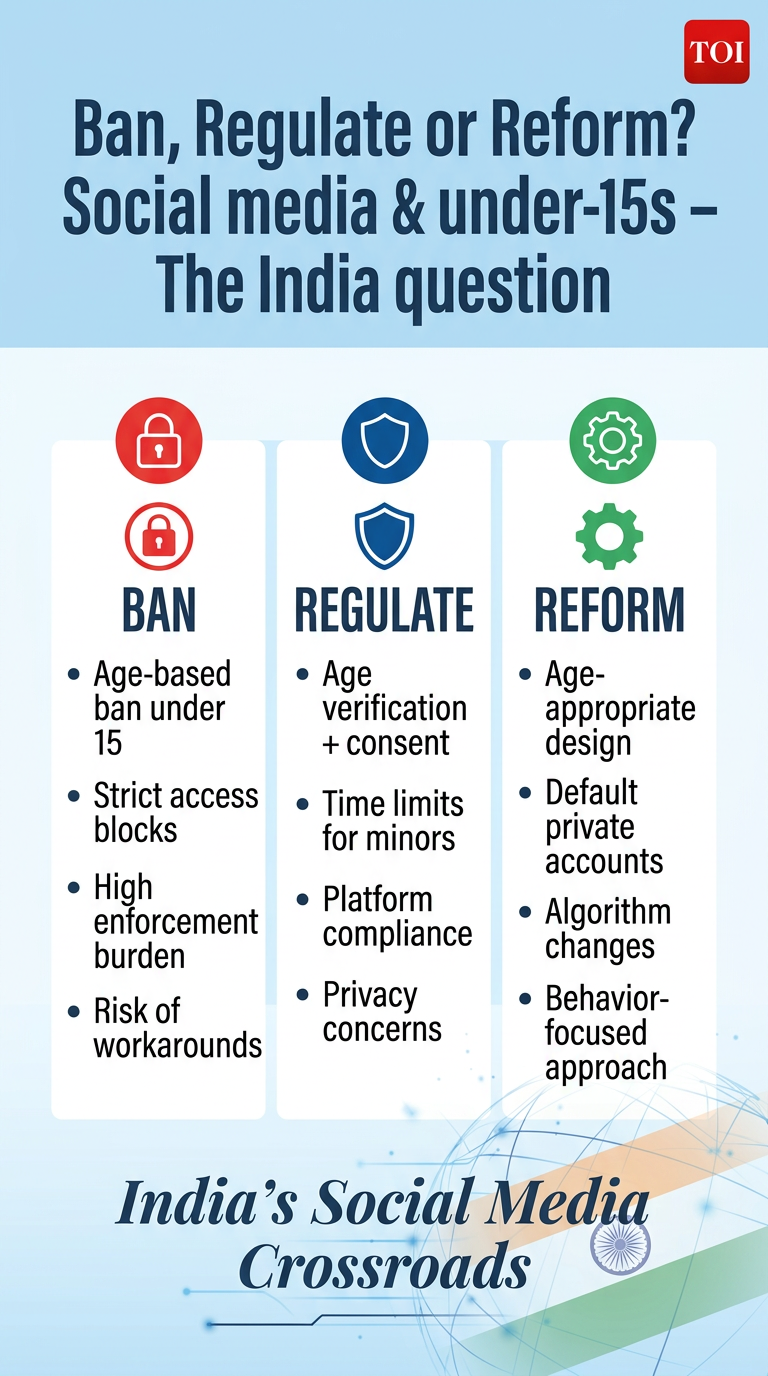
Borrowing from the UK’s age-appropriate design code, India could mandate that platforms default minors to private accounts, disable targeted advertising, remove public follower counts for young users, and limit algorithmic amplification of sensitive content. This approach shifts focus from access to environment.There is also a case for time-bound restrictions rather than outright bans, for instance, limiting usage hours for verified minor accounts or mandating built-in digital well-being tools. However, such measures depend heavily on platform cooperation and technical integration.Digital literacy is another lever. Experts argue that equipping children with critical thinking skills, teaching parents to set boundaries, and integrating online safety modules into school curricula may prove more sustainable than prohibition. The ministry of education’s ongoing digital awareness programmes could be expanded to include structured modules on cyberbullying, misinformation and privacy.
The constitutional and social balancing act
Any move toward a ban would likely invite legal scrutiny. Access to the internet has been described by courts as integral to freedom of expression and trade in certain contexts. While reasonable restrictions to protect minors are permissible, proportionality would be tested.India’s demographic reality adds complexity. A large chunk of its population is under 18. A uniform prohibition for under-15s could affect tens of millions of users, a scale unmatched by most Western nations experimenting with similar policies. Socio-economic context matters too. For children in resource-constrained settings, free digital platforms often double as learning tools, networking spaces and gateways to opportunities. Restrictive policies could inadvertently widen inequality if alternative safe platforms are not simultaneously developed.
Policy options include:
Public health experts increasingly advocate a layered approach:
Stronger age-verification systems, balanced against privacy concerns.
Age-appropriate design mandates, such as disabling targeted ads for minors and limiting algorithmic amplification.
Increase transparency in algorithms that recommend content to young users.
Default privacy settings for verified minor accounts.
Enforce stricter data protection norms for minors.
Strengthen reporting mechanisms for cyberbullying and harmful material.
Invest in digital literacy education for both children and parents.
Clearer parental control frameworks built into platforms.
Dr Mehra supports design reform. “If platforms reduced visible metrics like follower counts for minors, it could lower comparison anxiety,” she says.Research published in JAMA Pediatrics and The Lancet Child & Adolescent Health suggests that intensity and type of engagement matter more than mere access. Policymakers may therefore need to focus on the environment rather than outright exclusion.Such a framework recognises that the digital ecosystem is unlikely to recede. Instead of attempting to eliminate children’s access entirely, regulation could focus on reshaping the environment in which that access occurs.
Conversation already underway
Within India, the conversation is no longer theoretical. Andhra Pradesh has emerged as one of the most proactive states examining whether social media access should be restricted for school-going children. During a recent Assembly session, state home minister Vangalapudi Anitha informed lawmakers that a proposed law could limit social media use among minors. A government sub-group has since begun reviewing regulatory models, including age-based access controls and mechanisms to curb misinformation.IT and HRD minister Nara Lokesh publicly articulated the state’s concerns. In a post on X, he wrote:“Trust in social media is breaking down. Children are slipping into relentless usage, affecting their attention spans and education. Women are facing non-stop online abuse. This cannot be ignored.”He further noted that children below a certain age may lack the emotional maturity to process harmful online content, adding that the government is studying global best practices, including Australia’s under-16 framework. Official data cited by the state indicates over 1,300 cases linked to inappropriate online content, with more than 1,000 individuals taken into custody before court proceedings, figures that underscore enforcement challenges already underway.At the national level, TDP parliamentary party leader Lavu Sri Krishna Devarayalu has submitted a memorandum to Union minister Ashwini Vaishnaw seeking structured consultations on age-based regulation for minors. The Centre is expected to consider forming an expert panel before advancing any nationwide framework.Karnataka, meanwhile, is adopting a consultative approach. Chief minister Siddaramaiah recently sought feedback from university vice chancellors on restricting mobile phone use among students, referencing measures discussed in countries such as Australia, Finland and the UK.“Today we are discussing this… I want your opinion on this. We are looking at this,” he said, clarifying that any proposal would focus on minors rather than adult learners.Deputy chief minister DK Shivakumar has also raised concerns over rising screen dependence among youth. At the same time, Karnataka has rolled out a digital wellbeing initiative in partnership with Meta, covering nearly three lakh students and one lakh educators. The programme emphasises responsible and mindful technology use rather than outright bans, with outcomes currently under review. Together, these state-level experiments illustrate India’s emerging dilemma: whether to impose strict age-based bans, strengthen regulatory oversight, or prioritise digital literacy and behavioural reform. As debates intensify, the country appears to be testing multiple pathways before settling on a unified national position.
The balancing act ahead
The debate over banning social media for under-15s in India is ultimately about more than apps or algorithms. It reflects a broader anxiety about childhood in a hyperconnected age.India has one of the world’s youngest populations. Any move affecting under-15 users would impact tens of millions of families. The global momentum toward tighter regulation provides reference points, but India’s scale and diversity demand context-specific solutions.The evidence shows associations between heavy social media use and mental health risks, particularly among early adolescents. It also shows nuance: not every user experiences harm, and not every platform interaction is detrimental.For parents like Mohit, the question remains immediate. “We didn’t grow up like this. We are learning as we go,” he says.For clinicians like Dr Mehra, the trend is visible but complex. “This is not a single-cause issue. But social media is now a significant variable in childhood development.”Whether India chooses to ban, regulate or redesign access for under-15s, the policy must rest on evidence, enforceability and proportionality. The debate is less about whether children are online, they already are, and more about what kind of digital environment the country is willing to permit for them.
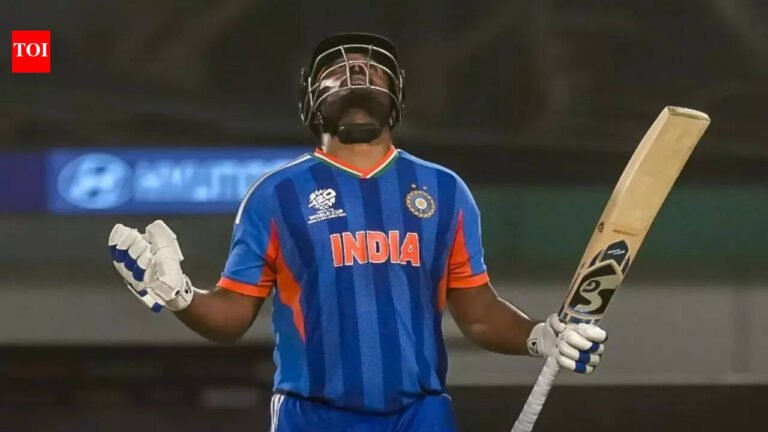
Sanju Samson celebrates his half-century during the cricket match between India and West Indies at the ICC Men’s T20 World Cup 2026 at Eden Gardens in Kolkata, West Bengal. (Press Trust photo)
TimesofIndia.com in Kolkata: Soon after reaching the winning boundary, Sanju Samson took off his helmet and knelt down to thank the Almighty. The right-hander had a relaxed look on his face as he delivered a stunning knock to take India into the T20 World Cup semi-finals. Even before the crowd could capture the winning moment, ‘Vande Mataram’ was at full volume and players from the Indian dugout rushed out to celebrate a top-notch run under pressure. “Lehra Do” followed, and laser lights joined the performance as the announcer egged the audience on. The party only started in Kolkata after India (199/5) beat West Indies (195/4) with four deliveries. Until a week ago in Ahmedabad, Sanju Samson was far from making the XI as India were content with two left-handers, Ishan Kishan and Abhishek Sharma, as their two openers. However, the constant threat of spin resulted in early wickets, forcing the think tank to re-strategize and bring the right-hander Samson back to the top of the order. He lost his place to the in-form Kishan but tactical requirements forced the southpaw to drop to No. 3 and the right-hander resumed. The move worked in the must-win game against Zimbabwe in Chennai earlier this week, not only giving India a brisk start but also maintaining their lead. Despite the introduction of spin early on in Kolkata and India losing two early wickets, Samson unleashed his best potential when the team struggled. The right-hander played a memorable knock while chasing a hard target to help India advance to the semi-finals of the multi-nation tournament. He drove the ball well, chipped ferociously and showed big-game flair in front of the Eden Park crowd.
T20 World Cup: Salman Ali Agha holds press conference after PAK vs SL
Be it pace or spin, Samson knocked them down with aplomb and never lost shape in the process. He hit the balls he was supposed to hit, but his ice-cold nerves came to the fore in his 50-ball 97*, which included 12 boundaries and four sixes.With plenty of dew on the pitch and no demons, batting becomes less difficult; however, the scoreboard pressure of a virtual quarterfinal makes it a difficult task. The wickets falling from the other end did little to change Samson’s approach; he continued to operate at a healthy strike rate and keep the asking price in check. A partnership with Suryakumar Yadav put the chase behind the early wickets on track and along with Tilak Varma gave the game a much-needed boost with a comfortable 42 runs off just 26 balls.When Hardik Pandya joined Samson, the equation was under control: 55 runs needed in 32 balls. As the batting progressed, India controlled the match from then on. Samson and Pandya gave India the win, with Samson taking five wickets to help India cross the finish line.Earlier, after opting to open the batting, India’s defense was a huge letdown, with the group letting down the bowlers in excellent batting conditions. Three false boundaries, two false catches and a missed run cost India dearly as they were unable to seal the high-flying West Indies batting line-up with regular breakthroughs. Midway through the match, things were not alarming and the bowlers kept the score at 82/1. The scoreboard could have been worse if they had caught the ball and capitalized on the run, but it was far from panic territory.Jasprit Bumrah and Varun Chakravarthy both had three overs left, while Suryakumar Yadav’s clever bowling changes gave India a tactical advantage heading into the second half of the innings. West Indies showed their determination by scoring 17 runs in the second over at Chakravarthy. The body language became ever so brief as Eden Gardens was about to erupt off Bumrah’s delivery in the 12th over.Two wickets, including that of the dangerous Shimron Hetmyer, had the crowd roaring with joy and chants of “Boom Boom Bumrah” echoed from the stands every time the bowlers stood above the target. He had a match-up advantage over the left-hander, bowled him out in just two deliveries and added another wicket with a slower ball, completely deceiving a well-placed Roston Chase. A few overs later, the score went from 102/1 to 103/3 and India did what assistant coach Ryan Ten Doushate expected: tit for tat.At the end of the 14th over, when the hosts went into the drinks interval of the final innings, the scoreboard read 119/3, but India still needed to get Hardik Pandya over. During the break, head coach Gautam Gambhir went straight to the all-rounder and discussed the angles he could explore against Sherfan Rutherford. Pandya executed the plan perfectly, dismissing the left-hander on the first delivery, putting India in the driver’s seat.125/4, with just five games left, is not a bad position to be in, especially with four overs from Bumrah and Arshdeep, and one from Chakarvarthy. Heavy dew is starting to fall but people will support them in getting the job done during this emergency. However, in the next five overs, Rovman Powell and Jason Holder put in a well-choreographed muscle attack; in the next 30 deliveries, they added a total of 70 runs, beating Bumrah, Arshdeep and Chakarvarthy in the process.Bumrah conceded 26 runs in the last two overs, Chakarvarthy conceded 14 runs and Arshdeep conceded 30 runs in the remaining two overs. Arshdeep’s 24-run delivery in the 16th over turned the West Indies’ momentum around. The left-hander looked out of form, conceding two sixes off five balls and another two balls, resulting in a dropped shoulder. Bumrah gave it his all in the remaining two overs and his reaction after Varun’s delivery went out of bounds summed up the overall performance on the field. It was a big letdown on their biggest night of the tournament so far.However, one special Samson overcame all odds to play the semi-final against England on March 5 at the Wankhede Stadium in Mumbai.Brief score: West Indies 195/4 in 20 overs (Roston Chase 40, Jason Holder 37, Rovman Powell 34; Jasprit Bumrah 2-36)India: 199/5 in 19.2 overs (Sanju Samson 97; Jason Holder 2-38)
The United States says its first Americans have been killed in a war with Iran that has spread to countries across the Middle East and threatens to upend energy markets.
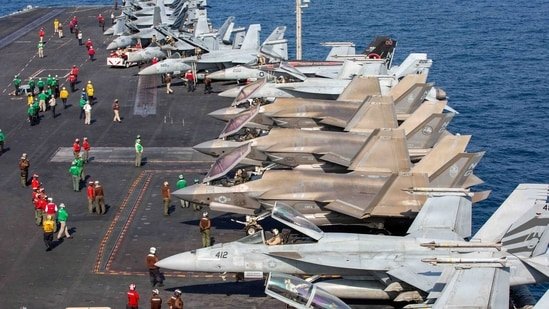
Aircraft belonging to Carrier Air Wing (CVW) 9 parked on the flight deck of the U.S. Navy’s Nimitz-class aircraft carrier USS Abraham Lincoln on February 28, 2026, in support of the Epic Operation Fury attack on Iran. U.S. Navy/Handout via Reuters This image was provided by a third party (via Reuters)
U.S. Central Command said on Sunday that three U.S. service members were killed and five others were “seriously wounded” in operations against the Islamic Republic, but gave no further details.
US President Donald Trump said in an earlier social media post that Iran’s supreme leader Ayatollah Ali Khamenei was killed on the first day of an attack by Washington and regional ally Israel. Tehran confirmed the news hours later, saying the government would hold 40 days of national mourning for the 86-year-old ruler who was killed in his office building.
“However, heavy, precise bombing will continue without interruption throughout the week or as long as necessary,” Trump said. Speaking on Sunday, Israeli Prime Minister Benjamin Netanyahu said Israeli forces were “attacking Tehran with increasing intensity and will only intensify in the coming days.”
The war spread across the Middle East on Sunday, with Iran firing waves of missiles at targets in multiple countries in response to initial attacks by the United States and Israel. Iranian shells hit buildings in Tel Aviv, while defense systems from Saudi Arabia, Qatar, Bahrain and Kuwait intercepted the incoming fire.
The main airport in Dubai, the world’s busiest aviation hub, came under attack, shutting down almost all civil air traffic in the Gulf. Dubai’s landmarks, including the luxurious Palm Jumeirah and Burj Al Arab hotels, were damaged in a series of explosions that rocked the financial center, as were Abu Dhabi’s skyscrapers. DP World has temporarily halted operations at Dubai’s Jebel Ali Port, according to a notice to customers seen by Bloomberg.
Both Israel and the United Arab Emirates announced death tolls. Iranian television reported on Saturday that the Islamic Republic’s air strikes had killed more than 200 people.
The conflict has reverberated across global energy markets. Oil prices have risen nearly 20% this year, mainly due to tensions between the United States and Iran, and OPEC agreed on Sunday to resume increasing production next month in response to expected further rises in crude prices. Oil markets were closed over the weekend.
Iran’s Tasnim News Agency stated that the Strait of Hormuz, an important oil and gas channel connecting the Persian Gulf and the high seas, has actually been closed, and tankers are increasingly avoiding the waterway. Two ships were reportedly hit off the coast of Oman, but Iranian Foreign Minister Abbas Araghchi said Iran had no intention of closing the route.
The assassination of Khamenei, the ruler of the Islamic Republic for more than three decades, has taken U.S. and Israeli efforts to suppress Iran’s regional influence to a new level. Iranian President Masoud Pezeshkian vowed “revenge and retaliation” for the killing, calling it a “legitimate right” and other officials vowed to step up the country’s military response.
Khamenei has not publicly named a successor, and the Assembly of Experts of the clerical body, which selects the supreme leader, must appoint a new successor. During this period, a council composed of the President, the head of the judiciary and a jurist from the Guardian Council assumes leadership responsibilities.
Videos from inside Iran flooded social media after news of the deaths broke, showing crowds dancing and chanting in celebration in the streets. Other clips show mourners. In Pakistan, at least nine pro-Iran protesters were killed in clashes with police as they tried to storm the gates of the U.S. consulate.
The UAE and Saudi Arabia have been outspoken in condemning the Iranian attack, a sign that Gulf Arab states are losing patience.
Anwar Gargash, a senior adviser to the UAE leadership, urged Iran to “return to sanity” via X, warning that the Islamic Republic was now isolated at a critical moment. Saudi Arabia summoned Iran’s ambassador in response to what it called a “blatant” attack on the kingdom.
Araghchi told Al Jazeera that Iran did not want anyone to step in for support and that the country was capable of defending itself, adding that Tehran was not starting a war. Oman, which served as a mediator in nuclear negotiations between the United States and Iran before the war, said Tehran was willing to make “serious efforts” that would help de-escalate the situation.
According to the Atlantic Monthly, Trump said he had agreed to dialogue with Iran’s new leadership.
The unfolding conflict could be a defining moment for the U.S. leader, potentially setting off a protracted regional war that could send energy prices soaring and cause more American casualties ahead of midterm elections in November. Trump said in a video posted on his Truth Social platform early Saturday that the attack was aimed at “eliminating the imminent threat of the Iranian regime” and urged the Iranians to “take over your government.”
Asked about oil prices on Fox News on Sunday, Trump said he was “not worried about anything” and that the Iranian people’s takeover was “progressing rapidly.”
Israel estimates its strikes destroyed hundreds of Iranian ballistic missiles and destroyed about half of the country’s weapons launchers, according to Israeli military officials.
About 200 Iranian missile launchers were destroyed and dozens more were rendered inoperable, said the official, who spoke on condition of anonymity discussing sensitive information.
Central Command said in a statement that the U.S. military successfully defended against hundreds of Iranian missiles and drones.
Targets included Islamic Revolutionary Guard Corps command and control facilities, Iranian air defense systems, missile and drone launch sites and military airfields, according to Central Command. Israel said the unit’s commander, Mohammad Parkpour, was killed.
Iranian media reported attacks on fortifications and civilian sites, including one that killed more than 140 people at a school in Hormozgan. According to reports, multiple large explosions occurred in the capital Tehran.
For U.S. Gulf allies such as the United Arab Emirates, Saudi Arabia and Qatar, the prospect of a weeks-long regional war is a nightmare. They have pushed hard for a diplomatic solution to the standoff between Iran and the United States over Tehran’s nuclear activities, fearing the ongoing chaos and flight closures could hit both countries’ economies and stymie tourists and foreign investment.
Trump said military action was needed after Iran refused to give up its nuclear weapons, which Tehran has repeatedly said it will not pursue. The latest round of talks took place on Thursday.
–With assistance from Eltaf Najafizada, Dana Khraiche, Galit Altstein, and Leen Al-Rashdan.