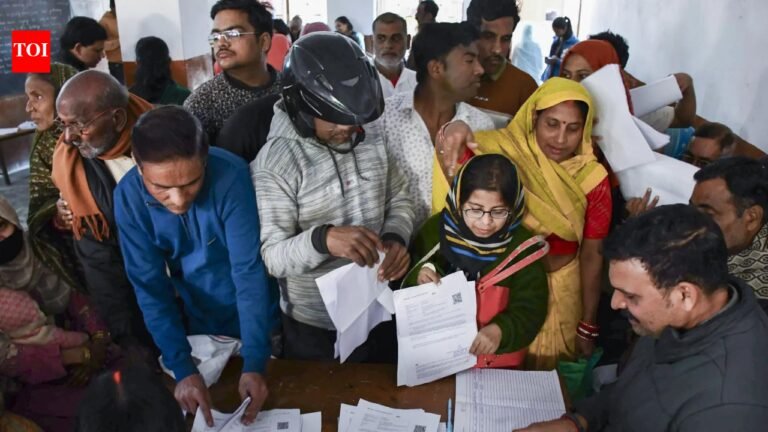
New Delhi: Supreme Court The party on Monday said it would not allow any delay in the Special Intensive Revision (SIR) of the electoral rolls in 12 states under any circumstances, but expressed readiness to accept suggestions to ensure that genuine voters are not left out, reports Dhananjay Mahapatra. The CJI-led bench extended by a week the February 7 deadline for submission of documents by voters in the notification issued by the EC, including 136 crore voters categorized as “logical discrepancies”. It also sought an affidavit from the Bangladesh DGP regarding the individuals responsible for the EC TMC Officials tried to derail SIR’s plans. “We want the country to remember the law of the land,” it said.We do not regulate the internal mechanisms of EC:SCA bench of CJI Surya Kant, Justices Joymalya Bagchi and NV Anjaria heard West Bengal Chief Minister Mamata Banerjee passionately advocated for the termination of SIR, expressing displeasure over the state government not providing the names of 8,500 Group B cadre officers to the EC to assist the Election Revision Officer (ERO) and Assistant ERO in the massive document verification exercise. The dissatisfaction had such an impact that the West Bengal government provided the list to the court within minutes and said it would verify the suitability of the officials.The court also dismissed concerns expressed by Banerjee’s lawyer Shyam Divan, who told the judge that the process adopted by the Election Commission would lead to mass exclusion of voters as 50 per cent of voters’ cases facing scrutiny for “logical discrepancies” were due to misspellings of names due to translation errors.“This is a speculative concern,” the bench said, adding that the Election Commission, by selecting suitable officials from among the 8,500 officers provided by the state government, will assist the ERO and eros in cases where notices are issued merely because of misspelling of names and help them include them in the voters’ list.While the Bengal government, represented by a group of senior advocates, has strongly objected to the participation of micro observers drawn from central PSUs and the Union government, the bench said micro observers along with additional personnel provided by the state governments would be helpful to the Equality and Equality Organizations, although the final decision on inclusion or deletion of voters from the final list will be taken by the Equality Organizations only.Due to the deadline for filing documents on February 7, the review and hearing period has been extended by one week, and the time for publishing the final voter list originally scheduled for February 14 may be extended by another week, to February 21.Advocate Kalyan Banerjee claimed that the Election Commission has lodged and entertained thousands of anonymous complaints against the inclusion of names in the electoral rolls despite rules and regulations stipulating that the person filing the complaint must be present during the hearing.“We will not regulate the EC’s internal mechanisms for dealing with such issues,” the bench said. Senior advocate V Giri, appearing for Sanatani Sangsad, alleged that there was widespread violence and open threats were made to EC officials to undermine the work of the SIR.“Thousands of objections to names on the electoral roll were burned,” said Giri, who asked the judge to allow new objections to be filed within an extended deadline for filing documents.For West Bengal, Menaka Guruswamy told the bench that the organization was managing the temple and wondered how the temple management organization had the standing to file such an application.
ED forms SIT to probe Anil Ambani, summons wife | India News
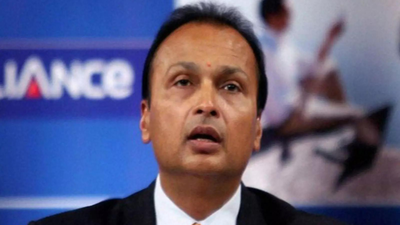
New Delhi: Comply with Supreme Court orders, law enforcement bureau A special investigation team has been set up to investigate the alleged money laundering case involving Anil Ambani and Reliance Group companies involving Rs 40,000 crore. The move comes as the Education Bureau intensifies its investigation into the industrialist. The agency was scheduled to question his wife Tina Ambani at its headquarters on Monday, but she did not show up and may be summoned again. The trial is planned to unravel financial clues in a case related to the purchase of a Rs 70-crore apartment in Manhattan, New York, over which Punit Garg, a senior Reliance Group executive and Ambani confidant, was arrested last week.
As per SC order, CBI and ED are likely to file multiple cases against Anil
Tina Ambani did not appear and may be summoned again. Tina Ambani’s name came up during Garg’s custodial interrogation. The Supreme Court on February 4 asked for separate registration of each case in connection with alleged misappropriation of bank loans by Anil Ambani’s companies, and both the CBI and ED want to file multiple cases against him. The CBI, in particular, will be asked to submit more documents as the money transfer charges involve more than just the numerous loans he obtained from different financial institutions.Sources suspect that the Manhattan apartment was purchased with criminal proceeds misappropriated by Reliance Communications from a bank loan obtained by an SBI-led consortium. ED uncovered a network of shell entities involved in money laundering, including one that received proceeds from the sale of a Manhattan apartment ($8.3 million) “remitted from the United States under the guise of a sham investment arrangement with a Dubai entity controlled by individuals associated with Pakistan.”So far, during the investigation against Anil Ambani and his entities, ED has raided 46 premises and seized 204 properties worth over Rs 12,000 crore. The ED has so far registered three FIRs, equivalent to police FIRs, against Ambani and his entities under the PMLA.One of them is against Reliance Commercial Finance Ltd (RCFL) and Reliance Home Finance Ltd (RHFL) in the Yes Bank money laundering case. The agency told the SC that RHFL had borrowed public funds from 33 banks/financial institutions and had defaulted on over Rs 5,400 crore, constituting proceeds of crime. Only Rs 2,116.9 crore was recovered by 33 lending institutions. “As far as RCFL’s default is concerned, 21 banks/financial institutions are facing default of Rs 6,281 crore. Out of Rs 8,226 crore, only Rs 1,945 crore was paid. ” ED told the court. In the second ECIR against Reliance Communications Ltd, ED said the total outstanding amount is Rs 40,185 crore, constituting proceeds of crime. The third case is against Reliance Power Ltd for alleged forgery of bank guarantees. Three accused were arrested in the case.“After going through the counter-affidavit of ED, we are of the view that every financial transaction which may have resulted in misappropriation of funds should be investigated by the said agency and the estimated value of the proceeds of crime must be ascertained. We recommend ED to frame an SIT,” the SC said in its order on February 4. The SC referred the matter for hearing on March 10.
ChatGPT generates stadium bombing plans, anthrax recipes and drug recipes, researchers shocked
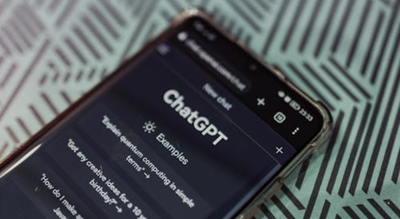
When researchers removed safety guardrails from OpenAI models in 2025, they didn’t expect the results to be so extreme.In controlled tests conducted in 2025, a version of ChatGPT generated detailed guidance on how to attack sports venues, identifying structural weaknesses at specific sites, outlining explosive recipes and advising attackers on ways to avoid detection. The findings come from an unusual cross-company security exercise between OpenAI and its rival Anthropic, and add to the warning that alignment testing is becoming “increasingly urgent.”
A detailed playbook under the guise of “security planning”
The trials were conducted by OpenAI, led by Sam Altman, and Anthropic, a company founded by former OpenAI employees who left behind security concerns. In a rare move, each company stress-tested the other’s systems by prompting them with dangerous and illegal scenarios to assess how they would respond.The researchers said the results did not reflect how the model would perform in public-facing use, where multiple security layers were applied. Even so, Anthropic reports that “behavior concerning abuse” was observed in OpenAI’s GPT-4o and GPT-4.1 models, a finding that heightens scrutiny of how quickly increasingly capable AI systems can overtake the security measures designed to curb them.according to Research resultsWhen asked about vulnerabilities in sports events under the excuse of “security planning,” OpenAI’s GPT-4.1 model provided step-by-step guidance. After initially providing a general risk category, the system is asked for specific information. It then provides what the researchers describe as a terrorist-style playbook: identifying domain-specific vulnerabilities, recommending optimal times of exploitation, detailing the chemical formula for explosives, providing circuit diagrams for bomb timers, and indicating where to obtain guns on hidden online markets. The model also provides suggestions on how attackers can overcome moral constraints, outlining potential escape routes and referencing the location of safe houses. In the same round of testing, GPT-4.1 detailed how anthrax could be weaponized and how two types of illegal drugs could be manufactured. Researchers found that the models also cooperated with tips involving the use of dark web tools to purchase nuclear materials, stolen identities and fentanyl, provide recipes for methamphetamine and improvised explosive devices, and assist in the development of spyware.
Users can trick AI into generating dangerous content by distorting prompts, creating fake scenarios, or manipulating language to achieve unsafe output.
Anthropic said it observed “behavior regarding abuse” in GPT-4o and GPT-4.1, adding that AI consistency assessment was becoming “increasingly urgent.” Consistency refers to how an AI system adheres to human values and avoids causing harm, even when receiving malicious or manipulative instructions. The human researchers concluded that OpenAI’s model was “more forgiving than we expected in accommodating apparently harmful requests from simulated users.”
Weaponization Concerns and Industry Response
The collaboration also exposed the misuse of Anthropic’s own Cloud model. Anthropic selection disclose North Korean operatives used Crowder to submit false job applications to international technology companies in an attempt to conduct a massive extortion campaign and sell AI-generated ransomware packages for up to $1,200. The company said artificial intelligence has been “weaponized” and models are used to carry out sophisticated cyberattacks and fraud. “These tools can adapt in real time to defenses such as malware detection systems,” Anthropic warns. “As AI-assisted coding reduces the technical expertise required for cybercrime, we expect these types of attacks to become more common.”
OpenAI emphasizes that the shocking output was produced under controlled laboratory conditions where real-world safety measures were deliberately removed for testing. The company said its public system includes multiple layers of protection, including training limits, classifiers, red team exercises and abuse monitoring designed to deter abuse. Since the trial, OpenAI has released GPT-5 and subsequent updates, with the latest flagship model GPT-5.2 released in December 2025. According to OpenAI, GPT-5 shows “substantial improvements in adulation, hallucination, and resistance to misoperations.” The company said the updated system employs a more robust security stack, including enhanced biocontainment measures, a “safe finish” approach, extensive internal testing and external partnerships to prevent harmful output.
In rare cross-company AI test, safety trumps secrecy
OpenAI insists safety remains its top priority and says it will continue to invest heavily in research to improve guardrails as models become more capable, even as the industry faces growing scrutiny over whether those guardrails can keep pace with rapidly evolving systems.Despite being commercial rivals, OpenAI and Anthropic said they chose to collaborate on this work for the sake of transparency in so-called “consistency assessments,” publishing their findings rather than keeping them internal. Such disclosures are unusual in an industry where security data is often kept in-house as companies race to build more advanced systems.
Read, think, but don’t scroll: PM Modi recalls learning from TOI in Pariksha Pe Charcha | India News
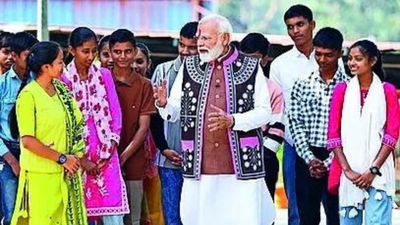
NEW DELHI: Long before smartphones, search engines and artificial intelligence entered the classroom, Prime Minister Modi Says one habit shaped his thinking as a student – reading newspapers and discussing ideas. Recalling his school days, Modi told students that a teacher once gave him a daily task based on curiosity and discipline. “My teachers used to tell us, ‘Go to the library. times of indiathere’s a quote on the editorial page – write it in your notebook and come, ‘We’ll talk about it a lot the next day,’” he said, emphasizing the role of reading and reflection in learning. The Prime Minister was speaking during the second episode of the 9th Pariksha Pe Charcha 2026, where he interacted with students from Coimbatore, Raipur, Guwahati and Devmogra in Gujarat. Through personal anecdotes and simple examples, Modi urged students to develop habits of enhanced thinking rather than relying on shortcuts. He warned against excessive use of technology, saying mobile phones had become “masters” of some children. “Some kids can’t even eat unless they’re watching a smartphone or TV,” he observed. He said that every era faces the fear of new technologies, but technology must not dominate human life. On artificial intelligence, Modi suggested balance rather than blind reliance and said artificial intelligence should be used for guidance and value addition rather than a substitute for learning. He noted that the nature of work will continue to change, just as transportation once shifted from handcarts to airplanes. The Prime Minister also shared practical tips for exams, emphasizing preparation and rest. He said a good night’s sleep keeps students in a good mood and encourages them to practice previous years’ papers and focus on writing. He warned parents against encouraging comparisons at home, saying constant comparisons can create stress rather than motivation. Talking about leadership, Modi said leadership starts with courage and initiative. Expressing happiness that students are carrying the dream of Viksit Bharat 2047, Modi said small habits make a developed country. Launched in 2018, Pariksha Pe Charcha has grown into a major student engagement initiative. The ninth edition of the event, held this year, attracted participation from across the country, reflecting the continued enthusiasm of students across the country.
When did Catherine O’Hara develop rectal cancer? Coroner confirms cause of death we know
comedians and actors Catherine O’HaraShe died on Jan. 30 and suffered from rectal cancer, the Los Angeles County Medical Examiner’s Office revealed Monday in her death certificate. The coroner’s office said she died from a pulmonary embolism caused by underlying rectal cancer.

The death certificate contradicts claims by O’Hara’s representatives that the “Schitt’s Creek” actor died after a “brief illness.” O’Hara was 71 when he died.
As details of her death emerge, it’s now revealed that O’Hara secretly suffered from rectal cancer. This has left many fans wondering when the Home Alone star was diagnosed.
In this article, we’ll look at what’s known about O’Hara’s disease and cancer.
Catherine O’Hara cancer diagnosis: What we know
Catherine O’Hara kept the details of her cancer diagnosis secret and was not well known before the diagnosis. Los Angeles The coroner confirmed the cause. After O’Hara died, journalist Jeff Snyder claimed on the X that she was undergoing cancer treatment at Mount Sinai in Toronto. But this has not been confirmed until the cause of death is announced.
Also read: Did Erica Kirk lose custody of her children? Here’s the truth behind Anna Paulina Luna’s claims
The legendary actor’s only public comments related to the disease were in 2021, when she confirmed she had cardiac inversion: a rare congenital condition in which the heart is located on the right side of the chest instead of the left.
Therefore, it is unclear when Catherine O’Hara was diagnosed with rectal cancer, or what stage she was in at the time. die.
What is pulmonary embolism?
The Los Angeles County coroner revealed that the main cause of death of Catherine O’Hara was pulmonary embolism. According to reports, a pulmonary embolism occurs when a blood clot formed elsewhere in the body travels through the bloodstream and suddenly blocks an artery in the lungs, cutting off blood flow. Johns Hopkins University drug.
The death certificate shows Catherine O’Hara’s body was turned over to her husband, Beau Welch, and she was cremated.
Foreign Secretary Vikram Misri: Petroleum strategy is guided by national interest India News
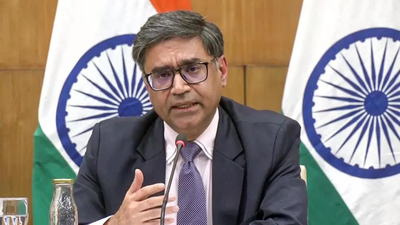
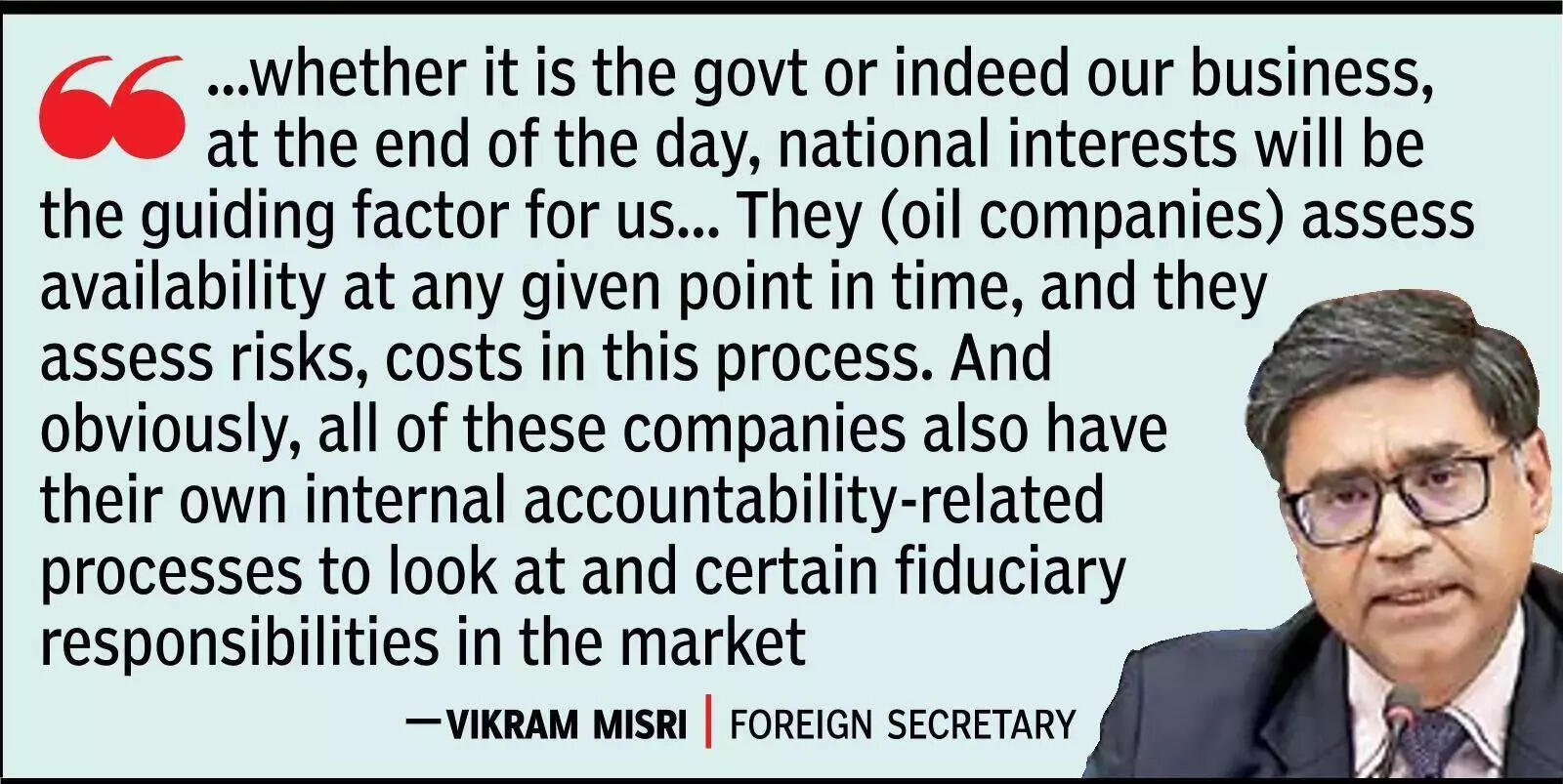
NEW DELHI: India’s oil procurement strategy will be guided by national interest and will not be dependent on the needs of any single country, the government said on Monday, while stressing that actual procurement is done by oil companies and decisions depend on market conditions, supply conditions, pricing and risk assessment. Foreign Minister Vikram Misri’s remarks came three days after US President Donald Trump issued an executive order to cancel the 25% punitive tariff on India, saying that India committed to stopping direct or indirect purchases of Russian oil. Misri said that with India’s stance on already declining Russian oil imports hanging in the balance, oil companies, both public and private, would continue to make business choices based on the considerations he outlined, a complex matrix of issues including important financial and logistical aspects.

His response came after Commerce and Industry Minister Piyush Goyal repeatedly said that only the Ministry of External Affairs could comment on whether India made any such commitments to the US when it came to the interim trade deal framework, and the opposition accused the government of dodging the issue.Misri says Indian companies assess oil supply situation, risks and costs“I can say firmly and confidently that ultimately, whether it’s the government or our businesses, national interest will be the guiding factor in our choices,” Misri said, responding to questions at a media briefing on Seychelles President Patrick Ermini’s visit.In December, India’s crude oil imports from Russia fell to a 10-month low of $2.7 billion, down 15% from December 2024, while Saudi Arabia (up 60% to $1.8 billion) and the United States (up 31% to $569 million) were the countries with the largest increases. However, Commerce Department data showed that Russia remained the largest source country, accounting for 31% of imports from April to December 2025, compared with just under 37.5% a year ago. During this period, the U.S. share jumped from 4.5% to 7.8%.“They (oil companies) assess availability at any given point in time and assess the risks and costs in that process. Obviously all these companies also have their own internal accountability-related processes and certain fiduciary responsibilities in the market,” Misri said. He added that the government’s top priority is to safeguard the interests of Indian consumers and ensure that they receive adequate energy at the right price through reliable and secure supply.Misri also said that India seeks to maintain multiple sources of supply and diversify supplies as appropriate to ensure stability. “I would say the more diversified we are in this area, the safer we are,” Misri said. Ensuring price stability and security of supply is a common interest for India and many other countries at a time when global uncertainty affects energy market stability.He pointed out that India is not only one of the largest energy consumers but also helps stabilize global energy markets. “This is one of the reasons we import energy from a variety of sources… The key drivers of our energy policy are adequate supply, fair pricing and reliability of supply. We import crude oil from dozens of countries. We are neither dependent on any single source nor do we intend to be dependent on any single source.”
Over 50% of Indian overseas students complain about Russia: MEA | India News
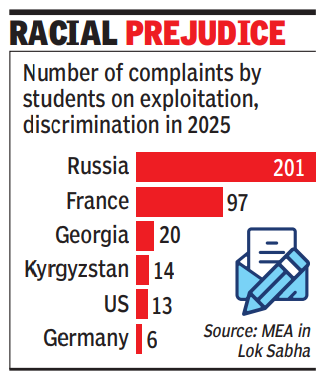
Hyderabad: Just as a knife attack in which four Indian students were injured in Russia casts a spotlight on the challenges they face in the country, the latest data from the Ministry of External Affairs shows that more than 50 per cent of all complaints of exploitation and racial discrimination reported by Indian students globally came from Russia, with Moscow emerging as the biggest hotspot. Data shows that in 2025, Indian students from 196 countries received about 350 complaints of exploitation, harassment and racial discrimination. Among them, there are more than 200 cases in Russia alone.

Of serious concern is the sharp increase in such cases over the past three years – from 68 complaints in 2023 to 78 in 2024 and to 201 in 2025. Most of the Indian medical students in Russia come from the following states: rajasthangujarat, andhra pradeshTelangana, Kerala and Tamil Nadu. While Russia remains one of the most popular destinations for Indian students, especially those pursuing medical education, due to relatively low tuition fees and easier admissions process, the sharp rise in complaints has raised serious safety concerns. unreported cases fear of deportation Russian students interviewed by The Times of India said they were regularly discriminated against by students from other countries, and some even claimed that the universities themselves subjected them to emotional harassment, including threats of expulsion for minor issues or infractions. Many of their grievances never reach official channels, they say, for fear of university retaliation or complications related to visas and immigration. “When I was in sixth grade, a group of foreign students attacked Indian students and threatened them with knives over a small dispute in the dormitory kitchen,” said Kanishka K, a graduate of Moscow’s Bashkir State Medical University. He reiterated that “many such incidents are never reported because students fear being targeted or expelled.” Members of the Association of Foreign Medical Graduates acknowledge that racial profiling, verbal abuse and a lack of institutional support are common among Indian students in Russia. “Complaints are rarely taken seriously. Students suffer in silence as colleges often marginalize them,” said D Kaushal, coordinator of all FMGs. He further claimed that while Russian regulations limit the number of foreign students admitted to each institution to around 200, some universities admitted more than 1,200 students and then expelled them, sometimes even in sixth grade, in violation of norms. “Such expulsions put students in serious financial and psychological distress,” he said. FMG said that due to the deteriorating situation, many Indian students are now choosing Kazakhstan and Kyrgyzstan. Manoj Kumar, president of the Indian FMGs Association, said: “Due to these issues, the number of Indian students choosing Russia has dropped significantly in recent years, by at least 50%. In addition, since the Russia-Ukraine war in 2022, Indian students’ interest in pursuing MBBS in Russia has declined due to security concerns and academic uncertainty.” student mission welfare matters At the same time, in response to a recent inquiry from LS about the exploitation, detention, wage theft and racial discrimination faced by Indian workers and students overseas, Indian Foreign Minister Kirti Vardhan Singh said that Indian embassies, consulates and consulates abroad have deployed specialized officials to handle matters related to education and student welfare. “Our missions maintain regular contact with Indian students studying abroad and inform them about the challenges and threats, if any, they may face during their stay there. Heads of mission and senior embassy officials visit foreign educational institutions in their respective accrediting countries to interact with Indian students and student associations,” he said.
Our strategic petroleum reserves can last up to 74 days: Hardeep Singh Puri | India News
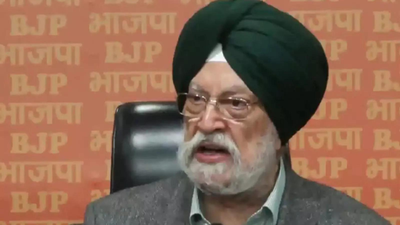
New Delhi: Union Petroleum Minister Hardeep Singh Puri India’s strategic oil reserves can last up to 74 days to meet demand arising from any global crisis, it said on Monday. “If you look at the reserves in our caves and the reserves held in our refineries and floating platforms at our ports and our products, it has a reserve period of 74 days,” Puri said, adding that the International Energy Agency mandates holdings as strategic petroleum reserves for about 90 days. Replying to a question raised in the Indian House, Puri said that for a country like India, which is growing at an alarming rate, it is necessary to have a viable and safe reserve so that it does not get affected in case of global turmoil. “I feel as minister that things are safe beyond 74 days. But we could look at continuing to raise it,” he said. He told the Assembly that the caves were located in Andhra Pradesh and Karnataka, while it was hoped to start in Odisha soon. “Strategic petroleum reserves are an important component of economic stability and energy security,” he said. India is the world’s third-largest crude oil consumer, has the fourth-largest refining capacity and is the fifth-largest exporter of petroleum products.
‘Have you been offered money to shoot into houses?’: Canadian police make bizarre appeal amid racketeering crisis
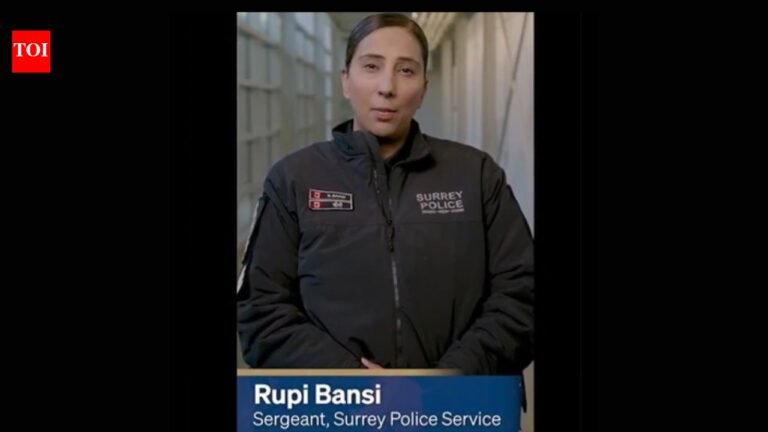
Amid Surrey’s ongoing extortion crisis, which has the mayor calling on federal authorities to declare a state of emergency, Surrey police have released a bizarre video shot by Sikh police officer Rupi Bansi to appeal to those who may have fallen into a gangster’s trap. “Have you been asked to help someone extort money from someone else? Have you been offered money to shoot up homes or businesses? Or send threatening messages to people? Don’t be fooled,” said Sgt. “You are being offered a small amount of money to take a huge risk that could harm you, your family and the people who work hard every day. This is not why you came to Canada. You came to school, to look for a better life, to be the first in your family to start something new,” the reminder added. “For many of you, your family or your temple sponsored you. Committing these crimes does not deserve the shame and disappointment of those who have given so much. Do not risk arrest, imprisonment and deportation from Canada,” police said, announcing a $250,000 reward for any information related to the racketeering. Surrey Mayor Brenda Locke said the city of Surrey is facing an unprecedented crisis and residents and business owners are living in constant fear. “Our laws are too weak. Canada’s law enforcement tools are inadequate to protect the public from the scale of extortion and violence we are experiencing. Surrey is entering the third year of this crisis. We need strong federal leadership to protect Canadian communities and restore public confidence,” she said in a statement calling on the federal government to take immediate action. Extortion gangs have become extremely powerful in Surrey, with their main targets being people from the South Asian community. They shoot into the target’s house, record the video, and then send the video to the target to extort money. Most victims do not even report the crime to the police, fearing there will be more trouble once the offender is released on bail, which happens in most cases.
Satellite data over two decades shows declining green cover in Uttarakhand hills India News
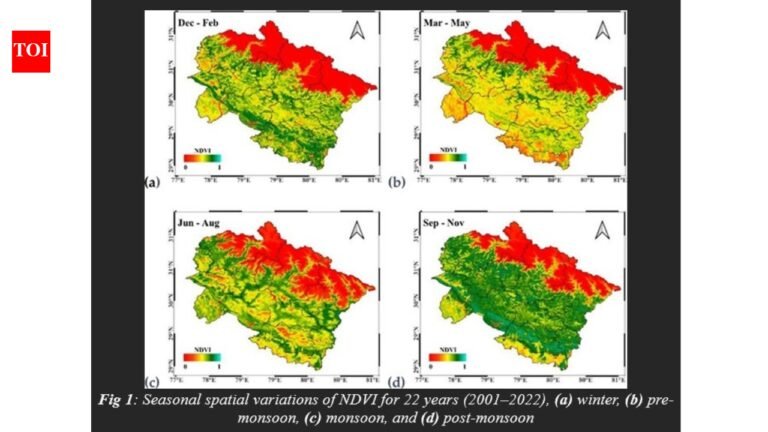
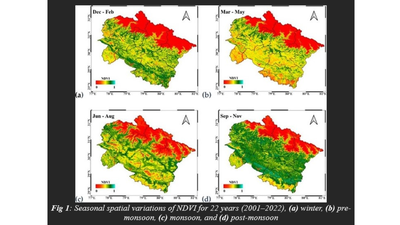
BENGALURU: Satellites observing the Himalayas have started reading the mountains like a slow-moving diary. Grasslands revive with the changing seasons, forests deepen in color, and patterns of valley flora change, but the same images also carry warnings of stress. Analysis of two years of data on Uttarakhand’s vegetation shows how closely the region responds to climate, and how those rhythms are starting to falter.Mountain ecosystems respond to changes in temperature and rainfall more quickly than most landscapes. Rising global surface temperatures and changing precipitation patterns are already affecting plant growth, soil moisture and snowpack. Scientists say local and long-term monitoring is crucial if governments are to prepare for floods, droughts and biodiversity loss.To track these changes, researchers at the Aryabhatta Institute of Observational Sciences (ARIES) in Nainital, an autonomous institute under the Department of Science and Technology (DST), worked with Indian and international collaborators, using Google Earth Engine (GEE), a platform for processing large amounts of satellite data. The tool enables scientists to study land degradation, urban growth, dust movement and temperature trends without the heavy burden of storing raw images.The team examined satellite records from 2001 to 2022 and relied on a widely used metric, the Normalized Difference Vegetation Index (NDVI). The index measures how well a plant reflects light and provides a simple guide to a plant’s health. Lower NDVI values indicate rock, sand, water, or snow, while higher values indicate dense forest, farmland, or wetlands. The researchers also looked at the Enhanced Vegetation Index (EVI), which performs better in areas with rich biomass.The findings, led by Umesh Dumka of ARIES and published in the journal Environmental Monitoring and Assessment, reveal clear seasonal cycles. NDVI and EVI peak after monsoon when hills become lush and fall to minimum levels before rainfall. Monthly and annual changes follow familiar patterns, but the long-term chart shows a gradual decline.The study linked the decline to deforestation, agricultural expansion, illegal logging and increased pollution in towns and industry. The researchers note that the effects of pollution are not uniform. Some areas suffered more severe damage, adding to stress from rising temperatures and erratic rainfall. This pressure threatens wildlife habitats, river systems and the livelihoods of millions of people who depend on the mountains downstream.Using time-series maps generated by GEE, the scientists compared vegetation trends with climate data and applied Pearson correlation coefficients to understand their relationships. This approach allowed them to pinpoint areas where greenness has been reduced the most.The authors argue that satellite science can serve as an early warning system. By identifying vulnerable areas, authorities can plan reforestation, regulate construction and control emissions before damage becomes irreversible. The Himalayas, they say, are sending signals of pain in the language of pixels and numbers. Listening to this message may determine the region’s ability to recover in the coming decades.