Home Blog Page 724

DNPA Conclave 2026: Why is it still difficult to get Indian users to pay for news? indian news

0

DNPA Conclave 2026: Why getting Indian users to pay to watch news remains difficult

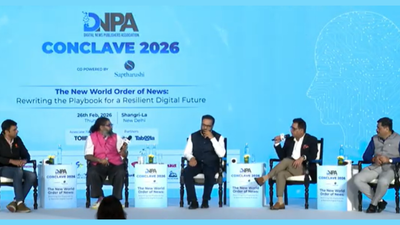
Leaders from media, technology and policy came together on Thursday to chart the future of journalism in a rapidly evolving digital environment at the 2026 DNPA Conclave. Themed “Rewriting the Playbook for a Resilient Digital Future,” the event focused on conversations around trust, innovation, artificial intelligence, regulation and sustainable growth, setting the stage for a deeper debate on the structural challenges facing the industry. In the final panel of the event titled “Making India Pay”, executives from media, technology and consumer platforms came together to confront a sobering reality: While subscriptions are widely seen as one of the industry’s long-term goals, the path to scale remains complicated.Avinash Mudaliar, CEO of OTTPLAY, puts the fight down to a behavioral level. He made a sharp contrast between news and streaming platforms, arguing that the gap lies not in technology but in psychology. “OTT addresses dopamine, news addresses cortisol,” observes Mudaliar, suggesting that entertainment platforms are designed around the reward cycle. “You’re not really hungry for attention; we’re hungry for talent. That was the bus we seemed to be missing. “He noted that OTT platforms simplify sampling for users. “News makes sampling so difficult. If you read two articles, the third one asks you to pay. OTT’s approach is simple – try it for a month, watch multiple episodes and then decide whether to stay.”Mudaliar also pushed back against the idea that video-led news subscriptions can drive growth on their own, citing the ad-supported success of platforms like YouTube. “News OTT won’t work unless you approach it in a different way – focus on the story, not just the information.”Anurag P, Vice President of Product at Swiggy, shared lessons learned from the SwiggyOne subscription model from the perspective of a consumer platform. “We’re not selling free shipping; we’re selling users psychological bandwidth,” he said, emphasizing the importance of reducing user friction.“How do you make the whole process frictionless?” he explained that was his thinking, adding that publishers would also have to identify where friction occurs in journalism, citing examples such as strict paywalls or overwhelming content richness.The panel agreed that subscriptions also need flexibility. Mudaliar emphasizes experimentation with pauses. “We have introduced a pause feature. If you have an annual subscription and want to pause, you can. This is all about being honest with users. “The conversation changed a bit with Neeraj Sharma, managing director at Accenture, who offered a pragmatic view of enterprise-level subscription opportunities. “The simple answer is no,” he said when asked about the viability of B2B news subscriptions in India. “For any business to invest broadly, it needs very unique content or depth. The same news is everywhere.”Sharma believes that in order to build paid communities, publishers must go deeper, not wider. “Build deep content through real-world opportunities and unique conversations—like a community. That’s when subscriptions might sell.”Jaideep Karnik, digital head and editor at Amar Ujala, echoed the sentiment of structural challenges. “Subscriptions really don’t work,” he admits, pointing to the historical economics of news in India.“When people pay for news, only a small portion comes from readers. Most comes from advertisers. We haven’t gotten people used to paying for news.”Kanik highlights behavioral barriers: “Even if a news source is free, people won’t pay. It’s also about habits. That’s not going to change in a day.”As the discussion continued, the panelists outlined what they believe could realistically convince Indian users to open their wallets.Jaideep Karnik highlights that news alone may not be enough to drive payment behavior. “People don’t pay for news, they pay for experience. What are you going to offer? Bundling,” he said, noting that publishers need to rethink value creation.Neeraj Sharma believes it’s depth, not volume, that can unlock the potential of subscriptions. “Depth,” he stressed the importance of specialization, high-value content and community-led products.Avinash Mudaliar emphasizes accessibility as a decisive factor. “Easy to access,” he noted.From a product perspective, Anurag P offers a more personal perspective, pointing to a utility-driven experience that resonates with users. “I’d pay for something that gives me the most important news in three minutes every morning without clutter,” he said, which shows what’s possible with personalization.The discussion ultimately suggests that success may depend less on strict paywalls and more on psychological, personalization and design experiences that users truly value.

PLA in danger: Xi Jinping’s purge weakens China’s military, raising concerns about combat vulnerability

0

PLA in danger: Xi Jinping's purge weakens China's military, raising concerns about combat vulnerability

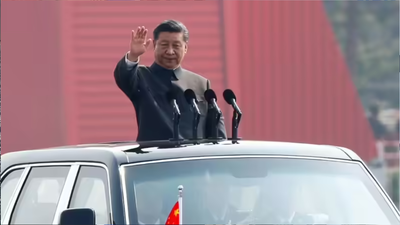
China’s ongoing military corruption purge has created serious flaws in the armed forces’ command structure and may have affected the People’s Liberation Army’s combat readiness, a leading defense research center said. The London-based International Institute for Strategic Studies (IISS) said this week that the purge led by Chinese President Xi Jinping involving the Supreme Central Military Commission, theater commands, weapons procurement, development plans and defense academia is not expected to be completed, Reuters reported.

Chinese company releases satellite images of U.S. F-22 stealth fighter jets deployed in Israel amid tensions with Iran

“From an organizational perspective, the PLA’s command structure has serious flaws until the vacancies are filled,” the International Institute for Strategic Studies said in its annual military balance survey.The report follows disciplinary investigations into China’s two most senior generals. Longtime Xi Jinping ally Zhang Youxia was put under investigation in January, while He Weidong was expelled last October. The crackdown left the seven-member military high command with only two current leaders: Xi Jinping himself and newly promoted deputy chairman Zhang Shengmin.The IISS stressed that “purges will almost certainly have a short-term impact” if personnel were promoted through connections or if there were flawed weapons and morale issues, although it called the impact “temporary” and noted that modernization is expected to continue.The report also mentions China’s assertive military posture in the Indo-Pacific region, especially increasing deployments around Taiwan in 2025 to support territorial claims and statecraft. China’s defense spending continues to lead the rest of Asia, with its share of regional military spending increasing from an average of 37% between 2010 and 2020 to nearly 44% in 2025.According to Reuters, earlier this month, Xi Jinping made a rare public reference to the purge in a virtual speech to the People’s Liberation Army: “The past year has been an extraordinary and extraordinary year. The People’s Army has conducted in-depth political education, effectively responded to various risks and challenges, and conducted revolutionary exercises in the fight against corruption.” China’s Defense Ministry did not immediately respond to the study.

Hunter College professor’s racist comments: Hunter College professor suspended for making racist comments about black students

0

Hunter College professor put on leave after heated comments about racist comments about black students

An associate professor at Hunter College has been suspended for allegedly making racist comments about black students during a virtual public school meeting, sparking widespread outrage and an official investigation.The incident occurred during the Feb. 10 Community Education Council (CEC) District 3 meeting, where parents, students and officials were discussing concerns about possible closures of Manhattan schools. Professor Allyson Friedman was attending the meeting as a parent and didn’t realize her microphone had been turned on when she made the controversial remarks.According to a recording of the meeting that later circulated online, Friedman said black students were “too stupid to know they were in a bad school.” She also made remarks about segregation, saying: “If you train black people well enough, they will know how to use their backs. You don’t have to tell them anymore.”

Racist outrage: ‘Black people are not apes’ slogan shocks Trump, lawmakers expelled

The comments came as an eighth-grader discussed concerns that her school could be closed. When attendees realized Friedman’s microphone was on line, the meeting fell silent and the moderator quickly apologized before continuing the meeting.Hunter College President Nancy Cantor said in a statement that the college has launched an investigation in accordance with its conduct and nondiscrimination policies.“The employee has been suspended pending the outcome of our investigation,” Cantor said, calling the comments “abhorrent.”The college, which is part of the City University of New York (CUNY) system, has not confirmed whether Friedman’s leave will be paid or whether further disciplinary action will be taken.Friedman later apologized for her remarks, saying they were taken out of context and that she had been trying to explain systemic racism to her children by invoking racist tropes. She said her views did not reflect remarks heard during the meeting.“Regardless of the context, my remarks were wrong and caused harm,” she said, adding that she took full responsibility for their impact.The comments drew sharp criticism from government officials and education leaders. Manhattan Borough President Brad Holman-Segal called the comments “outrageous,” while Queens Borough President Donovan Richards Jr. questioned why stronger action hadn’t been taken yet.Education officials say racism has no place in schools and stress the need to support affected students and families.The controversy has intensified the debate over racial equity and accountability in educational institutions. Hunter College said it remains committed to an inclusive environment and will take appropriate action based on the findings.

Dnpa conclave 2026: DNPA conclave 2026: Sudhir Chaudhary calls for rewriting of journalism script with purpose and clarity | News India

0

DNPA Conclave 2026: Sudhir Chaudhary calls for rewriting journalism script with purpose and clarity

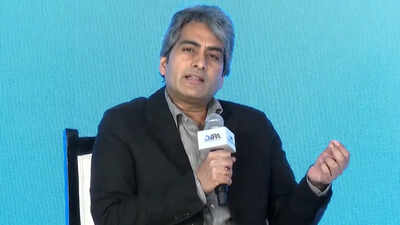
New Delhi: Senior journalist and news anchor Sudhir Chaudhary shared his thoughts on the evolution of television journalism and the rapidly changing digital news landscape at the 4th Storyboard18 Digital News Publishers Association (DNPA) Conclave 2026 in New Delhi on Thursday.In a captivating conversation moderated by RJ Raunac, artist, entertainer, and entrepreneur better known as “Bauaa,” the discussion, “The New World Order in News: Rewriting the Playbook for a Resilient Digital Future,” explored how technology continues to redefine storytelling, credibility, and audience engagement in the modern newsroom.Answering a question about the seismic shift from the early days of television to the rise of the digital and AI-driven era, Chowdhury traces his journey from the mid-1990s, when Indian television journalism was just taking root.“When I started my career in 1994-95, television was just emerging in India. There was only one news bulletin every day, aired around 9 or 10 pm. People would eagerly wait for that slot, believing that it marked the dawn of a new era in broadcasting. It was really just the beginning,” he recalls of how the medium has grown from a single evening bulletin to today’s 400-plus channels running 24 hours a day across the country.Chowdhury shares anecdotes from his early reportage, highlighting the challenges of telling stories with limited technology. He recounted how during the 1999 Kargil War, which he called India’s first “televised war,” it took up to two days to get footage from conflict zones to Delhi, often leaving reporters feeling anxious and helpless.Sharing another memory of the 2002 Parliament attack, he said, “I had the best visuals and the best footage of the incident, but there was no medium to send it from Parliament to my office in Noida. Although OB vans are common, we had no OB van available that day.”Looking back at the industry’s evolution, he observes that while the tools have changed – from broadcasting to social media and now artificial intelligence – certain core principles have remained the same.“People say television is dying now because it’s taken over by social media, which is also being challenged by artificial intelligence. But I feel like some things haven’t changed,” he said.Highlighting the enduring nature of journalism, Chowdhury noted, “Storytelling, clarity and accountability – these things never change. Technology can create content for you, but the emotion and intent behind the content will always be driven by you. “DNPA Conclave 2026 brings together policymakers, editors, technologists and industry leaders to discuss the future of journalism in a world dominated by artificial intelligence. The day’s conference explored how innovation, regulation and ethics can coexist to shape a trustworthy and sustainable digital media environment over the next decade.

‘Do I look like this?’ Bangladeshi man wrongfully detained in UK after facial recognition software identified him as a thief

0

'Do I look like this?' Bangladeshi man wrongfully detained in UK after facial recognition software identified him as a thief

Alvi Choudhury, a Bangladeshi-born software engineer, was arrested at his home in Southampton last month after facial recognition software mistakenly identified him as a burglary suspect in Milton Keynes, 100 miles away, and he was detained for 10 hours. Chaudhry told the Guardian he was confused when police knocked on his door and arrested him at work. When he saw the CCTV footage of the break-in, he was furious because the killer looked nothing like him. “I was very angry because this kid looked about 10 years younger than me,” said the bearded Chowdhury. “Everything is different. The skin is lighter. The suspect looks 18 years old. His nose is bigger. He has no hair on his face. His eyes were different. His lips are smaller than mine.“I just thought investigators saw me as a guy with curly brown hair and decided to arrest me.”Chowdhury said officers from Hampshire Constabulary laughed when he asked them “Does this look like me?”He added: “After seeing the suspect’s video and my photo, they knew I was not a suspect.”Chaudhry’s photo is in the system because he was arrested once in 2021, which he called a wrongful arrest. He said he was attacked while on an outing at a university in Portsmouth. He was released with no further developments in the case. But now he fears his picture is in the system again and if a brown man in Scotland robs a bank, they will come after him. Chaudhry is suing police for arresting him at his home, causing a scene in which neighbors watched him being led away in handcuffs.

Police say arrest was wrong but there was no racial bias

Thames Valley Police admitted the arrest was a mistake but insisted it was not due to any racial prejudice. A police spokesman told the Guardian: “While we apologize for the distress caused to the complainant in this case, their arrest was based on investigators’ own visual assessment that the individual matched the suspect on CCTV footage following a retrospective facial recognition match and was not influenced by racial profiling.”

Isha doing ‘pious work’: SC urges mediation to resolve gas crematorium dispute India News

0

Isha doing 'pious work': SC urges mediation to resolve gas crematorium dispute

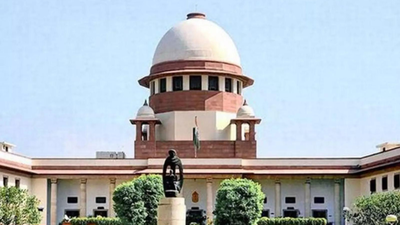
The Supreme Court on Thursday heard a special petition (SLP) filed by an individual challenging the establishment of a modern gas-fired crematorium at the Isha Yoga Center in Coimbatore, a case that was earlier dismissed by the Madras High Court.During the hearing, the Chief Justice of India described Isha’s services as “pious work” and recommended that both parties make arrangements for the petitioner’s alternative land. The Supreme Court noted that the petitioner had sold part of its land to the Isha Foundation but argued that the purpose of the sale was not to build a crematorium. The judge recommended that both parties discuss the adjacent land issue and explore an amicable solution, and both parties agreed to resolve the matter through negotiations. During the hearing, lawyer Prashant Bhushan, representing the petitioner, argued that the crematorium was creating a nuisance with bodies being cremated every day for the past few weeks and was in violation of local rules prohibiting setting up of crematoriums or burial grounds near residences or water bodies without a Gram Panchayat permit. He also emphasized that the petitioner’s home was in a tribal area where burial rather than cremation was the customary practice and the body brought to the crematorium was brought from Coimbatore city, about 30 kilometers away.For this purpose, the Supreme Court appointed retired Madras High Court judge Rajendran as mediator.The Madras High Court had earlier dismissed the case stating, “The petitioner has no legal basis. The gasifier crematorium was constructed with appropriate panchayat permission and in compliance with the rules. Furthermore, construction of crematoriums, especially gas crematoriums, is to serve the society; it cannot be held to be contrary to public interest.”The foundation said residents of more than five villages surrounding the Isha Yoga Center have requested authorities to set up a crematorium in the area. It is said that the Isha Foundation subsequently established a modern gasifier crematorium after obtaining the approval of the panchayat and the necessary permissions from relevant government departments such as the Tamil Nadu Pollution Control Board.The Isha Foundation said it has been operating and maintaining crematoriums in Tamil Nadu since 2010 with the goal of providing “dignity in death”. Currently, the company has 30 crematoriums in Besant Nagar, Coimbatore, Neyveli, Vellore and Thanjavur districts of Chennai.

Tulsi Gabbard religion: ‘I thought she was a proud Hindu’: Mehdi Hasan questions if Tulsi Gabbard ‘converted to Christianity’ after cabinet prayer

0

'I thought she was a proud Hindu': Mehdi Hasan questions if Tulsi Gabbard 'converted to Christianity' after cabinet prayers

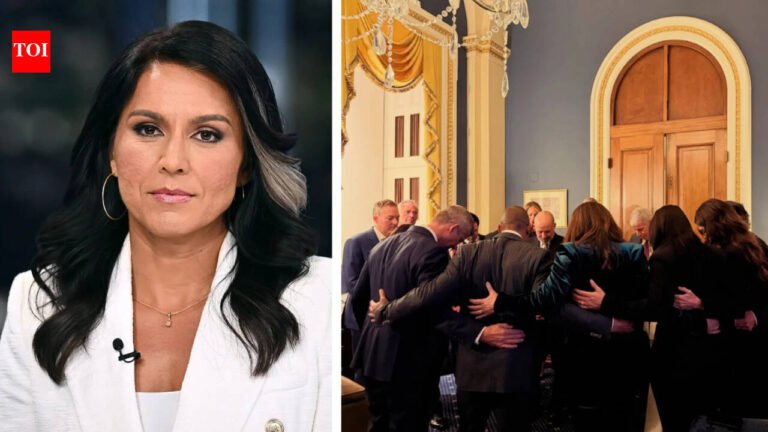
Prayers before the State of the Union raised questions about Tulsi Gabbard’s faith after British journalist Mehdi Hassan questioned a Trump aide’s religious beliefs.Hassan wrote on X, “I’m confused. Did Gabbard convert to Christianity? I thought she was a proud Hindu.”The comments come after Gabbard shared a post about participating in “Christian” prayers ahead of the president’s address to Congress this week.“The quiet moments are often the most important,” she wrote. “Last night, just before members of the Cabinet took to the House floor to deliver the President’s State of the Union address, we prayed together to give God all thanks and praise and to ask for clarity and strength to hear His voice, serve Him, and do His will.”The post included a photo showing Gabbard and other Cabinet members gathered together with their heads bowed in prayer shortly before entering the House chamber. The scene appears to be a private room or hallway inside or near the U.S. Capitol used in preparation for the event. This is not a religious place.The prayer comes ahead of U.S. President Donald Trump’s 2026 State of the Union address to the 119th U.S. Congress in the House Chamber of the U.S. Capitol in Washington, D.C. The speech lasted approximately 1 hour and 48 minutes, making it the longest State of the Union address in U.S. history. Trump spoke about the economy, immigration, trade and national security and recognized individuals including athletes and military personnel.Gabbard has long been openly Hindu. She was born in Leloaloa, American Samoa on April 12, 1981 and grew up in Hawaii. She later adopted the Gaudiya Vaishnava tradition of Hinduism. She practices Vaishnavism, a branch of Hinduism centered on devotion to Vishnu and his incarnations such as Krishna. In 2013, when she was sworn in as a member of the U.S. House of Representatives, she swore an oath to the Bhagavad Gita, becoming the first Hindu member of the U.S. Congress.She has previously spoken about her faith in interviews and public appearances.

Dubai to launch electric air taxis bookable with Uber later this year | World News

0

Dubai to launch electric air taxis bookable through Uber later this year
Dubai will launch electric air taxis bookable through Uber later this year that can carry four passengers / Representative image

Dubai residents will soon be able to find air taxis alongside their cars on the Uber app as the city prepares to launch an all-electric air ride service later this year. The move will enable passengers to book flights as easily as they book standard itineraries, marking a shift towards integrated ground and air transportation within a single platform.The new feature, called Uber Air, will appear within the existing app interface. The user will enter their destination as usual. If the journey qualifies for the air option, the app will display air taxi options as well as regular transportation services. Once selected, the system will manage the entire trip with one booking. This includes limousine transfers to the departure point, the flight itself, and ground transportation to the final destination.The aircraft is fully electric and can accommodate up to four passengers. Each flight will be operated by a certified commercial pilot. The cabin interior is equipped with comfortable seats and large windows, offering expansive views of the city skyline from every seat.From a technical perspective, the aircraft relies on six tilting propellers. These allow for vertical takeoff and landing before transitioning to forward flight. Air taxis can reach speeds of 200 miles per hour and can travel 100 miles on a single charge.Engineers customized the aircraft for the urban environment. It uses multiple layers of system redundancy to enhance security measures. Its acoustic design is also designed to blend with typical urban background noise, rather than contrast with it.Passenger services in Dubai are expected to launch later this year. This development represents a major step towards an intermodal transport system where passengers can seamlessly switch between road and air travel in one booking process.The plan builds on years of planning focused on integrating air transportation into daily commutes. The goal is to create a transportation network where switching between ground vehicles and aircraft becomes a routine matter rather than an exception.

Sunetra Pawar elected national president of NCP; succeeding late husband Ajit | News of India

0

Sunetra Pawar elected national president of NCP; succeeds late husband Ajit

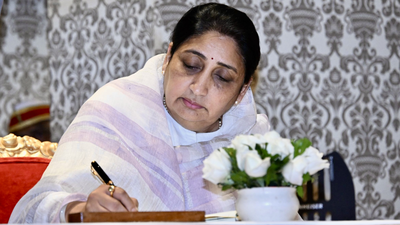
New Delhi: Kuomintang Congress Party (NCP) on Thursday formally elected Maharashtra Deputy Chief Minister Sunetra Pawar as the new state president, nearly a month after the death of her husband Ajit Pawar, who held both posts at the time.Ajit Pawar died in a private plane crash in his hometown Baramati on January 28. The crash also claimed the lives of his personal security guard, two pilots and a flight attendant, with no survivors.On January 31, the NCP unanimously elected Sunetra Pawar as its legislative party leader, another post she took over from Ajit. Hours later, she was sworn in as the deputy chief minister of Maharashtra. The late NCP leader served six terms and was the longest-serving lieutenant governor in the state.Sunetra Pawar made her debut in the 2024 Lok Sabha elections, contesting the Baramati seat against Ajit’s cousin Supriya Sule, who retained the constituency – a long-standing stronghold of the Pawar family – and won for a fourth consecutive term.The NCP then nominated Sunetra Pawar to the Lok Sabha. She has six months to ensure her election to the Maharashtra assembly in order to continue as deputy chief minister.

‘India need to revive their brand of aggression’: Akash Chopra’s blunt warning ahead of Zimbabwe clash Cricket News

0

'India needs to revive their brand of aggression': Akash Chopra's blunt warning ahead of conflict in Zimbabwe
Indian Cricket Team (ANI)

Former cricketer and commentator India gearing up for must-win clash with Zimbabwe in ICC Men’s T20 World Cup in Chennai Akash Chopra He urged the team to return to their fearless attacking approach if they want to keep their semi-final hopes alive.It’s going to be a high-pressure night at the MA Chidambaram Stadium as India need not just a win but a sizeable margin to improve their net run-rate.

India’s XI drama: How three players fight for two berths | Is Tri-State Samson there?

Speaking on JioHotstar, Chopra analyzed India’s promotion prospects and pointed out the challenges ahead.On India’s path to the semi-finals, he said: “The tough question for India is they need to win their remaining two Super Eights games and they also want South Africa to win their games against West Indies and Zimbabwe. But if that doesn’t happen, then net run rate comes into play. “Chopra stressed that India must rediscover their attacking mentality if qualification comes down to net run rate. He believes in the captain Suryakumar Yadav has a key role to play in this transition.“That’s when India need to come up with their explosive brand of cricket. Suryakumar Yadav is the man for this role. He needs to bat for three and bat freely. Against South Africa, I felt he was too slow. By the time he came out, the mountain was too high for others to climb,” he said.Chopra also expressed concerns over India’s current batting format, saying it lacks balance and clarity.“India’s batsmen went all out on the first ball and then lost wickets. This put the team in a tricky situation. Then the batsmen behind were too cautious and conservative. They started eating the ball regardless of the pitch, conditions or bowlers. They thoroughly gamed the situation and fell behind in the game. “He further noted that this cautious approach goes against the fearless cricketing spirit that India has shown in recent years.“This is not the brand of cricket that India have played in the last two years. They are proud to say we beat teams and scored 250, 260 Or 270. But Suryakumar Yadav and his men may have forgotten the formula. The template now is to score only 180-190 which is enough on some days, but good teams need to get back to their aggressive brand of cricket. If they don’t, they may be in trouble for the semi-finals,” he concluded.With their campaign hanging in the balance, India must perform well against Zimbabwe to remain in contention for a semi-final spot.