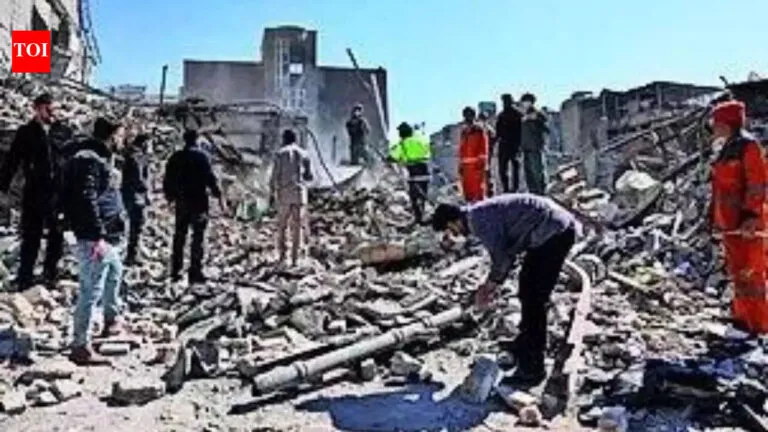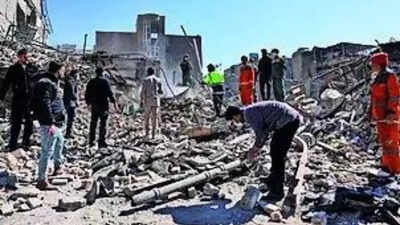
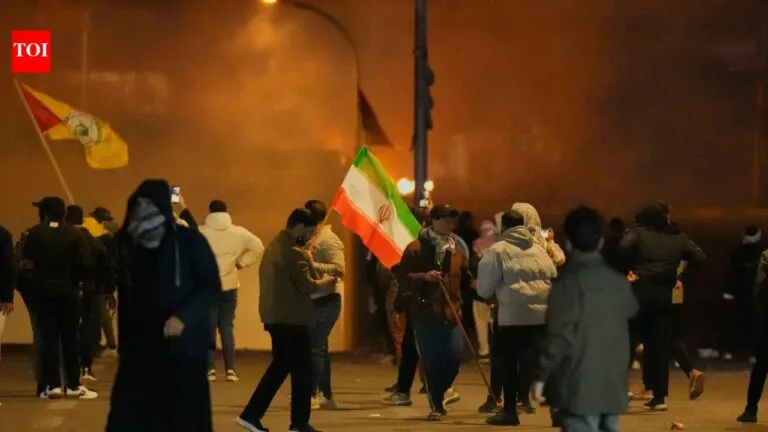
Explosions were heard across the Iranian capital before dawn on Wednesday as the country’s escalating conflict with the United States and Israel entered its fifth day, marking one of the most intense periods of fighting in the region in decades. The latest explosions in Tehran followed days of sustained U.S. and Israeli air strikes on Iranian military and nuclear facilities, with Tehran launching a sweeping retaliatory attack on Israeli territory and U.S. assets in the Gulf.Iranian state television reported explosions around Tehran at dawn, while Israel said its air defense systems had been activated in response to the Iranian missile attack.Israel has launched a new so-called “big wave” of strikes against Iran’s defense systems and missile launch sites. A day earlier, Israel carried out airstrikes against Iranian missile launchers and a nuclear research base.Follow live updates on the US-Israel-Iran warIsraeli military spokesman Brig.-Gen. General Efe Devlin said the military attacked a building in the Iranian city of Qom where clerics were expected to meet to discuss choosing a new supreme leader. He said the army was still assessing whether anyone was injured.The Israeli military said it also carried out air strikes on sites where Iran produces and stores ballistic missiles and destroyed what it called Iran’s secret underground nuclear headquarters. Without providing evidence, it said the site was used for research “to develop key components for nuclear weapons.”Iran says it has not enriched uranium since June, but it still reserves the right to do so and says its nuclear program is for peaceful purposes.
Iran retaliates in Israel, Gulf
Iran has launched dozens of ballistic missiles at Israel, but most have been intercepted. Eleven people have been killed in Israel since the conflict began.Tehran confirmed it had struck multiple locations in Bahrain, Kuwait, Qatar and the United Arab Emirates, all of which host U.S. military air bases, Fars news agency reported.“This operation will continue without mercy until the enemy is completely defeated,” Iran’s Islamic Revolutionary Guard Corps said, adding that all U.S. assets in the region are considered legitimate targets by the Iranian armed forces.Saudi Arabia’s Defense Ministry said two drones struck the U.S. Embassy in Riyadh, causing a “limited fire.” The embassy urged Americans to avoid the compound, which was later closed to the public.An Iranian drone struck a parking lot outside the U.S. consulate in Dubai, causing a small fire, Secretary of State Marco Rubio explain. The Dubai government media office said authorities put out limited fires near the consulate due to the drone strike.The CIA compound at the U.S. Embassy in Saudi Arabia was attacked on Monday by a suspected Iranian drone, according to people familiar with the matter.‘We’ve just begun’: US says it has bombed more than 2,000 targets in Iran – latest developments
US withdrawal and regional impact
The U.S. State Department authorized non-emergency U.S. government employees and family members to leave Saudi Arabia and Oman “due to security risks,” based on advice from the U.S. embassies in Riyadh and Muscat.The department also ordered the evacuation of non-emergency personnel and family members in Kuwait, Bahrain, Iraq, Qatar, Jordan and the United Arab Emirates. U.S. citizens were urged to leave more than a dozen Middle Eastern countries, although many were stranded by airspace closures. The U.S. State Department said it was preparing military and charter flights for Americans who wanted to leave the area.Oman has played a mediating role in negotiations between the United States and Iran, calling for a ceasefire. Riyadh condemned the salvos from Iran, including the attack on the U.S. Embassy in Riyadh.In view of the evolving situation in West Asia and the Gulf region, the Indian Ministry of External Affairs announced the establishment of a special control room and issued a helpline number to Indian nationals.
US military steps up military operations
Adm. Brad Cooper, commander of U.S. Central Command, said U.S. forces have struck nearly 2,000 targets in Iran as part of what he called the largest buildup of firepower in the region in a generation.“Simply put, we’re focused on shooting everything that can be shot at us,” Cooper said in a video message posted on X.“We are also sinking the Iranian navy – the entire navy,” he added. “So far, we have destroyed 17 Iranian ships, including the most combat-capable Iranian submarine that currently has holes in its sides.”“The Iranian regime has harassed international shipping for decades. Today, there is not a single Iranian ship operating in the Arabian Gulf, the Strait of Hormuz or the Gulf of Oman,” Cooper said. “We won’t stop.”He added: “We have hit nearly 2,000 targets with more than 2,000 munitions. We have severely degraded Iran’s air defense capabilities and destroyed hundreds of Iranian ballistic missiles, launchers, and drones. ““The first 24 hours of this operation were almost twice the scale of the first day of the shock strike against Iraq in 2003,” he said. “We will continue to strike Iran 24/7.”The U.S. military said it had destroyed 17 Iranian ships, including a submarine.According to the Red Crescent, U.S. and Israeli air strikes have killed at least 787 people in Iran. Iran has killed nearly 800 people since the conflict began, including the president Donald Trump said he had considered serving as a possible future leader of the country.In Lebanon, Israel launched retaliatory attacks against Hezbollah militants, killing at least 50 people, including seven children, according to the Lebanese Health Ministry. Lebanese state media also reported that an Israeli attack on a residential area in the city of Baalbek killed at least four people.The U.S. military confirmed the deaths of six U.S. service members. Four people were identified as captains. Cody A. Hawk, Sgt. 1st Class Noah L. Tietjens, Sgt. 1st Class Nicole M. Armor and Sgt. Declan J. Coady, assigned to the 103rd Sustainment Command, Iowa. A drone attack on a command center in Kuwait on Sunday killed four U.S. Army reservists and two other service members, the Pentagon said.Kuwait said an 11-year-old girl was killed by falling shrapnel as its troops intercepted “hostile air targets.” Three people died in the United Arab Emirates and one in Bahrain.
Uncertainty about Iran’s leadership
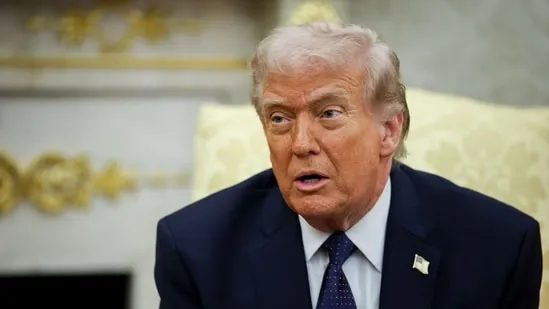
US President Donald Trump said Iran’s air force and navy had been “destroyed” and new attacks were targeting Iran’s leadership. He suggested the war could last weeks or longer.Trump said that as far as possible leaders in Iran are concerned, “the people in our minds are dead.”“I guess the worst thing that could happen is to do that and have someone replace someone who’s just as bad as the predecessor, right? That could happen,” Trump said. “We don’t want that to happen.”While the initial U.S. and Israeli strikes killed Iran’s Supreme Leader Ayatollah Ali Khamenei and Trump urged the Iranians to overthrow the government, senior administration officials have since said regime change was not the goal. Trump later suggested that “people within the Iranian regime” might be the best bet to take power once the campaign is over.Israeli media reported that the 56-year-old Ali Khamenei’s second son Mojtaba Khamenei has been selected as his successor, and the expert conference is expected to officially announce his successor. The New York Times reported that he had emerged as the leading candidate, with parliament allegedly electing him under pressure from the Islamic Revolutionary Guard Corps. Iranian state media has not independently confirmed this.