
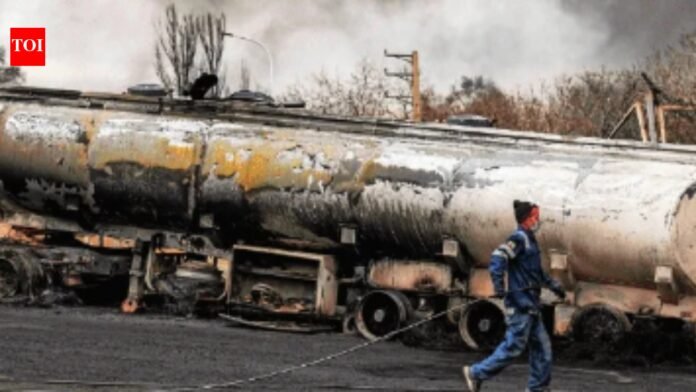
US President Donald Trump has asked allies to help reopen the Strait of Hormuz. But even if he is able to assemble a major coalition, ending Iran’s blockade may be difficult.Iran sits on one side of the narrow strait and has used drones, missiles and mines in response to U.S. and Israeli attacks, making the vital waterway unsafe.Why cut off the strait now?Threats to the strait have been made many times before, in 2011, when a commander of Iran’s Islamic Revolutionary Guard Corps (IRGC) warned that cutting off the strait would be “easier than drinking a glass of water.” Analysts have viewed closing the strait as a last resort because of the potential for retaliation against its own energy sector. The killing of Iran’s supreme leader changed that. Iranian officials say the war is an existential matter.
.
Why is security so difficult?The Strait of Hormuz is a narrow waterway between Iran and Oman. The channel is only two nautical miles wide and ships must turn across Iranian islands and mountainous coasts that provide cover for Iranian forces, according to shipping broker SSY Global. Retired Royal Navy Commander Tom Sharp said that Iran’s conventional navy has been basically destroyed, but the Iranian Revolutionary Guards still have many options, including fast attack boats, small submarines, mines and even motorboats filled with explosives. The Center for Information Resilience, a research group, said Tehran has the capacity to produce about 10,000 drones per month.Using seven or eight destroyers to provide air cover and escort three or four ships a day through the strait is feasible in the short term, but continuing for months would require more resources, Sharp said. Adel Bakhavan, director of the European Institute for the Middle East and North Africa, said that even if Iran’s ability to deploy ballistic missiles, drones and floating mines was destroyed, ships would still face the threat of suicide operations.
.
What does Trump want?Trump said on Sunday he expected many countries to send warships and asked them to do so, adding that his administration was in contact with seven countries for help. A week ago, he ordered the U.S. International Development Finance Corporation to provide insurance and guarantees for shipping companies.What other bottlenecks are there?Yemen’s Houthis are allied with Iran but have a much smaller military arsenal at their disposal. Despite efforts by U.S. and EU navies, Yemen’s Houthis have closed most traffic through the Red Sea for more than two years. Most shipping lines still use the longer route via the southern tip of Africa. The EU-led force has been more successful in combating piracy off the coast of Somalia, but the forces it faces are far less well-equipped than the Islamic Revolutionary Guard Corps.Are there any other options?The UAE and Saudi Arabia have been seeking to bypass the strait by building more oil pipelines. But these options are not currently operational, and the Houthi militia’s attack on the Saudi east-west pipeline in 2019 showed that these alternatives are also fragile. (This is a Reuters report)