
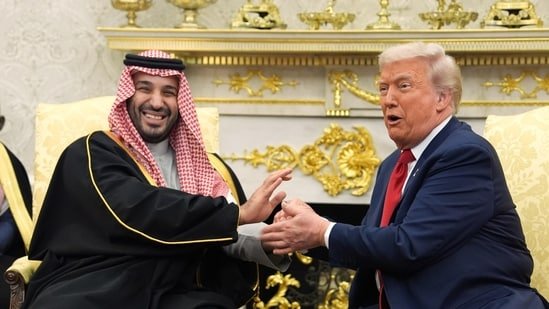
The United States has a civilian nuclear deal with Saudi Arabia under President Donald Trump. The agreement will help Saudi Arabia develop its civilian nuclear energy program. The deal is for the peaceful use of nuclear energy, but experts say it raises concerns that Saudi Arabia could one day move toward building nuclear weapons.
The deal reminds experts US policy According to the New York Times, U.S. President Dwight D. Eisenhower launched a program called Atoms for Peace in 1953. Under the policy, the United States will share nuclear technology with countries if they commit to using it only for peaceful purposes. Experts now say the world is entering a new phase called “nuclear hedging.” This means that countries are developing nuclear capabilities with the option of building weapons later if security conditions deteriorate.
Why the U.S.-Saudi nuclear deal raises concerns
The Saudi deal comes as many U.S. allies worry about war, regional threats, energy security and whether they can still rely entirely on U.S. military protection. Under the deal, Saudi Arabia may eventually be allowed to enrich uranium for nuclear reactors. Uranium enrichment is important because, if further developed, the technology used for civilian nuclear fuel could also be used to produce nuclear weapons material.
The deal could also limit the number of nuclear facilities that international inspectors can visit. Experts said the two concessions were highly unusual compared with recent U.S. nuclear deals and raised concerns about future weapons development, the New York Times reported. Saudi Crown Prince Mohammed bin Salman has publicly linked Saudi Arabia’s nuclear program to Iran’s actions. He has previously warned that if Iran built a nuclear bomb, Saudi Arabia would also seek one.
MIT professor Vipin Narang said many countries are now trying to prepare for an uncertain security situation. Vipin Narang, professor of nuclear security and politics at MIT, said: “We are back in the era of nuclear hedging.” According to the New York Times, Narang further said, “Many nervous countries face deteriorating security situations and are unsure whether they can rely on formal or informal protectors.” He also warned that “we’re going to see a cascade of countries seeking the capability to implement military programs” that could ultimately lead to the production of nuclear weapons.
According to the New York Times, Brandeis University professor Gary Samour said these countries are sometimes called “friendly proliferators.” Experts also say that not every country that develops civilian nuclear technology will eventually build nuclear weapons. Experts believe the global nuclear market may now become less stringent, with countries demanding more freedoms in future nuclear deals.
They also warned that countries such as Russia and China could use the Saudi deal as an example to offer similar deals to other countries. Gary Summer blamed waning confidence in U.S. security guarantees. “This is closely related to the damage Trump has done to the credibility of the United States as a guarantor of security,” Samour said, according to the New York Times.
Why more and more countries are considering nuclear power
Some countries that currently do not have nuclear weapons are discussing whether they should develop nuclear capabilities. These countries include Germany, Poland, Japan and South Korea. South Korea has begun plans to build nuclear-powered submarines with U.S. support because of the threat from a nuclear-armed North Korea. Despite its historical ties to Hiroshima and Nagasaki, Japan is also rethinking the role of nuclear weapons in national defense.
Polish President Karol Naworowski said Poland should pursue its nuclear programme. Germany joins France and other countries in high-level nuclear steering group European countries. France has pledged to strengthen its nuclear deterrent and provide protection to European allies amid concerns that U.S. security commitments are waning. “The next half century will be the age of nuclear weapons,” President Emmanuel Macron said. According to the New York Times, experts believe that strong military alliances are one of the biggest reasons why many countries never develop nuclear weapons.
Matthew Forman, a professor of security studies at the University of Texas, said: “The best non-proliferation tool the United States has ever had is its military alliances.” He added, “If the United States did not provide nuclear protection to so many countries, we would have more nuclear weapons states in the world.” Foreman also said, “But I don’t think that will reduce their desire to hedge,” meaning countries still want to be able to develop nuclear programs if needed. According to the New York Times, experts pointed out that France itself has historically helped countries such as Israel, Iraq and Pakistan develop nuclear programs.
How the war changed the global nuclear race
Following Japan’s Fukushima nuclear disaster in 2011, signing of civil nuclear deals slowed as many countries reduced their interest in nuclear power. Interest in nuclear energy has returned after Russia invaded Ukraine in 2022, raising energy security concerns. Concerns were further heightened after Iran disrupted shipping in the Strait of Hormuz following a conflict between the United States and Israel. Saudi Arabia’s new deal is different from the UAE’s 2009 nuclear deal with the United States.
The UAE deal does not allow uranium enrichment and requires strict international inspections, making it the “gold standard” for preventing nuclear weapons. Trump also removed a condition pushed by President Joe Biden that required Saudi Arabia to normalize relations with Israel before reaching a nuclear deal. According to the New York Times, experts believe Trump made these concessions because the conflict with Iran made Saudi Arabia feel less safe.
Suzanne Maloney of the Brookings Institution said the agreement reflected changes in U.S. security views. Suzanne Maloney said: “This agreement is tangible evidence that the trust and confidence in Washington has been eroded by the war with Iran.” She also said, “Gulf leaders except American security But they also saw first-hand evidence of its limitations and responsibilities. Therefore, they are determined to expand their autonomy and capabilities. ” According to the New York Times, experts say Iran’s damaged nuclear facilities may prevent some countries from building nuclear weapons because they may become military targets.
Others, however, may believe the opposite—that rapid acquisition of nuclear weapons could protect them from future attacks. Experts do not believe Saudi Arabia will be able to build a nuclear bomb anytime soon because its current nuclear infrastructure is very limited and it will take many years to produce weapons-grade uranium. Experts are even more worried that other countries with advanced nuclear technology may now demand the same rights as Saudi Arabia.
Gary Samour said the biggest concern was the example the deal set for the rest of the world. “To me, the danger of this deal is the precedent,” Mr. Samour said. According to The New York Times , he added, “What’s going to stop Russia from reaching such a deal?”