
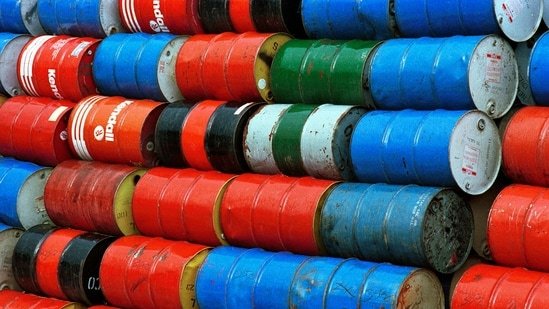
Oil prices rose on Monday as the conflict between the United States and Iran intensified over the weekend, raising concerns that global oil supplies could be disrupted. International benchmark Brent crude climbed to around $77-78 a barrel on Monday. This is about 7% higher than before the war began.
Wall Street is watching closely middle east conflict According to Fortune magazine, because rising oil prices could affect inflation, interest rates and the global economy. Of greatest concern is the Strait of Hormuz, one of the world’s most important oil shipping routes. About 20% of the world’s oil passes through this narrow waterway.
Ship traffic through the Strait of Hormuz has dropped sharply. The New York Times cited data from maritime data company Kpler as saying that only 14 ships passed through on Sunday, compared with more than 130 ships per day before the war. The decline in ship traffic has heightened concerns about less oil reaching global markets, pushing up prices.
US and Iranian attacks continue
Over the weekend, the U.S. military said it struck about 140 targets in Iran after Tehran allegedly attacked a commercial container ship in the Strait of Hormuz. Iran’s military said it responded by launching attacks against U.S. military targets in Bahrain, Jordan and Kuwait. Fortune also reported that Iran’s Islamic Revolutionary Guard Corps (IRGC) claimed responsibility for attacks on U.S. bases in Bahrain, Kuwait and Jordan.
U.S. Central Command (CENTCOM) said Iran took military action after attacking another commercial ship in the Strait of Hormuz. The new attacks have heightened concerns that commercial ships may avoid the strait, making it more difficult to transport oil safely.
Also read: An index fund that could soar in 2026 and 3 myths every index investor should know
According to the New York Times, Amena Bakr, head of Middle East research at Kpler, said the confidence that shipping companies had slowly regained over the past few weeks has now disappeared. Becker said confidence in using the Strait of Hormuz was “eroded very, very quickly” and the shipping situation was now “back to square one”. Although oil prices have risen, they remain well below levels of nearly $120 a barrel at the height of the war.
Oil supply and fuel prices
Last month, the United States and Iran agreed to a preliminary ceasefire that would allow more ships to pass through the strait and increase global oil supplies. The International Energy Agency (IEA) said the recovery helped Persian Gulf oil exports increase by 6.5 million barrels per day in June to about 16 million barrels per day. Increased oil exports last month also helped lower oil prices, the International Energy Agency said. However, the IEA said exports in June were still only about two-thirds of pre-war levels, indicating that the recovery is not yet complete.
The International Energy Agency warned that a full recovery depends on a rapid reduction in fighting between the United States and Iran. Economists are now concerned that if attacks continue, rising oil prices could hurt businesses and consumers by increasing fuel costs. According to the New York Times, citing data from AAA, the average price of gasoline in the United States reached $3.87 per gallon on Monday, up from $3.80 a week ago. Diesel prices also rose to $4.88 per gallon, compared with $4.76 per gallon a week ago, according to AAA.
Market worries about rising inflation
Investors also reacted cautiously. S&P 500 futures fell about 0.25%, indicating that U.S. stocks may open lower. Stock markets in Asia and Europe also fell as many countries in those regions rely heavily on oil and gas imports from the Middle East. Rising oil prices have also heightened concerns about inflation, as expensive energy tends to raise the cost of transporting goods and running businesses.
Goldman Sachs said higher oil prices could make it harder for the Federal Reserve to decide when to cut interest rates. According to “Fortune” magazine, Goldman Sachs chief U.S. economist David Mericle said that several factors may still help reduce inflation later this year, including a possible easing of conflicts, a weakening of the impact of tariffs and a slowdown in artificial intelligence-related demand.
Mericle said these factors may allow the Fed to keep interest rates on hold for the remainder of the year. However, Mericle warned that if oil prices return to $100 a barrel, inflation could rise further and make the Fed’s job more difficult.
Goldman Sachs It is expected that $100 oil could increase monthly core inflation by 3 to 4 basis points in the coming months. Merrick said another major oil supply shock could fuel concerns that inflation could remain elevated for longer, Fortune reported. Despite the latest fighting, President Donald Trump said the Strait of Hormuz remains open.
Iran shipping tensions continue
However, Iran insists the strait is closed, creating uncertainty for shipping lines that may now be hesitant to enter or leave the Persian Gulf. According to the New York Times, Iran said commercial ships should use Iranian waters when passing through the Strait of Hormuz. Instead, many ships sailed close to Oman’s coastline under U.S. military protection, the New York Times reported.
Iran objects to ships using shipping routes near Oman, and the merchant ship that was attacked over the weekend was sailing in Oman’s waters. The central Strait of Hormuz, which was widely used before the conflict, is now considered dangerous due to reports that the Iranian military could lay mines.
Kpler’s Amena Bakr said the oil market has become accustomed to recurring tensions in the oil market despite recent price increases. United States and Iran. According to the New York Times, Becker said oil prices are now more likely to fall if peace talks resume than to rise sharply after each new military strike.
Goldman Sachs commodities analysts said the current disruption could encourage Middle Eastern countries to build more oil pipelines, reducing future reliance on the Strait of Hormuz. According to Fortune magazine, Goldman Sachs expects the new pipeline project to protect more than 45% of Persian Gulf oil exports by the end of 2027 and more than 60% of oil exports by the end of 2028 from future disruptions in the Strait of Hormuz.