
Maps sit quietly in classrooms, on news websites and on mobile phone screens. They look solid and precise, but the world they represent is always slightly distorted. Because the Earth is round, any flat world map has to stretch or compress something. Over time, certain projections have become familiar, especially the Mercator projection. Critics have long argued that such repeated exposure could alter how people imagine the size of continents and countries. A large international study, “The impact of map projections on people’s global perception of maps: a global study”Published in MDPI , set out to examine this issue in a measurable way. The researchers collected responses from more than 130,000 participants and compared their size estimates to different map projections and true Earth scale. These findings add weight to ongoing debates in cartography and cognitive science.
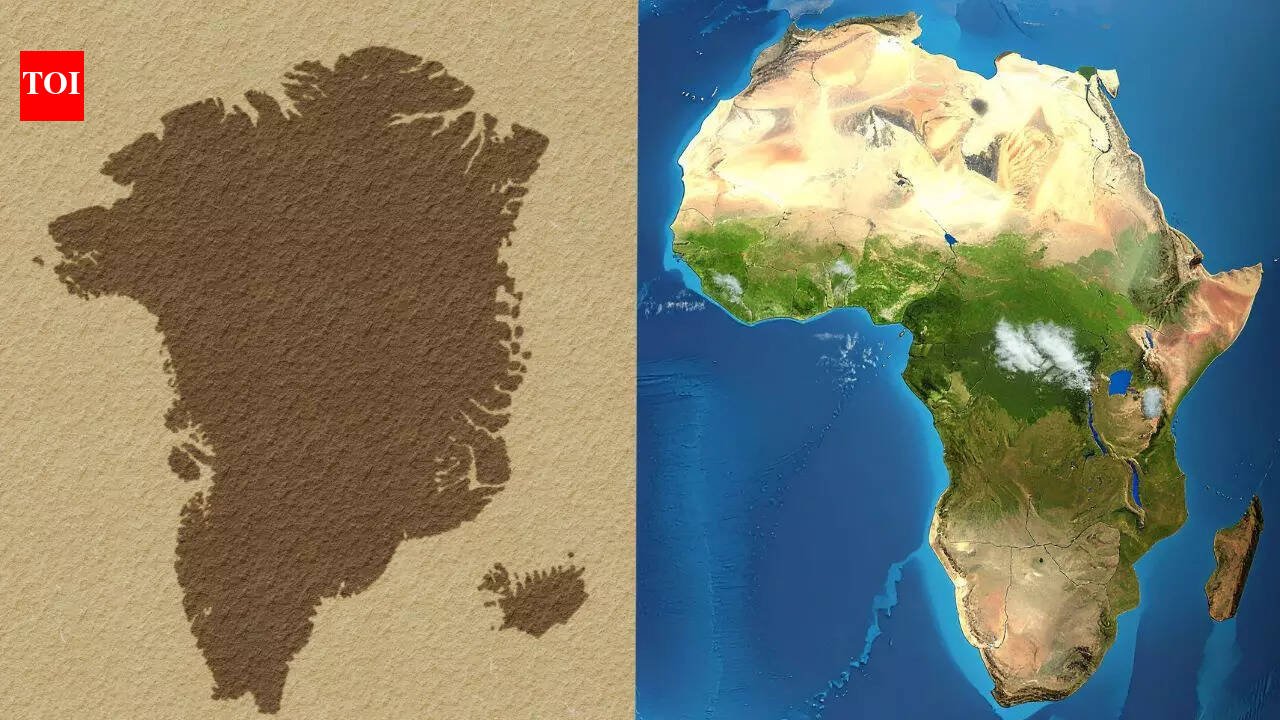
Mercator projection Greenland appear larger than Africa on the map
On a globe, the difference is obvious. Africa’s landmass stretches across the equator and into both hemispheres. Greenland lies further north, occupying a small portion of the space. Africa is approximately fourteen times the size of Greenland. This is not a marginal difference. It reflects basic geographical measurements. It was only when the curved Earth was flattened for display that the chaos began. Visual imbalance is closely related to the Mercator projection, created in the sixteenth century for navigation. The design preserves angles, which helps sailors chart straight courses. It does not preserve area.As latitude increases, the land appears to be stretched vertically and horizontally. Greenland is located near the Arctic Circle, so it expands dramatically on this projection. Most of Africa lies near the equator, still closer to its true size. The results feel convincing because the distortion is systemic. It affects all high latitudes, not just Greenland.
Flat maps cannot display a round earth without distortion
Any flat world map has to compromise. Some projections protect the area. Other protective shapes or orientations. No one can maintain all properties at the same time. Equal-area projections reduce the Greenland effect, although they change the shape in other ways. Digital earth-based maps have become increasingly common, but familiar flat world maps are still widely used in media and education. The problem is not deception. This is geometry.
Size bias affects perception more than projection
What really stands out is a familiar psychological pattern. Small countries are often overrated. The larger ones are underrated. This relationship is evident in reference cases such as Japan, South Africa and the United States.The researchers noted that this bias is consistent with established psychophysical principles. Human judgment does not scale evenly with physical dimensions. This trend seems to be more influential than exposure to specific map styles.
Familiarity with forecasts suggests limited impact
Participants were also asked which projection they knew best, including Robinson and Gall-Peters. Familiarity did not translate into more distorted estimates.The broader picture suggests that global cognitive maps are shaped by hybrid experiences rather than by one dominant cartographic image. These distortions remain on paper. Internally, they softened.