
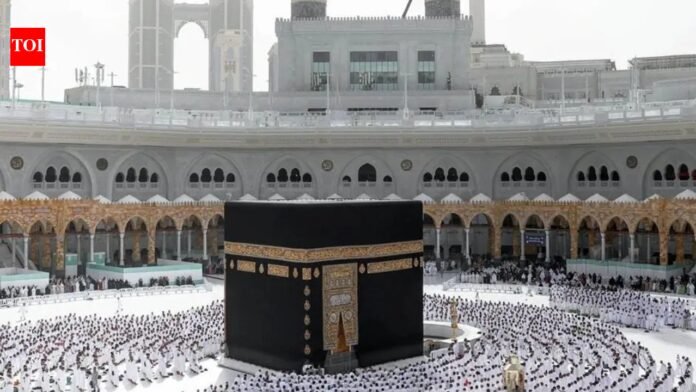
Anyone who has walked barefoot through the Kaaba in the height of summer knows the feeling. The sun was merciless and the air was sultry, but the marble beneath my feet did not burn. In a place where temperatures regularly climb above 45°C, this little detail has many people secretly confused.The courtyard surrounding the Kaaba is paved with fine light-coloured marble, widely believed to be Thassos marble. This type of dolomite is known for its high solar reflectivity and low heat absorption coefficient. Rather than absorbing and storing solar radiation like dark pavers, it reflects most of the incoming sunlight. As a result, surface temperatures remain significantly lower than materials such as concrete or asphalt, even when exposed to direct sunlight for extended periods of time.Scientific research has studied this behavior in detail. Published in 2022 Journal of the Indian Institute of Engineers Series Dtitled Studying the unique thermal properties of Thassos marbleanalyzed the thermophysical properties of stone. Researchers found that Thassos marble has a higher thermal conductivity than traditional white marble. This allows heat to dissipate more efficiently through the material instead of accumulating on the surface. The study also highlights that the marble’s microstructure and mineral composition enhance reflectivity and internal heat redistribution.A 2021 peer-reviewed study titled “Supplementing these findings” Thermophysical evaluation of cool white marble pavement at Al Masjid Al-Haram, Mecca, Saudi Arabia. Using local weather data and thermal models under real-world climate conditions, the researchers concluded that marble’s high reflectivity significantly reduces surface temperatures. Research determined that the use of cool white marble plays a vital role in maintaining safe and comfortable walking conditions for barefoot pilgrims.Strengthen the cooling effect through structural design. The marble slabs are thick and installed over specialized insulation and breathable spaces. This layered structure allows heat to dissipate downwards and sideways rather than being concentrated on the surface. The Grand Mosque’s vast open-air layout allows for constant air circulation within the courtyard, while the steady movement of worshipers also helps circulate air at ground level.What appears to be a simple stone surface is actually an elaborate thermal system. By combining highly reflective marble, enhanced thermal conductivity, layered insulation and architectural airflow, Mataf maintains moderate surface temperatures in one of the hottest urban environments in the world.