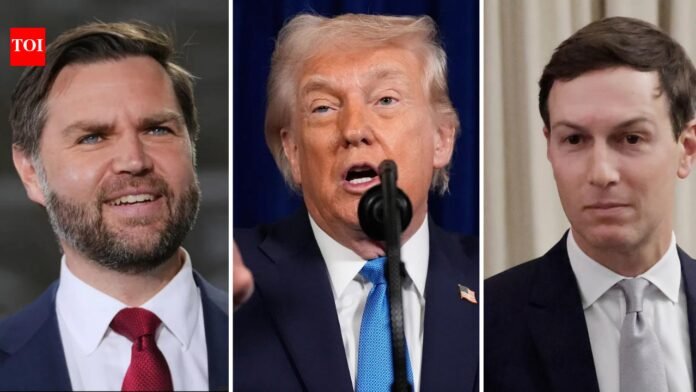
President of the United States Donald Trump Washington said on Tuesday it was “in talks with Iran,” a sign of its diplomatic efforts to combat the ongoing war. Speaking at the White House, Trump said several senior officials were involved in the negotiations. “We have a lot of people doing that. And the other side, I can tell you, they want a deal,” Trump said.
Who is involved in the negotiations?
According to Trump, the following officials were involved in negotiations with Tehran:
- Steve Witkoff (U.S. Special Envoy for the Middle East)
- Jared Kushner (Donald Trump’s son-in-law)
- Marco Rubio (US Secretary of State)
JD Vance (Vice President)- Donald Trump (President)
“J.D. (Vance) was involved. Marco was involved. Jared Kushner was involved… Steve Witkoff was involved, I was involved… If Iran had a nuclear weapon, it would use it. If I had not ended the terrible Barack Hussein Obama Iran nuclear deal in my first administration, they would have had a nuclear weapon three or four years ago. They would have used it… We eliminated their nuclear potential,” Trump said.Hours earlier, he said Iran wanted a deal to end the war, which is now entering its fourth week. Trump also claimed that recent conversations between U.S. envoys and Iranian officials were “very good” and “productive.”Earlier, Trump said in a post on The Truth Society that he had postponed planned attacks on Iranian power plants and energy infrastructure for five days to allow room for negotiations.He added that discussions between Kushner and Witkov with unnamed Iranian officials over the weekend were positive.Click here for live war updates The US president also said there was “major consensus” between the two sides and expressed optimism about a possible agreement. He said Iran must give up its stockpile of enriched uranium as part of any deal, adding that the Strait of Hormuz could soon be reopened if talks were successful.At the same time, Trump maintained a tough stance, claiming that “this war has been won” and that US-Israeli actions have weakened Iran’s leadership and nuclear capabilities.
Iran’s response and denial
However, Iranian officials strongly deny that any negotiations with the United States are ongoing.Iranian parliament speaker Mohammad Bagher Qalibaf said “no negotiations have been held with the United States yet” and accused Washington of spreading “fake news” to influence global financial and oil markets.Iran also dismissed claims that Trump had contacts with senior White House officials, saying it was trying to manipulate markets amid rising oil prices amid regional tensions.
Who does Iran want to negotiate with?
Iran has said through back channels that it would prefer to engage with Vice President Vance rather than U.S. envoys Steve Witkoff or Jared Kushner.Vance is considered more inclined to end the conflict. “Vance is believed to be interested in ending the conflict,” CNN reported, citing sources.However, the White House has denied these claims and claimed that only President Donald Trump can decide who will negotiate on behalf of the United States.Press Secretary Carolyn Leavitt said, “Only President Trump can decide who will negotiate on behalf of the United States. As the President said today, Vice President Vance, Secretary Rubio, Special Envoy Vitkov and Mr. Kushner will all be involved.”A White House official also dismissed reports of Iran’s preference as a “coordinated foreign propaganda campaign aimed at undermining the president,” CNN reported.
Why does Iran want JD Vance involved in negotiations?
Tehran’s preference for J.D. Vance stems from distrust caused by previous failed negotiations and subsequent military operations.According to CNN, Iran believes that discussions involving Steve Witkoff and Jared Kushner will not be productive due to past experiences. The breakdown of earlier talks, followed by attacks by the United States and Israel, created a “deficiency of trust”.Explaining this view, one source said, “Vance is believed to be interested in ending the conflict.”Iranian officials also view Vance as more supportive of ending the war than other senior U.S. officials such as Witkov, Kushner and Secretary of State Marco Rubio. His relatively cautious stance on military intervention shaped that view, the New York Post reported.At the same time, Iran said it did not want to re-engage with the previous negotiating team.Despite this preference, sources acknowledged that Iran may ultimately have no choice over who represents the United States. “The Iranians will have to deal with who the government decides to send, but that doesn’t mean they don’t have preferences,” one source stressed.However, the White House reiterated that the decision rests entirely with President Donald Trump, not Tehran.
What to do next?
A possible meeting between U.S. and Iranian officials in Islamabad later this week is still under consideration, but uncertainty remains over whether it will take place.The talks come amid a broader crisis in the Middle East, with tensions affecting global oil markets, particularly due to disruptions in the Strait of Hormuz, a key route for nearly 20% of the world’s crude supplies.