
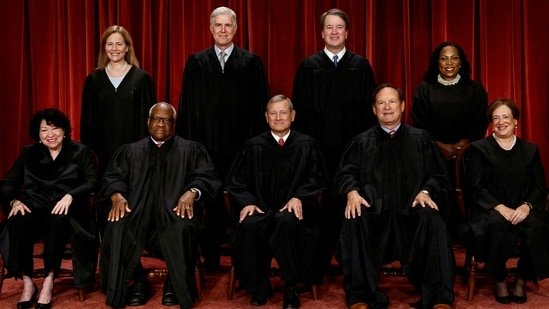
this United States Supreme Court President Donald Trump’s push to restrict birthright citizenship was rejected on Tuesday, handing the White House one of the biggest legal defeats of the year. Court rules 6-3 that Trump’s executive order violates Citizenship Clause Fourteenth Amendment.

The ruling on birthright citizenship reaffirms that nearly everyone born on U.S. soil automatically becomes a U.S. citizen.
Chief Justice John Roberts sided with the court’s three liberal justices and two other conservatives in rejecting Trump’s order, despite the court’s 6-3 conservative majority.
The executive order signed by Trump on his first day back in office directs that the citizenship of children born in the United States not be recognized unless at least one parent is a U.S. citizen or lawful permanent resident.
Civil rights groups argued the order was in direct conflict with the Constitution.
Who voted to retain birthright citizenship?
The six justices who voted to block Trump’s executive order and preserve birthright citizenship were:
1. Chief Justice John Roberts
2. Judge Amy Coney Barrett
3. Judge Ketanji Brown Jackson
4. Judge Elena Kagan
5. Justice Brett Kavanaugh
6. Judge Sonia Sotomayor
According to the majority opinion written by Roberts, the Fourteenth Amendment unequivocally guarantees citizenship to nearly all persons born in the United States, with rare exceptions.
“Citizenship, then and now, is the right to have rights — the freedom to participate in our political community,” Roberts wrote, according to Reuters. He added that the authors of the 14th Amendment extended that promise to every free-born person in the country, and “we make good on that promise today.”
Read more: What is the Fourteenth Amendment? The 158-year-old U.S. law behind Trump’s birthright case
Who voted to overturn birthright citizenship?
The three dissenting judges were:
1. Judge Clarence Thomas
2. Justice Samuel Alito
3. Justice Neil Gorsuch
They would have allowed Trump’s executive order restricting birthright citizenship to go into effect.
Reuters reported that Trump’s order could affect the legal status of up to 250,000 babies born each year. It could also force millions of families to prove the citizenship of their newborns before they can be recognized by the government.
Trump called the decision “terrible for our country” in an article for The Truth Society. He urged Congress to seek legislation to end what he called “expensive and unfair” birthright citizenship.