
What makes Lyn King’s Red List so unique: a UNESCO-recognized book that preserves the hidden history of medieval England | World News

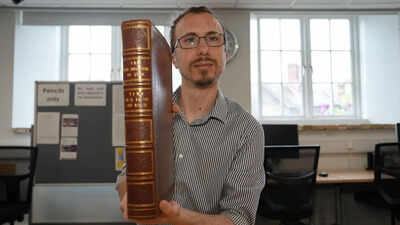
A tattered book bound in faded red leather has been officially recognized by the United Nations Educational, Scientific and Cultural Organization as one of the earliest surviving paper archives in England. It’s the kind of object that most visitors walk past without realizing that they’re looking at something that predates the printing press, predates modern record-keeping, and has still somehow survived the effects of humidity, accident, and administrative neglect that erased much of the medieval world. In King’s Lynn, the book is known simply as the Red Register, and its pages carry administrative memories of a 14th-century town that was already busy, well-connected and commercially active, the BBC reported.The recognition brings renewed attention to a place that has often stayed out of the historical spotlight. What survives in the register is not a romantic narrative of kings and wars, but something more down-to-earth: the bureaucratic pulse of everyday life.
The Red Chronicle reveals life in crisis-stricken England
The Red Chronicle, held in King’s Lynn, is not a chronicle in the traditional sense. It was closer to a running log of civic activity, written in abbreviated Latin that was familiar to clerks but now difficult to understand. Its entries include wills made during the Plague Years, lists of those sent for military service during the Hundred Years’ War, and records of local freemen whose status determined their status in the borough.Its texture is important. This is not a carefully planned historical narrative written after the fact. This is administrative work, documenting events as they unfold. According to the BBC, some pages chronicle the quiet ravages of the Black Death, with inheritance documents appearing more frequently than trade records, showing how normal civil life was suddenly disrupted.For historians, this continuity is what makes it unusual. Many medieval records survive only in fragments or later copies. Here, one volume serves overlapping responsibilities: legal memory, tax reference and citizenship rolled into one.
The surprising choice of materials behind Red Register’s survival
One detail that reportedly often surprises experts is the material itself. In the 1300s, parchment was still widely used for official documents throughout England. However, the Red Register was a paper material that was only beginning to circulate on a large scale in European administrative systems.At the time, King’s Lynn appears to have purchased approximately 200 sheets of paper, a decision that suggested a willingness to use newer, cheaper materials for record keeping. Paper is less durable than parchment, especially in humid conditions, but it allows for faster and more flexible management. Despite water damage to some edges, the cash register’s survival feels almost accidental in this case.
What survived the Black Death and the war years
Some of the most studied ones relate to times of crisis. Entries related to the Black Death do not describe the pandemic itself but rather the administrative consequences that followed. Wills appear in clusters, reflecting sudden changes in inheritance patterns. Property transfers and civil adjustments replaced the usual routine economic records.Mentioned elsewhere in the book are men sent from the borough to fight overseas during the Hundred Years’ War. These are not heroic stories. They are lists, names recorded for duty and responsibility, not for remembrance.
What Recognized by UNESCO Red Register Means of Survival
UNESCO’s inclusion of the Red List in the Memory of the World program places it alongside some of Europe’s most widely recognized historical documents. The list includes materials such as Magna Carta and Domesday Book, both of which are often considered the cornerstones of British documentary history.For archivists, recognition is more about visibility than prestige. Small municipal records attract little attention outside of academia, even if they preserve details that larger national archives miss. In this context, registers are not only relics of medieval administration but also evidence of how local governance functioned during a period when written records were still developing.
The town behind the book and its layered history
The register is closely associated with the Norfolk port town of King’s Lynn, whose trading history dates back to before the Middle Ages. Historically known as Bishop’s Lynn, it was once an important commercial center connected to continental trade routes.Today, relics of the past coexist with modern civic life. The town’s historic buildings and archives constantly present new material, sometimes in unexpected ways. St George’s Town Hall is widely regarded as one of the oldest theaters in the country, and its renovation has previously showcased the timber-framed building dating back to the 15th century.Together with the Register, the building forms part of a wider historic landscape that rarely makes national headlines but has ongoing documentary depth.