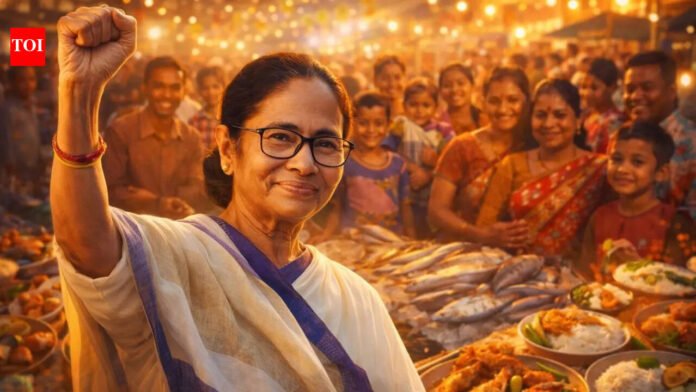
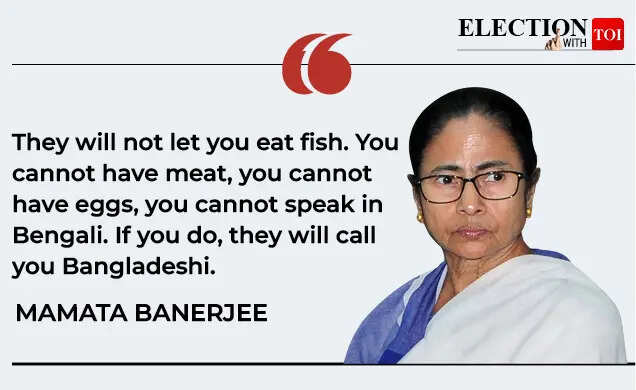
New Delhi: As West Bengal gears up for the 2026 assembly elections, ‘Mache Bhate Bangali’, a common slogan that dominates every Bengali household, has now entered the political sphere.In doing so, it has become a symbol of identity, culture and pride, shaping the narrative of this high-stakes electoral battle. Chief Minister Mamata Banerjee amplified the sentiment at a rally in Purulia, targeting bjp. “They won’t let you eat fish. You can’t eat meat, you can’t eat eggs, you can’t speak Bengali. If you do, they will call you Bangladeshi,” she said.
.
Fish, long considered the lifeline of West Bengal, are now at the center of this story. It is a staple food on almost every Bengali’s table, and it has transcended the scope of cuisine to become a symbol of cultural belonging.The phrase “Mache bhate Bangali”, which translates to Bengali for fish and rice, has leapt from the kitchen into the political arena, reflecting how everyday traditions shape the contours of the state’s election campaigns.
Fish on the campaign menu
In the electoral waters of West Bengal, the fish has swum from the dinner plate to the center of the political web.Trinamool Congress (TMC) is using it to appeal to Bengali pride, while the BJP is trying hard not to fall on the wrong side of the “mache bhate Bangali” sentiment.From the giant catla fish held aloft in road shows to ilish, pabda and chingri taking pride of place in speeches, fish has become a powerful metaphor. It now symbolizes issues of identity, culture and who truly represents the “real” Bengalis.The TMC has weaponized this sentiment, arguing that the BJP is associated with the Hindi-speaking, vegetarian-first politics of North India and is culturally incompatible with Bengal.
.
Mamata Banerjee highlighted this at a rally: “If the BJP comes to power, they will ban the sale of meat and fish in Bengal. I saw the deputy CM of Bihar saying that fish and meat cannot be sold in the open market. Only people with licenses can sell meat indoors. So, will everyone sell meat and fish in shopping malls? Only a few have the financial strength to do so. Most fish vendors sell fresh fish on the streets here. That’s how they earn their bread.” I condemn this politics. “By building a campaign around Bengali identity, the TMC turned the focus towards cultural nationalism. In this way, fish is no longer just a dish in every household, but a common meal. This is a badge of pride for Bengalis.
Culinary nationalism and social media
The TMC’s social media amplified the claim, posting photos of ilish bhapa, pabda jhal, chingri malai curry, kosha mangsho and other delicacies.Ahead of Union Home Minister Amit Shah’s 15-day visit to Bengal, the party tweeted: “Bangla welcomes tourists. Don’t miss our food. We highly recommend: Muri Ghonto, Pabda Macher Jhal, Ilish Bhapa, Chingri Malai Curry, Bhetki Paturi, Kosha Mangsho. Have a pleasant stay!”Political analyst Maidul Islam said: “Eating fish is an important factor in the Bangladesh project. It becomes a campaign point when fish markets elsewhere come under attack, or when Hindi-speaking leaders wrinkle their noses at fish. The TMC says it is an organic party of Bengalis and is therefore organically linked to the food habits of Bengalis. “
Fish as culture, ritual and identity
In West Bengal, fish is more than just food. It marks life’s events: from the ceremony when a baby eats rice for the first time, to gifts at weddings, to meals after mourning.According to PTI, World Bank data shows that West Bengal consumes 8.36 lakh tonnes of fish annually, almost double the national average, with fish and meat together accounting for almost a fifth of household food expenditure.For many, attempts to impose vegetarian or homogenous eating habits from abroad heighten fears of cultural invasion.Says a Kolkata-based Indologist: “For Bengalis, fish is more than food. It is memory, ritual and identity. Challenging this means being alienated from West Bengal itself.”Kaushik Maiti of Bengali nationalist group Bangla Pokkho added: “Fish is an important part of Bengali identity. But the BJP wants to impose North India’s vegetarian culture and we are against it.”
The BJP’s fish dilemma
The BJP insists that the TMC is creating fear. Leaders pointed out that there is no proposal to ban fish or meat in West Bengal. However, there is a strong perception that the BJP candidate is now campaigning with a fish in his hand.Sharadwat Mukherjee, the Bidhannagar candidate of the BJP, carried a katla fish weighing 5 kg through the blocks to assure voters that the BJP would never interfere with the eating habits of Bengalis.In Pandaviswar, BJP candidate Jitendra Nath Tiwari filed his nomination papers in a “fish parade” style, with supporters carrying baskets and he holding a large basket. “If promoting the culture of West Bengal is drama, then I am proud of this drama,” he said.Political analyst Suman Bhattacharya observes, “The BJP’s sentiment against fish and non-vegetarian food has become so strong that party leaders are now forced to openly eat fish and campaign on it. This in itself is an indication that their vegetarian politics elsewhere will not work in West Bengal.”BJP president Samik Bhattacharya stressed the point: “There is no issue of fish ban. Bengalis eat fish and Biharis eat mutton. If someone tries to stop me, I will fight back. “The TMC’s narrative has gained traction due to events in the BJP-ruled state. Earlier speech by Deputy Chief Minister of Bihar Vijay Kumar Sinha Restrictions on meat near schools and places of worship, as well as previous controversies over butcher shops and fish markets, have fueled concerns that Bangladesh could pursue a North Indian vegetarian-first cultural model.In January, a vendor was allegedly attacked in Kolkata for selling chicken patties near a religious gathering. The incident further deepened the controversy.
polling
What influences voters most in an election?
The election is a culture war
As elections intensify, the West Bengal assembly polls are not just about seats, governance or development but also about identity, culture and cuisine.That this humble fish, a culinary staple, has become a political symbol shows that in Bengal, cuisine and politics are inseparable.As TMC spokesperson Tanmoy Ghosh said: “Meat and fish eaters can be Nobel laureates, academics, entrepreneurs and rebels who have changed history with their pens rather than violence… Linking food habits with ‘violent tendencies’ is a moral imposition. India’s strength lies in pluralism, diversity and constitutional freedoms, not in the police pan.”West Bengal has a total of 294 seats and the elections will be held in two phases: April 23 (152 constituencies) and April 29 (142 constituencies). The results are expected to be announced on May 4.