
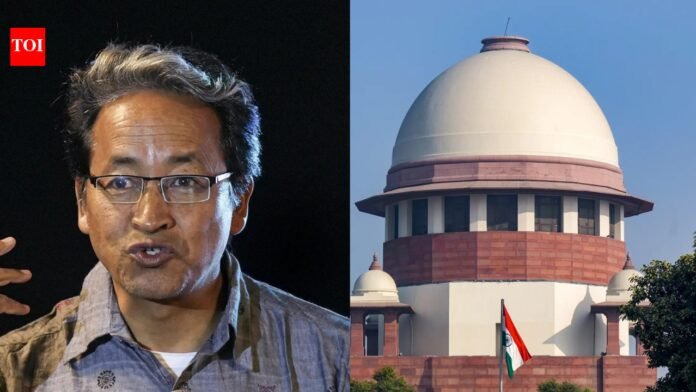
New Delhi: Supreme Court on Monday questioned the accuracy of video recordings submitted by the center against detained climate activists Golden Wangchuk And said translation must be accurate, especially “in the age of artificial intelligence.”Senior advocate Kapil Sibal, appearing for Wangchuk’s wife Geetanjali Ammo, argued that Wangchuk never made certain remarks, before Justices Aravind Kumar and PB Varalai asked the government to place the actual transcript of Wangchuk’s speeches on record.
The bench told Additional Solicitor General KM Nataraj: “Sir, counsel, we want an actual transcript of the speech. What he relies on is different from what you said. We will decide. There should be a true transcript of what he said. You may have your reasons. “The Supreme Court further stated, “At least, a true translation of whatever he says should exist. Your translation lasts 7 to 8 minutes, but the speech is only 3 minutes. We are now in the age of artificial intelligence, and the accuracy of translation is at least 98%.”Sibal questioned the authenticity of the translated material submitted to the court and said: “Wangchuk continues to strike and also continues to provoke young people by mentioning Nepal. Where did this sentence come from? This is a very unique detention order – you rely on something that does not exist and then you say it is based on subjective satisfaction.”In response, Nataraji told the judge that a separate department was responsible for preparing the transcripts and said: “We are not experts in this area.”The matter will be heard again on Thursday.The apex body is hearing a habeas corpus petition filed by Wangchuck’s wife seeking to have his detention under the National Security Act (NSA) of 1980 declared illegal. The NSA allows central and state governments to detain individuals to prevent them from committing acts “prejudicial to India’s defence”. The maximum period of detention under the law is 12 months, but it can be revoked earlier.Wangchuk, a climate activist known for his work in Ladakh, was detained on September 26 last year, two days after four people were killed and around 90 injured during violent protests in Leh demanding statehood and Sixth Schedule status. He is currently lodged in Jodhpur Central Jail.The earlier hearing saw heated exchanges between the Center and the court. The government defended the detention, claiming Wangchuck had made inflammatory remarks in an attempt to internationalize Ladakh’s problems and compare it to Chinese and Pakistani provinces. It also claimed he was trying to incite young people and referenced protests in Nepal and Bangladesh, including “Arab Spring-style riots.”Deputy Public Prosecutor Tushar Mehta told the judge that all procedural safeguards imposed by the National Security Agency were “strictly observed” and that Wangchuk was treated fairly in prison. “This court is dealing with a person who incited people in the border areas adjoining Pakistan and China, which involves regional sensitivities,” Mehta said.Regarding health issues, Mehta told the court that Wangchuck had undergone 24 medical examinations since his detention. “We have checked his health 24 times regularly. He is in good health and in good spirits. He has some digestive problems; he is receiving treatment. There is nothing to worry about, nothing to worry about. We cannot have such exceptions,” he said.He added: “The grounds for passing the detention order remain. It is not possible to release him on health grounds.” This may also be undesirable. We have given our utmost consideration. “However, Angmo argued that the violence in Leh on September 24 could not be attributed to Wangchuck’s actions or remarks. She told the court that Wangchuck himself had condemned the violence on social media and described it as the “saddest day” of his life, saying it would lead to the failure of the five-year peace “tapasha” in Ladakh.In an earlier proceeding, the apex court had asked the Center whether it was possible to reconsider the detention and directed the authorities to submit original files related to the detention to the Centre. The court also directed Wangchuk to undergo examination by a specialist and submit a medical report.


