
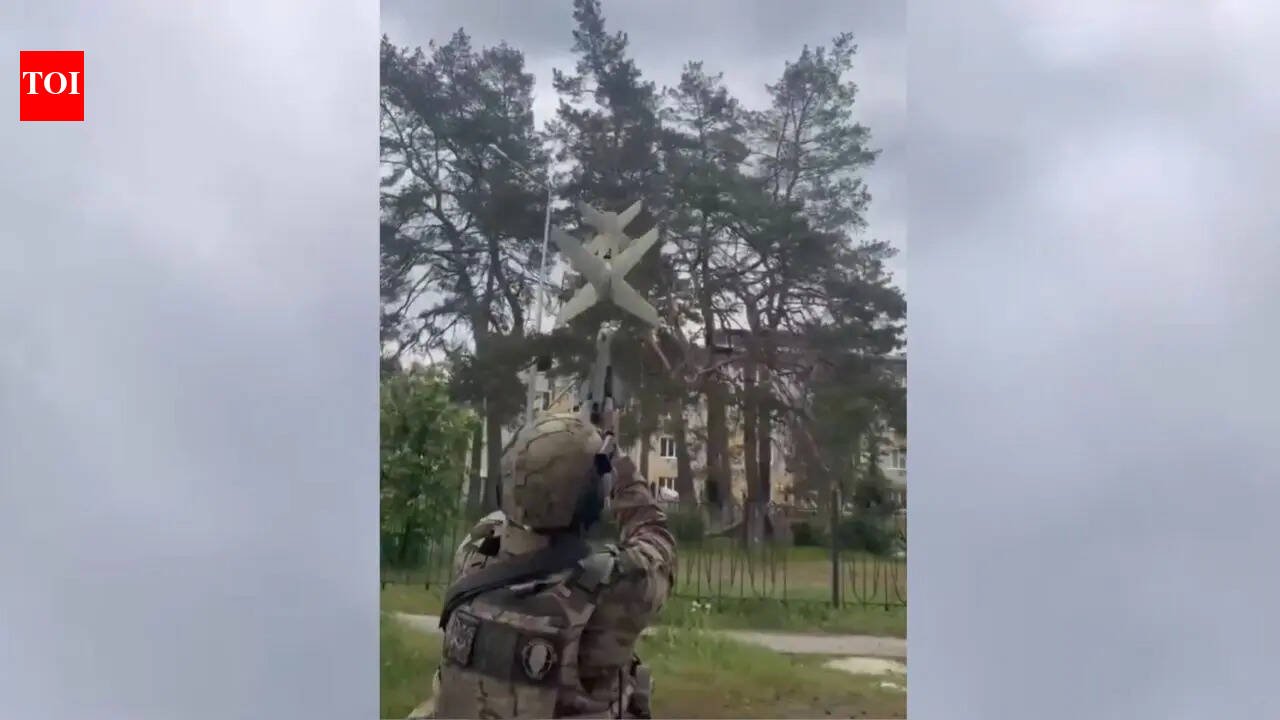
New footage circulating online appears to show the Russian military deploying the handheld Yolka interceptor drone system in combat, signaling a broader operational use of low-cost counter-drone weapons designed to target enemy reconnaissance and FPV drones.The latest video shows a Russian soldier firing a compact interceptor with a pistol-like handheld device, which then automatically tracks and attacks the target.The Yolka system first came to public attention during Russia’s Victory Day parade in May 2025, when a security official standing near President Vladimir Putin was seen carrying a compact drone-like device that analysts later speculated could be the Yolka system or a related variant.Video evidence of the drone’s use first emerged in September 2024, highlighting its role as a portable “fire and forget” interceptor designed to counter the growing threat posed by battlefield drones.Unlike traditional interceptors, Yolka does not carry an explosive warhead. Instead, it relies on direct kinetic impact to destroy or disable enemy drones, thereby reducing the risk of collateral damage.The interceptor has a cylindrical fuselage with two sets of X-shaped wings powered by four electric motors mounted on its rear. Open source reports suggest it uses a dual-spectral seeker that combines thermal and optical tracking with an artificial intelligence module.“Once the seeker locks onto the target, the drone transitions to autonomous flight.”The AI-assisted guidance system allows the drone to continue to track its target independently after launch and is reportedly resistant to traditional electronic warfare jamming.According to current specifications, Yolka can attack targets at a range of up to 3-4 kilometers and can reach speeds of about 200-250 kilometers per hour. The interceptor reportedly weighs between 1 and 3 kilograms, while the entire launch system weighs about 6 kilograms, allowing it to be operated by one soldier.Open source evaluations estimate that each Yolka interceptor costs about $500, making it a relatively cheap solution for increasingly common battlefield drones.The emergence of systems like Yolka reflects the growing emphasis on man-portable counter-drone weapons, as militaries seek cost-effective ways to counter the widespread use of drones in modern warfare.