After a staggering turnout of over 93% in the first phase, the second phase of voting to elect who will govern Bengal for the next five years now has an unlikely parameter: how many voters will turn out to cast their votes. That turned what was supposed to be a vote in the Trinamool’s comfort zone into a battle of arithmetic and nerves, with the ruling party trying to capitalize on anti-SIR sentiment and the opposition BJP trying to capitalize on anti-incumbency sentiment, with both trying to figure out what unprecedented voter turnout might mean.
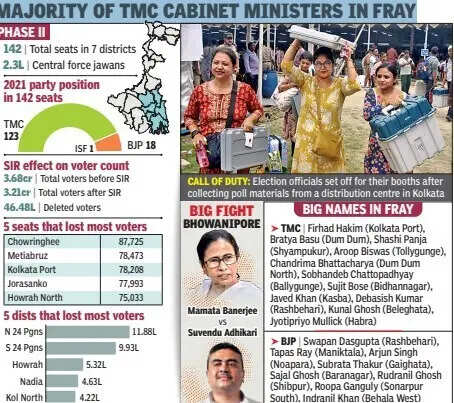
Most TMC cabinet ministers locked in feud
Traditionally, higher voter turnout means a larger share of the anti-incumbent vote. But when voter turnout rises to an unprecedented level (as happened in the 152 seats that went to the first phase of voting, and may happen again today due to SIR concerns), traditional calculations can go awry. Poll managers in both parties seem to understand this, although their leadership’s public broadcasts may be more about showboating and bragging. The seven constituencies going to polls today – Kolkata, North and South 24 Parganas, Nadia, Howrah, Hooghly and East Burdwan – have been Trinamool bastions, with some resistance concentrated in several places in North and South 24 Parganas, Nadia and Hooghly. The BJP enjoys a certain degree of support among a section of the electorate: the Matuas of Nadia and North 24 Parganas, the non-Bengali speaking population of the industrial belt of North 24 Parganas and the mainly agricultural areas of some districts in Hooghly. Likewise, the ISF was restricted to the Bangalore-Canning belt on the southern fringes of Kolkata. But to a large extent, these seven districts hold the Trinamool’s key to Nabanna. In 2021, for example, the Trinamool won 123 of the 142 seats polled today (see chart). But this time, after 15 years in power, Trinamool candidates and their flagbearers are facing a degree of resistance even in areas that had voted for the party since it became the main opposition party in Bengal (1997-2011). The Trinamool infantry had to redouble its efforts in several constituencies in Kolkata, from Jorasanko and Shyampukur in the north to Chowringhee in the center to Rashbehari in the south. Leader of Opposition in Parliament Suvendu Adhikari intruded into Chief Minister Mamata Banerjee’s den, adding to the heat in what was supposed to be a non-contested situation in Bhowanipore.