
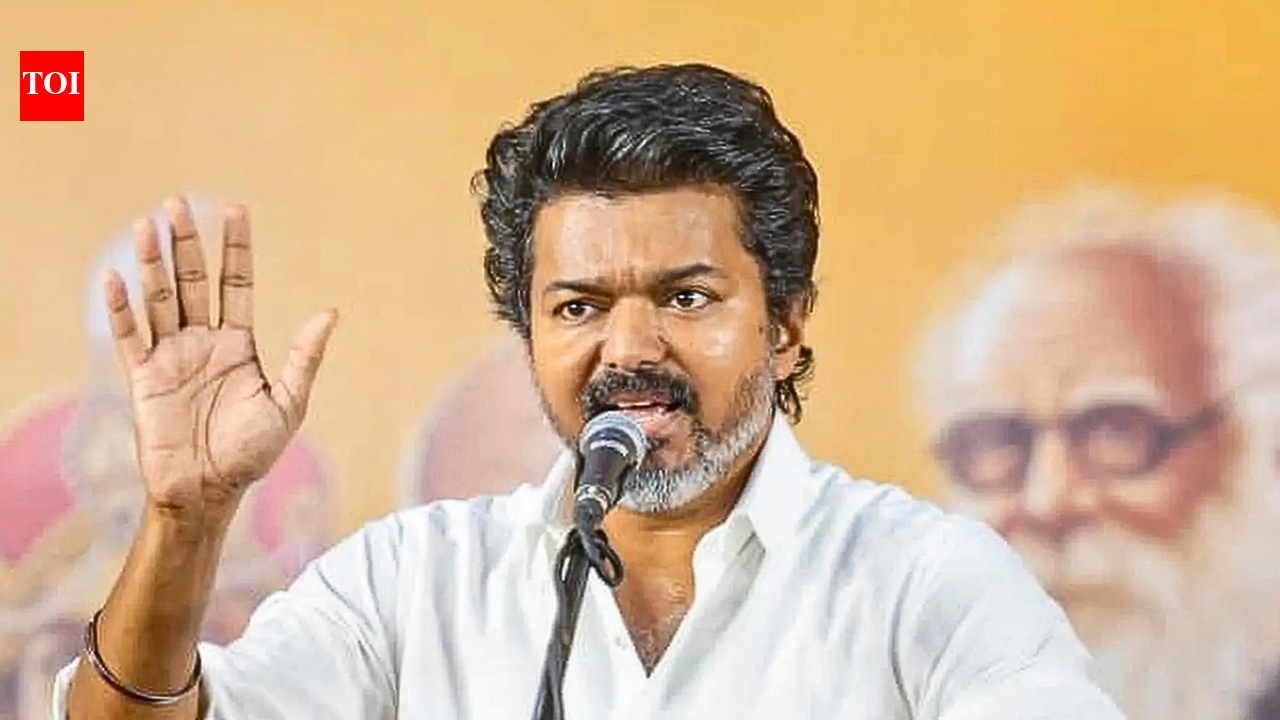
New Delhi: actor-politician Vijay After the May 4 verdict made Tamil Nadu TVK the single largest political party in the state, the party will meet Tamil Nadu Governor Rajendra Vishwanath Arlekar for the third time in a bid to form the government.From silver screen superstar to the fringes of Fort St George in Chennai, Vijay has caused the biggest political chaos in Tamil Nadu in decades. His two-year-old party Tamilaga Vettri Kazhagam stormed into parliament with 108 seats, breaking the DMK-AIADMK’s long-standing dominance of nearly half a century.The ‘Thalapathy wave’ has rattled seasoned Dravidian veterans like MK Stalin, O Panneerselvam and Edappadi K Palaniswami. Vijay, 51, transformed almost overnight from a political newcomer to Tamil Nadu’s biggest force, winning the two seats he contested in: Perampur and Tiruchirappalli east.However, despite this historic debut, the final leap in power hit a constitutional wall.Despite gaining the support of five MPs, TVK still has 108 seats, but the alliance still has 112 seats, six short of the magic majority of 118 seats in the 234-member parliament.And that gap has now become the centerpiece of the latest political and constitutional showdown in Tamil Nadu.
Governor’s suspension sparks new political storm
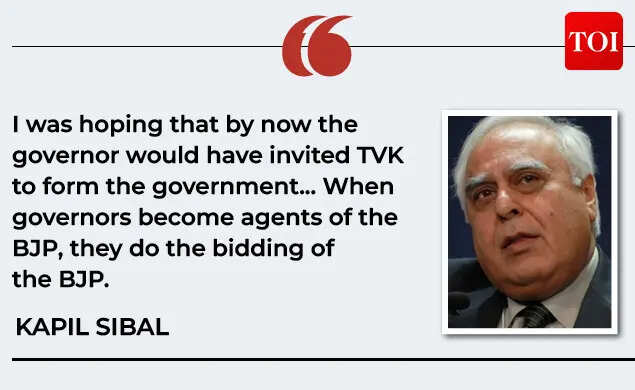
TVK’s huge numbers did not move Governor Rajendra Vishwanath Arlekar to call party leader Vijay and move him away from power.Tamil Nadu Governor Alekha sees an “unestablished majority” as the only key reason for the constitutional impasse between superstar Vijay and the traditional gatekeepers of state power.According to news agency PTI sources, Alekha called Vijay to Lok Bhavan and sought clarification on the “magic number” required to form the government. He reportedly asked TVK to provide details of lawmakers who support his claims.The governor’s stance triggered an immediate strong reaction from TVK leaders and the opposition, with many accusing Raj Bhawan of deliberately delaying the process.State Congress chief Girish Chodankar claimed that the governor was “caving in” to the BJP and not to the Constitution. Senior advocate and former Congress leader Kapil Sibal accused the governor of “buying time” to facilitate political manipulation.“I had hoped that the governor would have invited TVK to form the government by now… When the governor becomes an agent of the BJP, they will take orders from the BJP,” Sibal said.
at the same time, Artificial Intelligence ADMK State spokesman Kovai Sathyan defended the governor’s stance and attacked TVK’s claims.“TVK confessed, claiming that we are the largest party with 108 seats and we have the support of five more seats. Therefore, it is the Governor’s duty to ask, ‘Where are the other five?’ ‘ said Sathyan.
Can the governor insist on providing evidence before inviting it?
The core constitutional question now dominating politics in Tamil Nadu is simple: Can the governor require a party to prove its majority before inviting it to form the government?Kirti Uppal, a senior lawyer and former president of the Delhi High Court Bar Association, told TOI that there is no absolute constitutional rule requiring the governor to invite the single largest political party first.“There is no constitutional provision or absolute right that the single largest party must be invited first. The ‘single largest party’ is a political convention and not a binding constitutional mandate,” Uppal said.He pointed out that Article 163(2) of the Constitution gave the governor discretion in certain circumstances.“Section 163(2): If any question arises whether any matter is a matter within which the Governor is required by this Constitution to act in his discretion, the decision of the Governor in his discretion shall be final and the validity of anything done by the Governor shall not be called into question on the ground that he should or should not have acted in his discretion.”Uppal further noted that plenary vote remains the ultimate democratic method of determining majority.“The governor can order a Lok Sabha test at any time, either before the formation of the government or during the tenure of the Cabinet. Ultimately, the Lok Sabha test is considered the highest democratic method of testing the majority of the government in the House of Representatives,” he added.However, another Supreme Court advocate, Vivek Narayan Sharma, offered a very different explanation.“The governor cannot insist on a Lok Sabha test before inviting parties to form the government. Constitutionally, the purpose of the Lok Sabha test is to test the majority of members of the already appointed government and not decide who will be appointed in the first place,” the advocate told TOI.“The governor’s role at the invitation stage is only a superficial gratification and not a conclusive verdict. The governor can go for a prima facie inquiry through a letter of support or an alliance claim but cannot insist on a ‘first prove the majority and then I will appoint you’ approach as if Raj Bhawan himself is the voice of the House.”
What does the Constitution and the Supreme Court say?
The debate over the governor’s power in a hung Assembly is not new.Under Article 164(1) of the Constitution, the Chief Minister is appointed by the Governor-General, but the order in which political parties or coalitions are invited is not specified.Constitutional experts say it’s the governor’s job to objectively determine who is best positioned to win the confidence of the House. That might be:
- single largest political party
- pre-poll alliance
- Alliance after polls
- Any other group that can demonstrate majority support
A major precedent emerged after the 2017 Goa Assembly elections. The Congress emerged as the single largest party but the then governor Mridula Sinha invited the BJP after getting letters of support from allies and showing majority support.When the matter came to the Supreme Court in the case of Chandrakant Kavlekar v. Union of India, the court did not overturn the governor’s decision. Instead, it ordered immediate ground testing.A similar situation occurred in the 2017 Manipur Assembly elections and the 2018 Meghalaya Assembly elections, where the Congress emerged as the single largest party but the BJP-backed alliance was invited as it showed a better majority.The constitutional debate intensified during the 2018 Karnataka government formation dispute and the 2019 Maharashtra government formation crisis, with questions over the governor’s discretion reaching the Supreme Court.In Karnataka in 2018, when the Bharatiya Janata Party (BJP) emerged as the single largest party with 104 seats, it failed to secure a majority.The Congress and JD(S) formed an alliance soon after the polls and claimed they had enough numbers to form the government.Despite this, the then Governor Vajubhai Wala invited BJP leader BS Yediyurappa to form the government first and asked him to secure a majority in the Assembly.The move sparked a constitutional dispute that reached the Supreme Court. The court ordered immediate floor testing. Before the polls began, Yediyurappa resigned after failing to garner enough support. The Congress-JD(S) alliance later formed the government led by HD Kumaraswamy.Another landmark case that is often cited is Rameshwar Prasad v. Union of India. The Supreme Court noted that plaintiffs who can demonstrate majority support are usually given priority before the single largest party that lacks the numbers, such as a coalition government.The court also clarified that the governor cannot reject the majority’s claim simply because of doubts about the way the coalition was formed.
TVK fights for numbers, allies think deeply
As the situation continued to develop under the influence of the constitution, TVK worked harder to rally from smaller parties, such as VCK and Left, both of which had 2 members.TVK joint general secretary CTR Nirmal Kumar met Communist Party of India leaders in Chennai to seek support for the “progressive government”.CPI leader M Veerapandiyan confirmed that Vijay had formally written to the party seeking support and said an emergency executive meeting had been convened.Thor Thirumavaravan also urged the governor to invite Vijay to form the government and prove his majority in the Assembly.Meanwhile, CPM general secretary Ma Baobao questioned the delay in the governor’s invitation and said the party would make the final decision after consultation with the governor. DMK.
Tension between Congress and DMK
Political turmoil has also shaken one of Tamil Nadu’s oldest alliances.Congress’s decision to support TVK has severely strained its relationship with the DMK, with DMK leaders accusing the Congress of betrayal and calling the party “the mastermind”.The DMK legislative party passed a resolution condemning the Congress party’s “sudden political turn”, while party leaders pointed out that the Congress had benefited from the alliance in previous elections.DMK MP Kalanidhi Veeraswamy alleged that TVK has become “desperate” and alleged that the Congress may change its stance after promising ministerial posts.
Beyond the numbers, there’s a larger federalism debate
The standoff has once again heightened long-standing tensions between Tamil Nadu and the governor’s office, as well as broader questions about the country’s federalism.The debate echoes Supreme Court Justice BV Nagarathna’s recent observation that states “are not affiliated with the Centre, but rather coordinate units within the constitutional scheme”.The impasse in Tamil Nadu is seen not just as a numbers game but as part of a larger national debate over governor’s discretion, cooperative federalism and the balance of power between elected governments and constitutional institutions.Vijay has transformed politics in Tamil Nadu. Whether he can now overcome the final gubernatorial hurdle and turn chaos into government is the question that will define the state’s next political era.